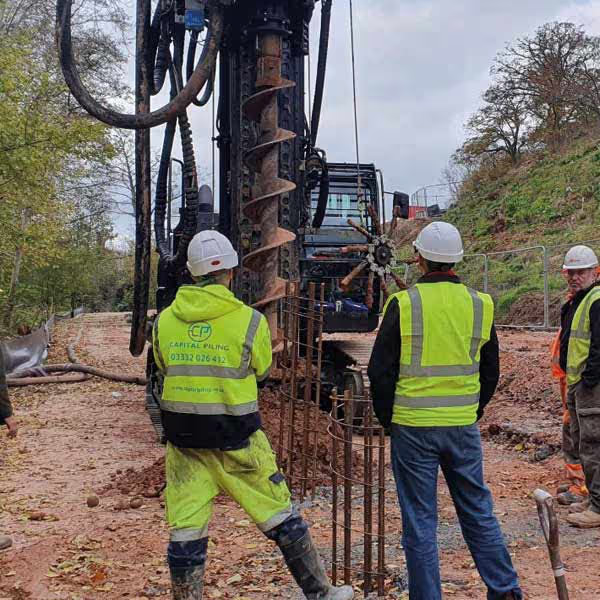
Mini Piles and Ground Beam Connections
Mini piles do not work in isolation. Once installed, they must be connected together to form a complete foundation system. The system must be capable of supporting the structure above. This is typically achieved using reinforced concrete ground beams or slabs. These transfer loads from the building into the piles.
This connection is what turns individual piles into a stable and continuous foundation.
How Loads Are Transferred
The role of the connection is to transfer loads from the structure into the piles in a controlled and consistent way.
Ground beams or slabs span between pile heads. They distribute the weight of the building across multiple piles rather than relying on individual points of support.
This ensures that loads are shared evenly and reduces the risk of differential settlement across the structure.
Ground Beam Systems
Ground beams are reinforced concrete elements constructed between piles, typically beneath load-bearing walls.
They span between pile positions and transfer loads from the structure above into the piles. In most cases, beams are cast in situ, although precast systems can also be used depending on the project.
Ground beams are commonly used where:
- Load-bearing walls define the structure
- A beam and block floor will be installed
- A staged build-up is required before construction begins
They provide a flexible and widely used solution across both residential and commercial projects.
Piled Slab Systems
In some cases, a reinforced concrete slab is used instead of ground beams.
A piled slab sits directly on top of the piles and distributes loads across the entire footprint of the building. Unlike ground beam systems, this creates a continuous surface that can be built on immediately once complete.
Piled slabs are often used where:
- A flat working surface is required
- Construction speed is a priority
- The structure benefits from evenly distributed loads
This approach can simplify the build process by reducing the need for additional floor construction.
Connection at Pile Heads
The connection between the pile and the beam or slab is critical to the performance of the system.
Pile heads are typically cut back to the required level to expose sound concrete and reinforcement. The ground beam or slab reinforcement is then tied into the pile reinforcement. This creates a structural link between the two elements.
This ensures that loads are transferred effectively from the beam or slab into the pile without movement or separation.
Reinforcement and Structural Continuity
Reinforcement plays a key role in ensuring the connection behaves as a single structural system.
Steel reinforcement within the beam or slab is designed to work in conjunction with the pile reinforcement. This allows the system to resist bending, shear, and load redistribution across the foundation.
This continuity is essential for maintaining structural integrity. It's particularly important where loads are uneven or ground conditions vary.
Integration with the Superstructure
The ground beam or slab forms the base for the structure above.
- Ground beams typically support masonry or structural walls. They require additional floor construction, such as a beam and block
- Piled slabs provide a finished structural base that can be built directly on
The choice depends on design requirements, programme, and preferred construction method.
Construction Sequence
The connection is formed as part of the overall construction process.
After pile installation:
- Pile heads are cropped to level
- Excavation and formation for beams or slab is completed
- Reinforcement is installed and tied into the pile heads
- Concrete is poured to form the beam or slab
This creates a continuous structural system linking all piles together.
A Complete Foundation System
Mini piles alone do not form a foundation. It is the combination of piles, ground beams, or slabs that creates a complete and stable system.
This approach links piles together and distributes loads effectively. It provides a reliable solution for a wide range of ground conditions and structural requirements.
Do You Need More Information?
Do you require further guidance on mini pile and ground beam or slab connections? If so, a specialist contractor such as Capital Piling can review your drawings. We'll advise on the most suitable foundation arrangement for your project.