What the difference is between mini piling and traditional piling and why the comparison matters for projects where both methods could theoretically deliver the required structural outcome
Mini piling and traditional piling are not competing products where one is simply better than the other. They are different tools that are appropriate in different circumstances, and the decision between them on any given project should be the output of an honest assessment of the ground conditions, the structural loads, the site access, and the programme rather than a default based on familiarity, cost alone, or what was used on the last project of a similar type. Understanding what distinguishes mini piling from traditional piling methods, where each performs best, and where the boundaries of their respective capabilities lie is essential for anyone involved in specifying foundations on projects where both options could be on the table.
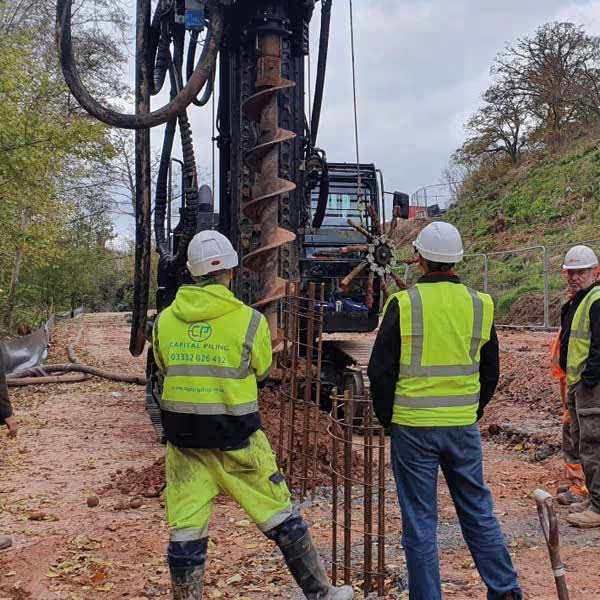
Traditional piling in this context refers to the larger diameter methods commonly used in UK construction, covering CFA piling with diameters typically from 300mm to 900mm, rotary bored piling from 450mm upwards, and driven steel or precast concrete piles where the installation method involves percussive or vibratory driving rather than boring. These methods use larger, heavier equipment with greater torque output, higher concrete volumes, and broader site footprints than mini piling equipment, and they are designed and optimised for projects where open access, substantial structural loads, and the programme capacity to accommodate larger plant are all available.
The fundamental differences between mini piling and traditional piling and how those differences affect the choice of method on a given project
The most fundamental difference between mini piling and traditional piling is the size of the equipment used to install the piles and the access that equipment requires. Traditional piling rigs are large, heavy machines that need a clear working area of several metres around each pile position, a site access route capable of supporting the machine weight, and an overhead clearance sufficient for the mast or Kelly bar to operate without obstruction. Mini piling rigs are compact machines that can operate in working areas measured in centimetres rather than metres of clearance, access sites through openings as narrow as 700mm to 800mm, and work within headroom constraints that would prevent a traditional rig from operating at all.
The second fundamental difference is diameter and load capacity per pile. Traditional CFA and bored piles carry significantly more load per pile than a mini pile of equivalent depth in the same ground conditions, because their larger shaft diameter provides more shaft friction area and their larger toe area provides more end bearing resistance. This means that fewer traditional piles are required to carry a given total load, and the pile layout is simpler and potentially faster to install where site access allows a traditional rig to operate effectively. Where site access does not allow this, the capacity advantage of the larger diameter pile is irrelevant because the rig cannot reach the pile positions in the first place.
The third difference is the vibration and noise profile of the installation. Mini piling using rotary boring techniques generates low vibration and moderate noise, comparable to the plant noise of a small tracked excavator. Traditional driven piling using percussive or vibratory methods generates significant ground vibration and high noise levels that can damage adjacent structures and require formal vibration monitoring, neighbour notification, and in some cases restricted working hours as conditions of the works.
How the performance of mini piling and traditional piling compares in practice across the range of project types where both methods are potentially applicable
On an open commercial site with unrestricted access, flat ground, and substantial column loads, a traditional CFA or rotary bored pile layout will typically deliver the required foundation more efficiently than a mini pile layout of equivalent total capacity. The larger diameter piles carry more load per pile, the rig moves quickly between positions on an open site, and the programme for the piling works is shorter than it would be for a mini pile layout requiring more piles at closer centres to achieve the same total capacity. On this type of project mini piling is not the most efficient solution and would not normally be specified unless there were specific constraints that prevented the use of traditional equipment.
On a residential inner city project where the pile positions are in a rear garden accessible only through a 750mm side passage, where an existing building sits immediately adjacent to the pile layout, and where the structural loads are modest, the comparison reverses completely. A traditional CFA rig cannot access the site. A driven pile method would generate vibration levels unacceptable to the adjacent building and its occupants. Mini piling with a compact rotary rig is the only method that can physically deliver the foundation within the constraints the site imposes, and the comparison between mini piling and traditional piling becomes academic because traditional piling is simply not an option.
Between these two extremes lies a range of projects where both methods are potentially feasible and where the choice is made on the balance of access constraints, load requirements, programme, and cost. On these projects the comparison needs to be made explicitly and honestly, with the structural engineer and the foundation contractor working together to identify which method delivers the best overall outcome rather than defaulting to one approach without testing the other.
The circumstances where mini piling is clearly preferable to traditional piling, where traditional piling is clearly preferable, and where the choice is genuinely open
Mini piling is clearly preferable to traditional piling where site access prevents the use of traditional equipment, where headroom constraints prohibit the operation of a standard rig mast or Kelly bar, where vibration sensitive neighbours or structures require a non-percussive low vibration installation method, or where the structural loads are modest enough that small diameter piles at appropriate centres can carry them efficiently without requiring the larger diameter and greater capacity of a traditional pile.
Traditional piling is clearly preferable where the site is open, access is unrestricted, structural loads are substantial, and the programme benefits of installing fewer, larger diameter piles at wider centres outweigh any advantages that mini piling might offer in terms of equipment compactness. On large commercial and industrial projects where the pile layout involves dozens or hundreds of positions carrying significant column or wall loads, the efficiency of a traditional CFA or rotary bored pile layout on an open site is unlikely to be matched by a mini pile alternative regardless of how it is configured.
The genuinely open cases are those where site access is tight but not impossible for traditional equipment, where loads are at the upper end of what mini piling can carry efficiently, and where programme and cost are both relevant constraints. On these projects the comparison must be made on the actual numbers for the specific project rather than on general principles, and the involvement of a foundation contractor with experience of both methods is essential to ensure that the comparison is made fairly and completely.
How mini pile and traditional pile capacities compare across different diameter ranges and ground conditions and what this means for pile layouts and foundation costs
At the lower end of the mini pile diameter range, a 150mm to 200mm grouted tube pile in firm London Clay at ten metres depth carries a working load of the order of 150 to 250 kN depending on the grout to ground bond and the shaft geometry. A 300mm CFA pile in the same ground at the same depth carries a working load of the order of 400 to 600 kN, and a 450mm CFA pile carries considerably more. This difference in capacity per pile means that a mini pile layout carrying the same total load as a CFA layout requires more piles, more pile positions, more ground beam spans between pile heads, and more installation time per unit of total load carried.
At the upper end of the mini pile diameter range, a 400mm to 450mm mini pile in suitable ground conditions approaches the lower end of the CFA pile diameter range and can carry loads that are comparable to a small CFA pile in the same ground. On projects where the loads fall in this range and access constraints favour compact equipment, the capacity difference between a 450mm mini pile and a 450mm CFA pile installed with different equipment becomes the deciding factor, and the choice is made on access, programme, and cost rather than on a significant structural performance difference between the two methods.
What to be aware of when comparing mini piling and traditional piling and what the most common errors are in making that comparison
The most common error in comparing mini piling and traditional piling is making the comparison on cost per pile or cost per metre of pile length without accounting for the total number of piles required, the total programme duration, and the site specific costs associated with access, logistics, and neighbour management. A traditional CFA pile may cost more per pile than a mini pile but require fewer piles to carry the same load, producing a lower total foundation cost on a project where both methods are genuinely accessible. A mini pile may cost less per pile but require significantly more piles, more ground beam complexity, and more installation time, producing a higher total cost on a project where the access advantage of compact equipment is not actually needed.
The second common error is assuming that traditional piling is always the more structurally reliable option because it uses larger equipment and carries more load per pile. Structural reliability is a function of design quality, installation quality, and verification quality, not of pile diameter or equipment size. A well designed and properly verified mini pile foundation is as structurally reliable as a well designed and properly verified CFA foundation of equivalent total capacity, and the method that produces the better outcome on a specific project is the one that is better suited to that project's specific combination of loads, ground conditions, access constraints, and programme requirements.
Capital Piling has direct experience of both mini piling and traditional piling methods and approaches every project with the specific circumstances of that project as the starting point rather than a preference for one method over another. Where mini piling is the right solution we will specify and install it. Where a larger diameter method is more appropriate we will say so and recommend accordingly, ensuring that the foundation method selected is always the one that best serves the structural, programme, and practical requirements of the specific project.