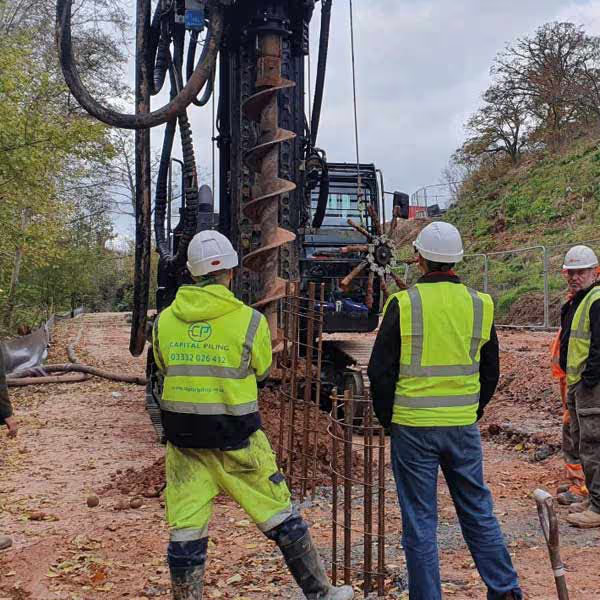
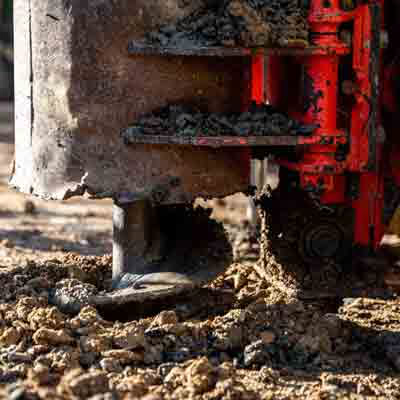
Selecting Depth and Diameter for Mini Piles
The selection of pile depth and diameter is a key part of mini piling design. It affects load capacity, performance, and efficiency. These two factors are not chosen independently; they are considered together. This works to ensure the foundation can support the structure. At the same time, it remains practical to install.
The final design depends on ground conditions, structural loads, and site constraints.
Understanding the Role of Depth
Pile depth depends on reaching bearing strata or generating enough shaft friction. In weak or variable soils, piles reach deeper to transfer loads into stable strata. This ensures long-term performance.
Mini piles extend several metres below ground level. Often, they can reach depths of 5 to 20 metres or more, depending on soil conditions and load requirements.
Increasing depth is often the most effective way to improve load capacity. This is particularly true where stronger ground exists at lower levels.
Understanding the Role of Diameter
Pile diameter influences both load capacity and installation practicality. Larger diameters increase the surface area of the pile. This improves shaft friction and end-bearing potential, which lets piles support higher loads.
Mini piles range between 100mm and 300mm. Larger diameters, up to 450mm, suit higher loads or more difficult ground.
However, increasing the diameter must be balanced against site constraints. For instance, access and available equipment.
Balancing Depth and Diameter
Depth and diameter are always considered together as part of the design process. Often, increasing depth is more efficient than increasing diameter. On restricted access sites, equipment caps the pile size that contractors can install.
For example:
- Deeper piles may be used in weaker soils to achieve enough friction
- Larger diameters may be used where loads are higher or where depth is limited
The most effective solution tends to be a balance between the two. It's based on both engineering requirements and practical installation constraints.
The Influence of Ground Conditions
Ground conditions shape both depth and diameter:
- Weak or compressible soils need deeper piles to reach stable strata
- Variable ground conditions may need different depths across the site
- Stronger soils may allow for shallower or smaller diameter piles
A ground investigation identifies soil layers and the depth of bearing strata.
The Influence of Structural Loads
The size and type of structural loads also play a key role in pile design.
Heavier loads will generally need:
- Increased pile diameter
- Greater depth
- Or a combination of both
Load distribution across the structure is also considered. This ensures that each pile is designed to perform as part of the foundation system.
Site Constraints and Practical Limitations
Design is not based on engineering alone; site constraints must also be considered.
Restricted access, limited headroom, and equipment all limit the pile diameter and depth. Mini piling systems are designed to work within these limitations. They make foundations possible in locations where larger piling systems would not work.
This is particularly relevant on residential and urban sites.
The Role of Ground Investigation
Accurate selection of pile depth and diameter relies on understanding the ground profile. A site investigation identifies soil type, strength, and the depth of bearing strata.
Eurocode standards recommend extending investigations beyond the expected pile depth. This covers all ground conditions that affect performance.
Without full ground data, designs start with assumed conditions. Contractors refine them during installation.
An Engineered Balance
Pile depth and diameter selection balance structural performance, ground conditions, and practical installation. Oversizing piles can increase cost and time, while undersizing can compromise performance.
Mini piling adapts to many projects by adjusting depth, diameter, and installation method.
Do You Need More Information?
Do you need further guidance on pile depth and diameter selection? If so, Capital Piling can review your drawings and site conditions. From this, we can recommend the most suitable design for your project.