What pile depth means in screw piling design and why it cannot be assumed before the ground conditions are understood
Pile depth is the distance from the ground surface to the base of the lowest helical plate on the installed pile. It is one of the most important variables in the foundation design and one of the most commonly misunderstood. Depth is not selected arbitrarily and it is not based on a rule of thumb about what is typical for a given area or soil type. It is calculated by the structural engineer using the ground investigation data to identify the depth at which the soil conditions are capable of developing the required load capacity, and it is verified during installation by the torque recorded as the pile advances through the ground.
On some sites the required depth is relatively shallow because competent bearing strata are close to the surface. On others, particularly sites with deep made ground, soft alluvial deposits, or variable fill, the pile must go considerably deeper before it reaches ground capable of carrying the design load. Neither outcome is a problem as long as the ground investigation has been carried out properly and the design reflects what the ground actually contains rather than what it is assumed to contain.
Why pile depth is a calculated output of the design process rather than a fixed input
The depth of a screw pile is determined by two things working together: the soil profile at the site and the load the pile needs to carry. The structural engineer uses the soil parameters from the ground investigation to calculate the shaft friction and helical plate bearing that a pile of a given geometry can develop at each depth increment. The pile is designed to the depth at which the cumulative capacity exceeds the design load by the required factor of safety.
This means that pile depth can vary across a single site if the soil profile changes between pile positions, which is common on brownfield sites, sites with irregular made ground, and sites where the natural stratigraphy varies laterally. It also means that the target depth stated in the design is a minimum founding depth, not a fixed installation depth. If the torque required to verify capacity is achieved before the target depth is reached, the design team must confirm whether that depth is acceptable before installation is stopped short.
How depth is established during design and confirmed during installation
During the design stage, the structural engineer analyses the borehole or trial pit data from the ground investigation to build a picture of the soil profile across the site. The relevant soil parameters, typically undrained shear strength in cohesive soils and friction angle in granular materials, are extracted from that data and used to calculate the capacity a pile of the specified geometry can develop at each depth. The design depth is the point at which the calculated capacity meets the structural requirement with the specified factor of safety applied.
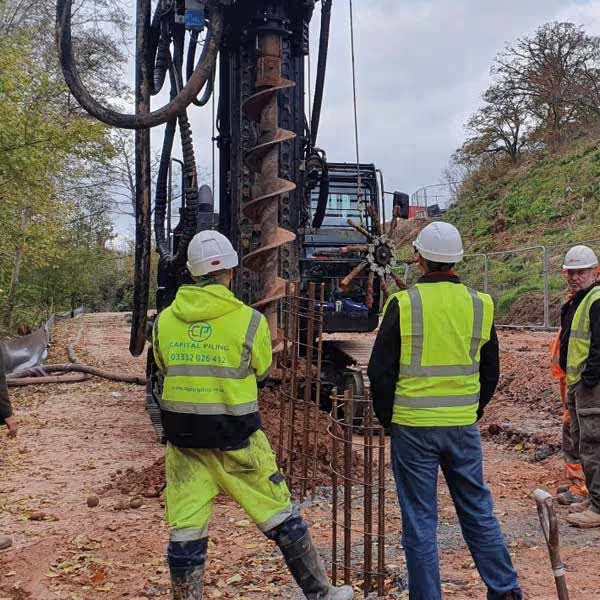
During installation, depth is monitored continuously and recorded alongside the installation torque at regular intervals. The two records together tell the story of how the pile behaved as it advanced through the ground. Where the torque builds steadily and reaches the required threshold at or near the target depth, the pile is accepted. Where torque is lower than expected at the target depth, the pile is extended until the threshold is achieved or the design team is consulted to determine the appropriate course of action.
Capital Piling records depth and torque for every pile installed and includes this data in the completion documentation issued at the end of the project, giving the structural engineer and the client a full verifiable record of what was installed and where.
How depth requirements vary across different ground conditions and project types
On residential projects in areas of London Clay, pile depths for lightly to moderately loaded structures typically fall between five and ten metres. The clay provides reliable shaft adhesion and helical plate bearing at these depths, and the soil profile is generally consistent enough that significant variation across a single residential plot is uncommon. On sites with made ground over natural strata, the depth required to found below the made ground and into competent material depends entirely on how deep the fill extends, which varies considerably between sites and sometimes between positions on the same site.
On commercial projects with heavier column loads, greater depths are often required to develop the capacity needed at each pile position. On sites with soft alluvial deposits, peat, or loose granular fill of significant thickness, depths of fifteen metres or more may be needed before the pile reaches ground capable of carrying the design load. These are not unusual situations and screw piling can accommodate them, but the depth implications need to be understood and costed at the design stage rather than discovered during installation.
The relationship between depth, torque, soil type, and capacity in screw pile design
In cohesive soils, pile capacity increases with depth primarily through shaft adhesion along the pile length and bearing on the helical plates at the founding level. Both contributions increase as the pile goes deeper into stiffer material, and the design reflects this by calculating capacity as a function of the soil strength profile with depth rather than assuming a uniform value throughout.
In granular soils, end bearing on the helical plates is typically the dominant capacity mechanism, and the bearing resistance at the helix level is a function of the effective vertical stress and the soil friction angle at that depth. Increasing depth in granular soils increases the effective stress and therefore the bearing resistance, but at a diminishing rate as depth increases beyond a certain threshold depending on the soil relative density.
The torque to capacity correlation used to verify installed screw piles is an empirical relationship between the torque measured during installation and the axial load capacity of the pile. It is expressed as a torque factor Kt, which relates the measured installation torque in kilonewton metres to the ultimate pile capacity in kilonewtons. The value of Kt varies with soil type and pile geometry and is established during the design process based on the ground conditions and the pile specification.
What needs to be in place before depth can be reliably specified and what happens when ground conditions differ from those anticipated
Pile depth cannot be reliably specified without a ground investigation. Assumptions about depth based on experience of nearby sites, local knowledge, or published geological maps are not a substitute for site specific data. Ground conditions can vary significantly over short distances, particularly on brownfield and urban sites, and a design based on assumed rather than measured soil parameters carries a real risk of producing piles that are either over-designed at unnecessary cost or under-designed with consequences for the structural performance of the foundation.
Where ground conditions encountered during installation differ materially from those anticipated in the design, the design team must be informed immediately. Installing piles to the original target depth without reassessing the design when the soil profile is clearly different from what was assumed is not acceptable. The torque records will usually make this visible, but the response needs to be a design review rather than a decision made on site without engineering input.
Capital Piling's in-house design service covers the ground investigation, pile design, and installation as a single coordinated process. This means that the engineers who interpreted the ground investigation data and set the target depths are the same team overseeing the installation, and any divergence between the anticipated and encountered conditions is identified and addressed immediately rather than discovered after the foundation is complete.