Ensuring Safe Access for Specialist Equipment
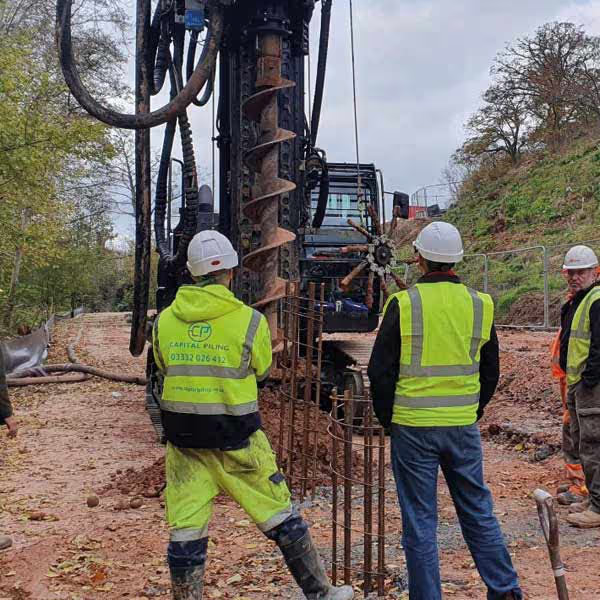
Piling rigs require suitable access to reach the construction area safely and operate efficiently throughout the foundation programme. Before piling begins, access routes must be assessed and prepared to accommodate the size, weight, and movement of heavy specialist plant.
Access planning is an important part of site preparation, as restricted or unsuitable routes can delay construction, increase safety risks, or limit the choice of piling equipment. Properly designed access ensures that rigs, support vehicles, and material deliveries can move around the site without disruption.
At a high level, access requirements focus on providing safe, stable, and unobstructed routes for piling operations.
Planning Safe Equipment Access
Access routes must be wide and strong enough to accommodate piling rigs, cranes, concrete wagons, and other support vehicles. The ground must have sufficient bearing capacity to support heavy loads without excessive settlement or damage.
Overhead and underground obstructions should also be identified before equipment arrives. Utilities, trees, structures, and restricted height areas may all influence how rigs enter and move around the site.
Well-planned access improves efficiency by reducing delays during mobilisation and allowing equipment to be positioned safely at each pile location.
Preparing Routes for Construction Plant
The process begins with a review of the site layout and the dimensions of the piling equipment that will be used. Engineers and contractors assess access points, turning areas, and working zones to identify any constraints.
Where necessary, temporary access roads or reinforced working areas are constructed using compacted aggregate or engineered fill. These routes are designed to support repeated movements of heavy machinery throughout the piling programme.
Once completed, access routes are inspected before mobilisation to confirm they are suitable for safe operation and material deliveries.
Required Before All Piling Operations
Access planning is required on every piling project, regardless of the piling method or project size. Whether the development is residential, commercial, industrial, or infrastructure-related, heavy equipment must be able to reach the working area safely.
It is particularly important on constrained urban sites, redevelopment projects, and locations with restricted entry points where space for large machinery may be limited.
Early consideration of access requirements helps avoid programme delays and supports efficient site operations.
Ground Capacity and Site Constraints
Access routes should be designed to withstand the axle loads and operational weight of piling rigs and associated vehicles. Ground conditions, gradients, drainage, and turning radii are all considered during planning.
Temporary bridges, protection mats, or reinforced access roads may be required where existing ground conditions are unsuitable or where services need protection.
Route planning should also consider equipment dimensions, including transport height and width, to ensure safe passage through site entrances and around existing structures.
Maintaining Safe and Efficient Site Access
Access routes should be regularly inspected throughout the project to ensure they remain stable and free from obstructions. Heavy rainfall, frequent vehicle movements, or changing ground conditions may require maintenance or repairs.
Good communication between the groundworks contractor, piling contractor, and site management team helps coordinate deliveries, equipment movements, and site logistics.
Ultimately, providing suitable access for piling rigs improves safety, reduces delays, and ensures that foundation works can be carried out efficiently from mobilisation through to completion.