Understanding the drilling phase of CFA pile installation
The drilling phase is where the CFA pile installation begins. Before any concrete is pumped, before any reinforcement is placed, the auger has to get to the design depth cleanly and consistently. How it does that, and what happens along the way, sets the conditions for everything that follows. A well executed drilling phase produces a stable bore at the correct depth with reliable ground resistance data that informs the rest of the installation. Understanding what the drilling process involves and what it tells the installation team about the ground is useful context for anyone commissioning or managing CFA piling works.
What the auger drilling phase involves in CFA piling
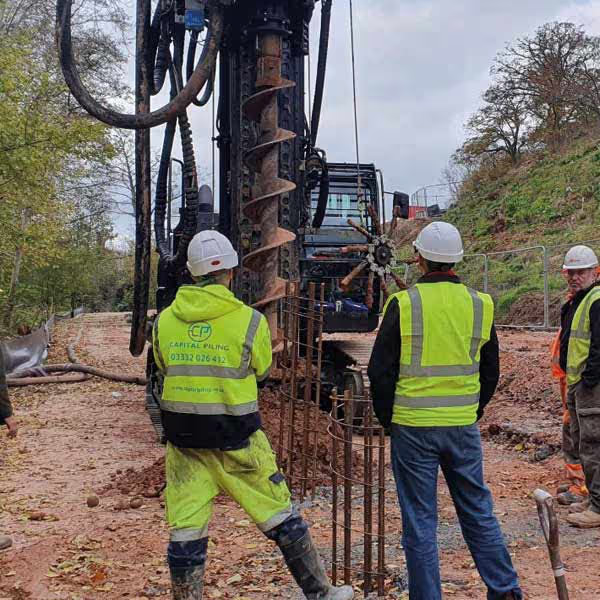
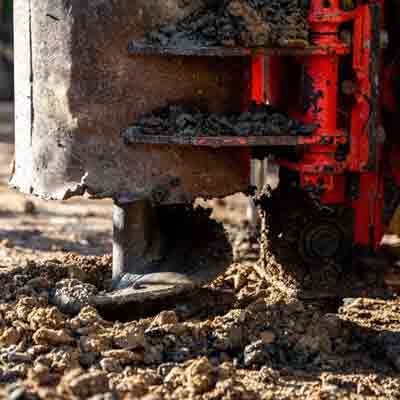
The continuous flight auger is rotated into the ground in a single uninterrupted pass from the surface to the design depth. Soil is retained on the auger flights as it advances, which provides natural support to the bore walls during drilling and prevents the bore from collapsing before concrete is introduced. The rate of advancement and the torque required to rotate the auger both vary with the ground conditions encountered at each depth, and these variations are recorded by the monitoring system throughout the drilling phase. No temporary casing is required during drilling because the retained soil on the flights performs the stabilising function that casing would otherwise provide.
How the auger advances through the ground and what the drilling data reveals
The rig positions over the pile location and the auger begins rotating under the crowd force applied by the rig. As the auger descends, soil fills the flights and is carried upwards around the outside of the stem. The rate at which the auger advances depends on the density and strength of the soil being drilled. In soft cohesive soils the auger advances quickly and with relatively low torque. In denser or stiffer materials the advancement rate slows and the torque increases. In very stiff clays, dense gravels, or cemented layers the auger may slow significantly or in extreme cases reach refusal before the design depth is achieved.
The monitoring system records the advancement rate and torque throughout the drilling phase, producing a continuous log of drilling resistance against depth. This data gives the installation team a real time picture of the ground profile as the auger descends and provides early warning of unexpected conditions such as a hard layer, an obstruction, or a zone of significantly weaker material than anticipated. Where the drilling data deviates from what the ground investigation predicted, the site supervisor and structural engineer are notified so that a decision can be made about how to proceed before concrete pumping begins.
How the drilling phase varies across different ground conditions and project types
In London Clay, which is the most common ground condition for CFA piling across the south east, the drilling phase is typically smooth and consistent. The clay provides good support to the bore walls, the auger advances at a steady rate, and the torque profile with depth is predictable and broadly consistent with the ground investigation data. These are the conditions in which the CFA drilling process performs at its best.
In more variable or mixed ground profiles, such as made ground overlying natural soils on brownfield sites, the drilling phase requires more careful monitoring. Made ground can contain obstructions, voids, or pockets of material significantly different from the surrounding soil, all of which show up as anomalies in the drilling data. Identifying these conditions during drilling, before concrete is introduced, allows the installation team to assess their significance and respond appropriately rather than discovering them afterwards through integrity testing.
In granular soils below the water table, the drilling phase needs to be completed and concrete pumping begun without any unnecessary delay. The longer the bore sits without concrete after the auger reaches depth, the greater the risk of instability at the bore walls before the pressurised concrete can take over the supporting role.
The technical parameters recorded during the drilling phase and how they are used
The key parameters recorded during CFA auger drilling are advancement rate, rotation speed, torque, and crowd force, all plotted against depth. Together these produce a drilling log for each pile that reflects the ground resistance encountered throughout the depth of the bore. This log is reviewed alongside the ground investigation data to confirm that the ground conditions encountered during drilling are consistent with what was predicted at the design stage.
Where the drilling log shows significantly higher resistance than expected at a particular depth, it may indicate the presence of a hard layer, a cobble, or an obstruction that was not identified in the investigation. Where resistance is lower than expected, it may suggest a weaker zone, a void, or a loss of soil density. Neither of these outcomes necessarily means the pile cannot be completed successfully, but both require assessment before installation proceeds.
The design depth is confirmed by the structural engineer's piling drawings, but the drilling data provides the site team with the ability to identify whether the ground conditions at that depth are consistent with the design assumptions. Where there is a significant discrepancy, the engineer may instruct that the pile be drilled deeper to reach more consistent bearing conditions.
What to be aware of during the drilling phase and how ground conditions can affect it
Auger refusal before the design depth is reached is one of the more disruptive problems that can occur during the drilling phase. It happens when the auger encounters a material it cannot penetrate, whether that is rock, a large boulder, a dense cemented layer, or a significant buried obstruction. Once refusal occurs the options are limited. The obstruction can sometimes be broken through with increased crowd force and torque, but this risks damage to the auger and is not always successful. In some cases the pile position needs to be moved or an alternative method considered, both of which have programme and cost implications.
The best way to reduce the risk of unexpected refusal is a thorough ground investigation that characterises the ground profile to sufficient depth across the full site footprint. Where the investigation identifies potential obstructions or hard layers, the pile design and method selection can be reviewed before work begins rather than when the rig is already on site. This is a straightforward conversation to have at the pre-construction stage and one that experienced contractors will raise as a matter of course.