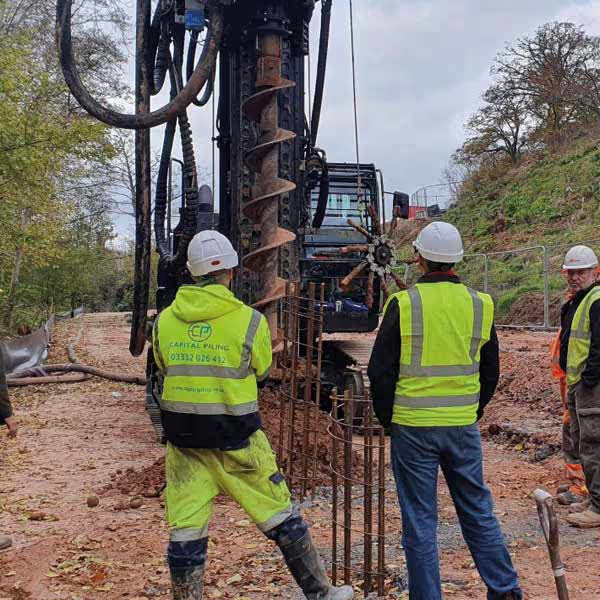
Why CFA piling is one of the most trusted foundation methods in the UK
CFA piling has become the go to foundation method across a huge range of UK construction projects, and that is not by accident. It offers a combination of speed, reliability, structural performance, and minimal disruption that is difficult to match with any other piling method. For homeowners commissioning a residential extension, developers building out a housing scheme, or contractors delivering a commercial frame, understanding the benefits of CFA piling helps explain why it is so consistently specified and what it can realistically deliver on your project.
The most important benefits of CFA piling at a glance
CFA piling is fast. Because the drilling and concreting happen in one continuous uninterrupted sequence, pile cycle times are short and a well organised CFA operation can install a significant number of piles in a single working day. This has a direct and measurable impact on programme duration and overall project cost.
It produces very low noise and vibration compared to driven piling methods. There is no hammering, no percussive impact, and no ground shock transmitted to neighbouring structures or properties. This makes it a practical and considerate choice on urban sites, residential streets, and anywhere that minimising disruption to the surrounding environment is a priority.
The bore is never left open or unsupported at any point. Concrete is pumped under pressure as the auger is withdrawn, which means there is no risk of bore collapse regardless of the ground conditions encountered. This gives CFA piling a reliability advantage over open bore methods in a wider range of soil types.
It is also a highly consistent method when carried out correctly. Modern CFA rigs are equipped with electronic monitoring systems that record installation data in real time for every pile, providing an objective quality record that can be reviewed by the engineer and relied upon by the client.
How the CFA process delivers its benefits in practice
The benefits of CFA piling are not incidental. They are a direct result of how the method works. The continuous drilling sequence means there are no pauses to install or remove temporary casings, no multi stage spoil handling, and no waiting between drilling and concreting. Each pile is formed from start to finish in a single efficient operation.
The pressurised concrete delivery through the hollow auger stem is what eliminates bore collapse risk and ensures the pile is fully formed without voids or unsupported sections. The real time monitoring systems fitted to modern rigs capture withdrawal rate, rotation speed, concrete volume, and pump pressure throughout each installation, allowing the operative to identify and respond to any deviation from the expected parameters before it affects pile quality.
The project types where the benefits of CFA piling are most clearly realised
The speed and low vibration benefits of CFA piling are most valuable on urban residential and commercial sites where programme pressure is high and neighbouring properties are close. New build housing developments, apartment schemes, commercial office buildings, mixed use urban developments, and residential extensions are all project types where CFA piling delivers its full range of benefits consistently.
On sites underlain by London Clay, which covers a significant proportion of the south east, CFA piling combines well with the ground conditions to deliver fast, high quality piles with strong shaft friction capacity. Capital Piling installs CFA piles regularly across these areas and the method is well suited to the ground conditions and project types commonly found throughout the region.
The technical performance characteristics that underpin CFA piling's benefits
CFA piles are available in diameters from 300mm to 900mm and can be installed to depths exceeding 30 metres. This range of sizes means the method scales effectively from lightly loaded residential structures to heavily loaded commercial frames without requiring a change of approach.
The electronic monitoring data recorded during CFA installation provides more than just a quality record. It also offers early warning of unexpected ground conditions. A sudden increase in concrete volume beyond the theoretical bore volume, for example, can indicate the presence of a void or soft zone in the ground. A change in drilling resistance can signal a transition to different soil or the presence of an obstruction. These signals, picked up in real time, allow the contractor and engineer to respond before a problem develops.
Making sure the benefits of CFA piling are fully realised on your project
The benefits of CFA piling are fully realised only when the method is matched correctly to the ground conditions, the site constraints, and the structural requirements. Specifying CFA on a site where the rig cannot operate safely, or where ground conditions make consistent auger advancement impossible, eliminates those benefits entirely and creates problems that are costly to resolve.
A thorough ground investigation before design, combined with experienced installation by a contractor who understands the method, is what makes the difference between a CFA project that delivers all of its potential benefits and one that falls short. Capital Piling's in house design service covers the full process from ground investigation review through to pile specification and installation, making sure the design is right for your site and that the installation delivers exactly what the design requires. If you are considering CFA piling for your project, getting the design right at the start is the single most important step.