What SCD driven piling brings to a project and why it is specified
Every piling method has a set of conditions where it delivers its best results, and SCD driven piling is no different. Its benefits are most clearly realised on sites where ground conditions make bored methods unreliable, where programme certainty matters, and where a robust and verifiable foundation is required in challenging ground. Understanding what those benefits are and how they translate into practical outcomes on site helps project teams make a more informed case for the method when it is genuinely the right choice.
The practical benefits SCD driven piling delivers on the right project
The steel casing provides continuous and complete bore support throughout installation, removing the dependency on ground stability that bored methods carry. Pile capacity is confirmed during installation through measurable driving resistance and set criteria, providing real time verification that does not rely entirely on post installation testing. The displacement of soil during driving increases lateral stress around the pile shaft in granular ground, which enhances shaft friction capacity compared to a bored pile of equivalent dimensions in the same conditions. The method is effective across a wide range of challenging ground conditions including loose sands, running gravels, variable made ground, and sites with a persistently high water table. It is suitable for both residential and commercial applications and can achieve significant structural load capacity.
How the SCD installation process delivers its benefits
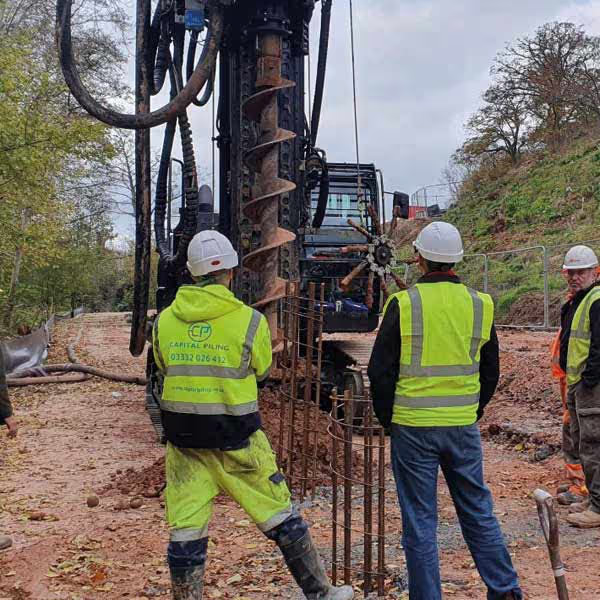
The benefits of SCD driven piling flow directly from the way the method works. Driving the steel casing into the ground by displacement rather than excavation means the bore is supported at every stage of the process without any reliance on the ground remaining stable. There is no window of vulnerability between drilling and concreting where the bore could collapse, because the casing is always present and always providing support.
The driving process also generates continuous feedback about what is happening in the ground. The resistance encountered with each hammer blow tells the installation team how the ground is responding at that depth, and the set measurement at the end of driving confirms that the pile has reached a level of bearing resistance consistent with the design. This in-process capacity verification is one of the most practically valuable aspects of driven piling and something that bored methods, which rely more heavily on post installation testing for capacity confirmation, do not provide in the same way.
In granular soils the compaction effect of driving also improves the ground around the pile, increasing the lateral stress at the pile and soil interface and enhancing the shaft friction capacity of the finished pile. This means that in the right ground conditions a driven pile can achieve more capacity than a bored pile of the same size, which can translate into fewer or shorter piles for the same structural requirement.
The situations where the benefits of SCD driven piling are most clearly realised
The benefits of SCD driven piling are most apparent on sites where bored methods would struggle. Loose granular soils, running sands, high water tables, variable made ground, and sites with a history of difficult ground conditions are all situations where the bore stability advantage of the driven casing translates directly into more reliable installation outcomes and greater confidence in the finished pile quality.
On projects where programme certainty is important, the in-process capacity verification offered by driving resistance monitoring and set criteria is a genuine benefit. Knowing that each pile has reached adequate bearing resistance before moving on, rather than waiting for post installation test results to confirm it, reduces the risk of programme disruption from pile failures or remedial works later in the foundation programme.
The technical performance characteristics that underpin the benefits of SCD driven piling
The load carrying capacity of an SCD driven pile is derived from shaft friction along the casing length and end bearing at the pile tip, in the same way as a bored pile. However in granular soils the unit values of shaft friction achievable with a driven pile are typically higher than those for a bored pile of equivalent dimensions because of the increased lateral stress generated by the displacement installation process.
The set criterion used to confirm pile capacity during driving is derived from dynamic pile driving formulae or wave equation analysis, both of which relate the measured driving resistance to the static load capacity of the pile. On projects where a higher level of capacity verification is required, dynamic load testing using high strain impact methods can be carried out on installed piles to provide a more detailed assessment of capacity and pile integrity.
What to keep in mind when weighing up the benefits of SCD driven piling for your project
The benefits of SCD driven piling are real but they are not universal. They apply most strongly in the ground conditions and project contexts described above. On a site underlain by consistent cohesive soils with no groundwater complications and good access for a bored rig, a bored method will almost certainly be faster, quieter, and more economical. Claiming the benefits of driven piling on a site where those benefits do not apply does not make them real.
Noise and vibration need to be weighed alongside the structural and programme benefits when SCD driven piling is being evaluated. On sites where the surrounding environment is sensitive, the noise and vibration produced by the driving process may require mitigation measures or restricted working hours that affect programme and cost. A pre-construction assessment of the likely vibration levels and their impact on the surrounding area is a straightforward and worthwhile step before the method is confirmed, and one that allows an informed decision to be made rather than one based on assumption.