Managing Challenging Soil Conditions in Foundation Construction
Building foundations on difficult ground refers to the process of designing and constructing foundation systems on sites where soil conditions are weak, variable, or otherwise unsuitable for standard shallow foundations. These conditions often require engineered solutions such as piling, ground improvement, or reinforced concrete systems.
Difficult ground can include soft clays, loose sands, peat, filled ground, or areas with high groundwater levels. These conditions can reduce the natural bearing capacity of the soil and increase the risk of settlement if not properly addressed.
At a high level, foundation design on difficult ground focuses on transferring structural loads safely past weak soil layers into more competent ground strata.
Challenges of Poor Ground Conditions
Difficult ground typically presents issues such as low bearing capacity, high compressibility, or unpredictable settlement behaviour. These factors make it unsuitable for supporting conventional shallow foundations without modification.
Ground variability can also lead to uneven load distribution, which increases the risk of differential settlement within the structure. This can affect structural integrity if not properly managed.
Groundwater conditions may further complicate construction, requiring additional control measures during excavation and foundation installation.
Engineering Solutions for Weak or Variable Soils
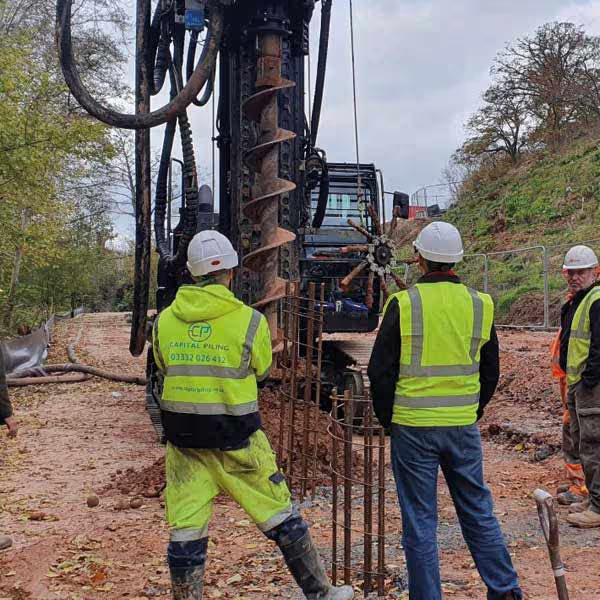
When building on difficult ground, engineers typically design deeper foundation systems such as piles to bypass weak soil layers. These piles transfer loads into more stable ground at greater depths.
Ground beams, pile caps, and reinforced concrete slabs are then used to connect the piles and distribute loads evenly across the structure. This creates a stable and integrated foundation system.
In some cases, ground improvement techniques such as compaction, stabilisation, or replacement of unsuitable soils may be used in combination with or instead of deep foundations.
Sites with Challenging Geotechnical Conditions
Foundations on difficult ground are common in areas with naturally weak soils, such as coastal regions, floodplains, reclaimed land, or sites with high organic content in the soil.
They are also frequently encountered on brownfield or previously developed sites where fill material or disturbed ground conditions are present.
Residential, commercial, and infrastructure projects may all require engineered foundation solutions when soil conditions cannot support traditional shallow foundation systems.
Load Transfer and Geotechnical Design
The design of foundations on difficult ground relies heavily on geotechnical investigation data, including soil strength, compressibility, and groundwater conditions.
Pile design is based on achieving adequate shaft friction and/or end bearing capacity to safely transfer structural loads into competent strata. Ground beams and pile caps are then designed to distribute these loads across the foundation system.
Settlement analysis is also a key part of the design process, ensuring that both total and differential settlement remain within acceptable limits for the structure.
Risk Management and Construction Control
Working on difficult ground requires careful planning to manage risks associated with instability, groundwater, and variable soil conditions. Construction methods must be adapted to suit the specific site conditions.
Accurate ground investigation and interpretation are essential to avoid design assumptions that could lead to foundation performance issues.
Ultimately, successful foundation construction on difficult ground depends on combining geotechnical understanding with appropriate foundation design and controlled groundworks execution.