Creating a Continuous Load Path Through the Foundation System
Connecting piles to ground beams is a critical stage in groundworks where deep foundation elements are structurally integrated with the ground beam system. This connection ensures that loads from the superstructure are transferred efficiently through the beams and into the piles below.
The connection between piles and ground beams forms the primary load path in many piled foundation systems. It is achieved through careful coordination of pile head preparation, reinforcement detailing, and concrete placement.
At a high level, this process ensures that piles and ground beams behave as a single, unified structural system.
Structural Integration Between Elements
The connection between piles and ground beams allows loads from the building to be distributed into the pile system without interruption. This helps improve stability and ensures consistent load transfer across the foundation.
Pile heads must be exposed, trimmed, and prepared correctly to ensure a sound structural bond with the ground beam. Any contamination or weak concrete must be removed to achieve full structural performance.
Reinforcement continuity between piles and ground beams is essential, as it allows tensile and shear forces to be transferred effectively between both elements.
Forming the Structural Connection on Site
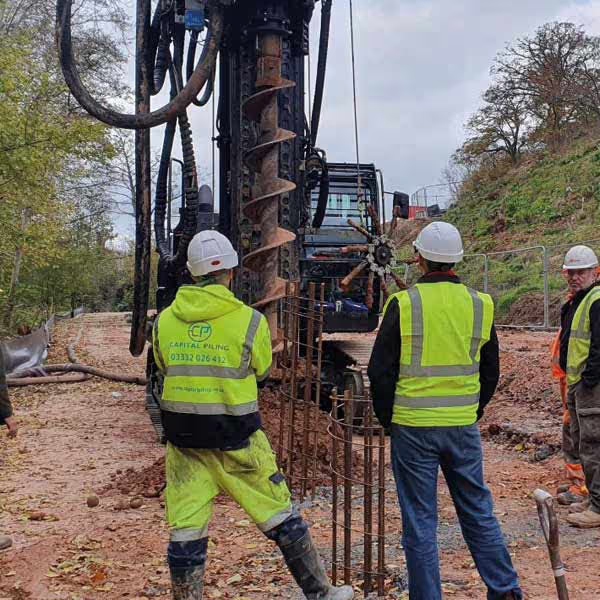
Once piles have been installed, excavation is carried out to expose the pile heads to the required level. The pile heads are then broken down or trimmed to reveal sound concrete suitable for structural connection.
Reinforcement from the ground beam is then positioned to overlap or integrate with the pile reinforcement, depending on the design. This creates a continuous steel framework that links both elements together.
Concrete is then poured to form the ground beam, encapsulating the pile head and reinforcement, and creating a rigid structural connection between the pile and beam.
Standard Practice in Piled Foundation Systems
Connecting piles to ground beams is a standard requirement in virtually all piled foundation systems used in residential, commercial, industrial, and infrastructure projects.
It is particularly important where ground beams span between multiple piles or where loads from structural columns must be transferred into the pile network.
This connection is essential in ensuring that the foundation behaves as a unified system rather than a series of isolated elements.
Load Transfer and Reinforcement Continuity
The connection is designed to transfer axial, shear, and bending forces between the ground beam and the pile. This requires careful detailing of reinforcement to ensure proper anchorage and continuity.
Pile heads must be prepared to expose sound concrete, free from laitance or weak material, to achieve proper bonding with the surrounding concrete of the ground beam.
Structural design specifications define lap lengths, anchorage requirements, and detailing at the interface to ensure safe and efficient load transfer.
Accuracy and Construction Quality
Accurate pile positioning is essential to ensure correct alignment with ground beams. Misalignment can affect reinforcement placement and reduce the effectiveness of the structural connection.
Proper pile head preparation is critical, as poor-quality or contaminated concrete at the interface can compromise load transfer and durability.
Ultimately, successful connection between piles and ground beams depends on precise construction, correct sequencing, and strict adherence to structural design requirements.