Forming the Structural Link Between Piles and the Superstructure
Pile caps are reinforced concrete elements that connect one or more piles to the structural system above. They act as a load distribution platform, transferring loads from columns or walls into the supporting piles and ensuring that forces are spread evenly across the foundation system.
Constructing pile caps is a key groundworks activity in piled foundation systems, typically carried out after piles have been installed and cut to the correct level. The pile cap ties the individual piles together into a single structural unit.
At a high level, pile caps provide the critical interface between deep foundation elements and the load-bearing structure above.
Purpose and Function of Pile Caps
Pile caps are designed to distribute structural loads from the superstructure across multiple piles, reducing concentrated stress on any single pile. This improves stability and helps manage varying load conditions within the structure.
They also help control differential settlement by linking piles together, ensuring that the foundation system behaves in a more unified and stable manner.
The size, depth, and reinforcement of a pile cap depend on the number of piles it connects and the loads it is required to carry.
Constructing the Pile Cap in Sequence
Construction begins with excavation around the pile heads to the required formation level. The pile heads are then trimmed to the correct height to expose sound concrete for structural connection.
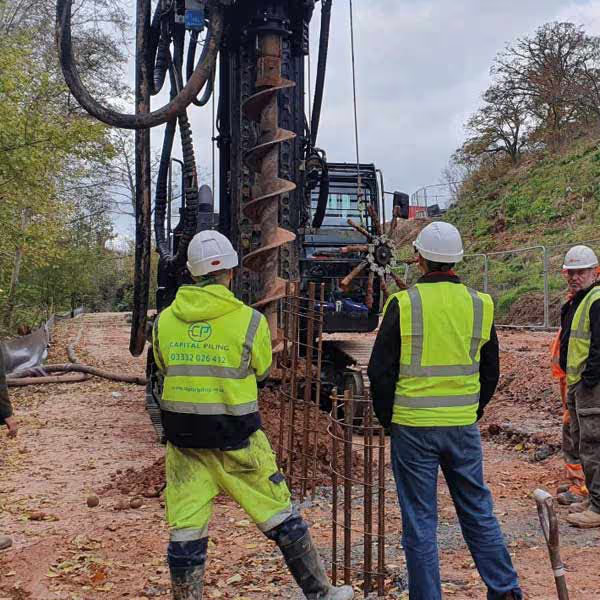
Reinforcement is installed according to the engineering design, often forming a cage that ties together the pile heads and provides structural continuity. This reinforcement is critical for transferring loads effectively between piles and the cap.
Concrete is then poured into the prepared formwork or excavation, encapsulating the reinforcement and pile heads to form a solid structural block that connects the piles together.
Applications in Piled Foundation Systems
Pile caps are used in virtually all piled foundation systems where loads must be transferred from columns or walls into one or more piles. They are common in residential, commercial, industrial, and infrastructure projects.
They are particularly important where multiple piles support a single structural point, such as heavily loaded columns or structural cores.
Pile caps are also used in areas where ground conditions require deep foundations, and direct load transfer into the ground is not suitable.
Structural Design and Load Distribution
Pile caps are designed based on structural calculations that consider load magnitude, pile arrangement, and spacing. The geometry of the cap is determined by how loads will be transferred into each supporting pile.
Reinforcement is detailed to resist bending, shear, and punching forces that occur where the superstructure loads are introduced into the pile group. Proper detailing ensures efficient load transfer and structural integrity.
Concrete strength, cover requirements, and pile integration details are specified to ensure long-term durability and performance of the foundation system.
Construction Accuracy and Integration
Accurate pile positioning is essential for pile cap construction, as misaligned piles can complicate reinforcement installation and load transfer performance.
Excavation depth and formation levels must be carefully controlled to ensure that the pile cap is constructed at the correct elevation and aligns with ground beams or slab systems.
Ultimately, successful pile cap construction depends on precise coordination between piling, groundworks, and structural engineering to ensure the foundation system performs as intended.