A complete picture of the SCD driven piling installation process from mobilisation to completion
Understanding the full SCD driven piling installation process helps everyone involved in a project plan their programme effectively, manage their expectations, and make informed decisions when conditions on site do not go exactly to plan. From the moment the rig arrives to the point where the last pile head is cropped and the foundation is ready for ground beams and RC slabs, there is a structured sequence of activities that needs to be coordinated carefully to run efficiently and deliver a foundation that performs as the design intends. Capital Piling manages this process end to end, and for clients who do not yet have a structural engineer in place our in house design team can take the project from initial ground investigation review through to completed foundation, keeping every stage of the process under one roof.
The stages that make up an SCD driven piling installation contract
A driven piling installation contract involves a sequence of connected activities beginning well before the rig arrives on site. Pre-construction preparation covers ground investigation review, pile design and set criterion derivation, site setup, services detection, working platform construction, and setting out. The installation phase covers driving each casing to the required depth or set, placing the reinforcement cage, and concreting. Post installation activities include pile head cropping, installation record compilation, and testing where required. Where Capital Piling is delivering the complete foundation package, ground beam and RC slab construction follows as a continuation of the same contract, maintaining a single point of coordination from the first pile to the finished slab.
How an SCD driven piling contract is delivered on site from start to finish
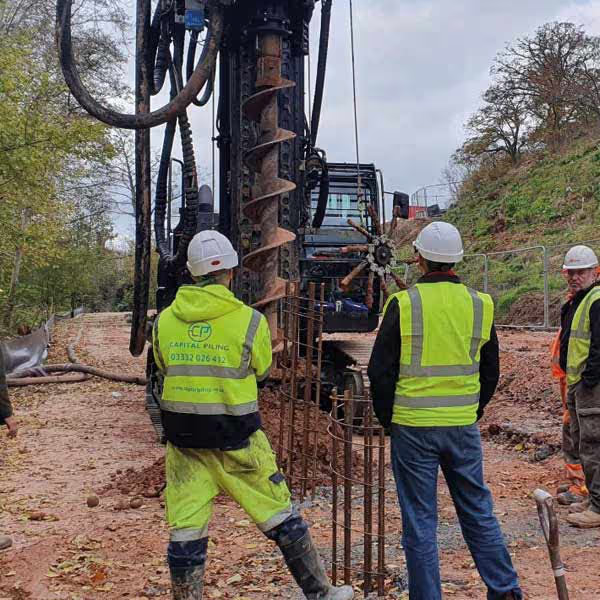
The piling contractor mobilises once the working platform is in place, services have been located and marked, and the site datum has been confirmed. The rig is positioned at the first pile location and driving begins, with the hydraulic hammer striking the top of the steel casing and advancing it into the ground by displacement. Driving resistance is monitored and recorded throughout, with the set criterion checked at regular intervals as the casing approaches the design depth.
When the set criterion is achieved, driving stops. The reinforcement cage is lowered into the casing to the specified depth, checked for position and orientation against the structural drawings, and concrete is poured to fill the casing from the bottom up. The casing remains in place permanently as a structural component of the finished pile. The monitoring data for that pile is reviewed by the site supervisor before the rig moves to the next position.
This sequence is repeated across every pile on the site. Where the driving data raises a concern, the pile is flagged and reviewed with the structural engineer before a decision is made about whether to accept it, carry out additional testing, or install a replacement. This process runs continuously throughout the programme and is what allows quality issues to be identified and resolved during the works rather than after completion.
Once all piles are installed and have reached sufficient strength, pile head cropping begins. Each pile head is broken down to the level shown on the structural drawings, laitance and poor quality concrete are removed, and the projecting reinforcement is exposed ready for the ground beam or slab construction above. Installation records for all piles are compiled and submitted to the structural engineer or warranty body as required.
How the installation process adapts to different project types and site conditions
On a small residential project the installation programme may be completed in a day or two, with a compact rig, a straightforward pile layout, and a modest concrete volume. On a larger residential development or commercial scheme the programme may run for several weeks, with a higher daily output, more complex logistics, and a more detailed concrete supply and spoil management operation.
On constrained urban sites the installation process requires more careful management of access, working space, and the movement of plant and materials. Where SCD driven piling is being carried out close to existing structures or occupied buildings, vibration monitoring during driving is typically required to confirm that the levels being generated remain within acceptable limits throughout the programme. Capital Piling manages these requirements as part of the site delivery process and coordinates with the main contractor and structural engineer to make sure the programme runs as smoothly as possible within whatever constraints the site presents.
The standards and documentation that govern SCD driven piling installation
SCD driven piling installation in the UK is carried out in accordance with BS EN 12699, the European standard for the execution of displacement piles. This standard sets out the requirements for pile installation, monitoring, recording, and testing, and defines the tolerances within which piles must be installed in terms of position, level, and verticality.
For residential projects subject to NHBC Building Control or Buildmark warranty, Chapter 4.4 of the NHBC Standards sets out additional requirements specific to piled foundations including the information that must be submitted before the foundation works are accepted. On commercial projects the contractual requirements for installation standards, records submission, and testing are defined in the specification issued by the structural engineer or employer's agent.
Installation records for every pile, integrity and load testing results where applicable, and any deviation notices for piles installed outside tolerance are compiled into a foundation completion document that forms part of the permanent record for the building. Capital Piling produces this documentation as a standard deliverable on every project and it is submitted to the relevant parties promptly at the end of the piling programme rather than as an afterthought weeks later.
What to think about when planning and managing an SCD driven piling installation contract
The quality of the pre-construction planning is the single biggest factor in a smooth driven piling installation. A solid working platform, located services, a confirmed site datum, an agreed installation sequence, and a reliable concrete supply in place before the rig arrives are what allow the programme to run efficiently from day one. Sites where these things are not in place before mobilisation lose time at the start of the programme that is very difficult to recover.
Vibration management is a consideration that needs to be planned before installation begins rather than responded to reactively once complaints arise. Establishing baseline vibration levels at sensitive receptors before driving starts, agreeing trigger levels with the structural engineer and the relevant authorities, and having a clear escalation process in place means that any issues can be identified and managed within the programme rather than causing it to stop. This is particularly important on urban sites and in residential areas where the tolerance for construction related vibration is lower and the consequences of exceeding acceptable levels are more significant. Capital Piling works through all of these considerations with clients and structural engineers during the pre-construction stage, and for clients managing this process for the first time our in house team can provide the guidance and support needed to make sure nothing is overlooked before work begins.