Understanding the fundamental difference between driven and bored piling
Driven and bored piling are the two broad categories that most foundation piling methods fall into, and understanding the difference between them is useful context for anyone involved in specifying, commissioning, or managing piling works. The choice between the two is not simply a matter of preference. It is a technical decision driven by ground conditions, structural requirements, site constraints, and programme considerations, and it has real consequences for cost, quality, and the way the foundation performs over its design life.
The core distinction between driven and bored piles and what it means in practice
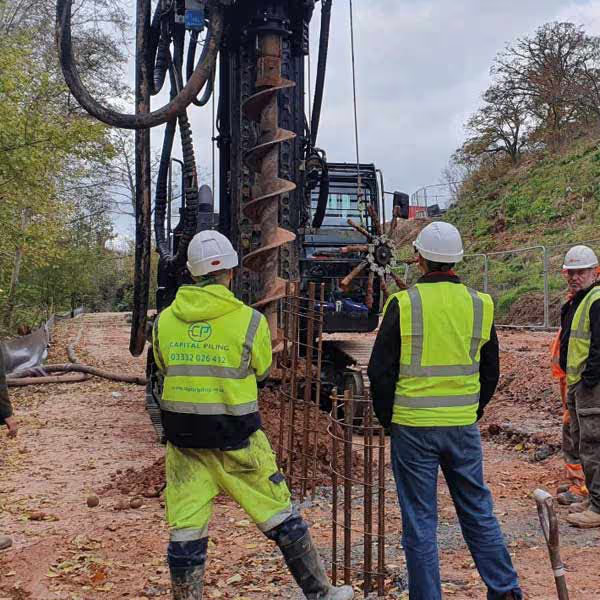
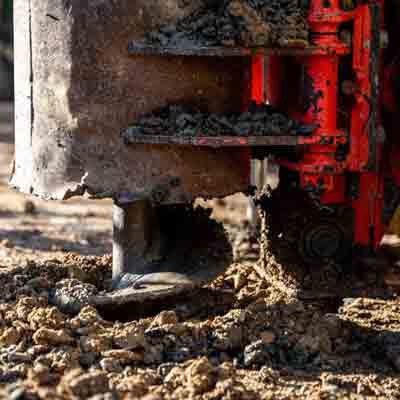
Bored piles are formed by drilling or augering a hole into the ground and filling it with reinforced concrete. The pile is cast in-situ, meaning it is formed within the ground rather than manufactured elsewhere. CFA piling, SFA piling, and mini piling are all bored methods. The bore may be supported by the ground itself, by a temporary casing, or by pressurised concrete during installation depending on the method.
Driven piles are installed by forcing a pile element into the ground using a hammer or press. In SCD driven piling the element being driven is a steel casing which is subsequently filled with reinforced concrete. In other driven methods precast concrete or steel section piles are driven directly without any subsequent filling. The key distinction is that driven piles displace the soil rather than removing it, and they derive part of their load carrying capacity from the densification and increased lateral stress that displacement creates in the surrounding ground.
How the installation process differs between driven and bored piles and why it matters
In bored piling the ground is removed to create the pile bore. The pile is then formed within that void using reinforced concrete. The quality of the finished pile depends on the stability of the bore during installation, the quality of the concrete placement, and the accuracy of the reinforcement positioning. Modern bored piling methods use pressurised concrete, temporary casings, or a combination of both to manage bore stability, but there remains a dependency on the ground cooperating with the installation process to some degree.
In driven piling the ground is not removed. The pile or casing is forced into it, displacing the soil outwards and downwards as it advances. This means bore stability is not a consideration in the same way, because there is no open bore to maintain. The steel casing in SCD piling provides a complete and continuous structural liner from the surface to the pile tip, and the pile is formed within this liner in conditions that are entirely independent of the surrounding ground behaviour.
This fundamental difference in how the two types of pile interact with the ground is what makes them suited to different conditions. Where the ground is stable and well characterised, bored methods are often faster and more economical. Where the ground is loose, variable, waterlogged, or prone to instability, driven methods offer a more reliable and predictable installation outcome.
When the choice between driven and bored piling is most significant
The choice between driven and bored piling is most significant on sites where ground conditions are challenging or variable. On a straightforward site underlain by consistent London Clay to a reliable depth, bored methods such as CFA piling will almost always be the preferred choice on the basis of speed, cost, and low vibration. On a site with loose sandy soils, a high water table, significant made ground, or a variable ground profile with unpredictable layers, driven piling may offer more reliable results and greater confidence in the finished pile quality.
The choice also matters on sites where programme certainty is important. Driven piling offers the advantage of measurable set criteria that confirm pile capacity during installation, rather than relying entirely on post installation testing to verify performance. On projects where delays to the foundation programme have significant consequences for the overall construction timeline, this in-process verification can be a valuable benefit.
The technical differences between driven and bored piles in terms of capacity and design
Driven piles in granular soils typically achieve higher unit shaft friction values than bored piles of the same diameter in the same ground, because the displacement and compaction of the surrounding soil during driving increases the lateral stress at the pile and soil interface. This means a driven pile can sometimes achieve the same load capacity at a shallower depth than a bored pile in granular conditions, which has implications for programme and cost.
Bored piles in cohesive soils such as London Clay generally perform very well in terms of shaft friction capacity and are the dominant method in these conditions across the UK. The undrained shear strength of the clay provides reliable and well understood shaft friction values that translate into consistent and predictable pile capacities, making bored methods the natural choice in cohesive ground.
The design process for both types follows BS EN 1997, Eurocode 7, but the calculation methods and the empirical correlations used to estimate capacity differ between driven and bored piles, reflecting the different ways in which the two types interact with the surrounding ground.
What to factor into the driven versus bored decision before it is made
The driven versus bored decision should always be made on the basis of the ground investigation data and a proper assessment of the site constraints, not on the basis of what equipment a contractor has available or what method was used on a neighbouring site. Ground conditions vary considerably even over short distances, and a method that worked well on the plot next door may not be appropriate for yours.
Noise and vibration are the most commonly cited concern with driven piling, and they are a legitimate consideration on sensitive sites. However they should be assessed on the basis of actual measurements and calculations rather than assumed to be prohibitive without investigation. In many cases driven piling within appropriate working hours and with modern hydraulic hammers produces vibration levels that are well within acceptable limits for the surrounding environment. Getting a proper assessment done before ruling the method out is a more reliable basis for the decision than a general concern about noise.