Why the connection between a CFA pile and a ground beam is one of the most important details in a piled foundation
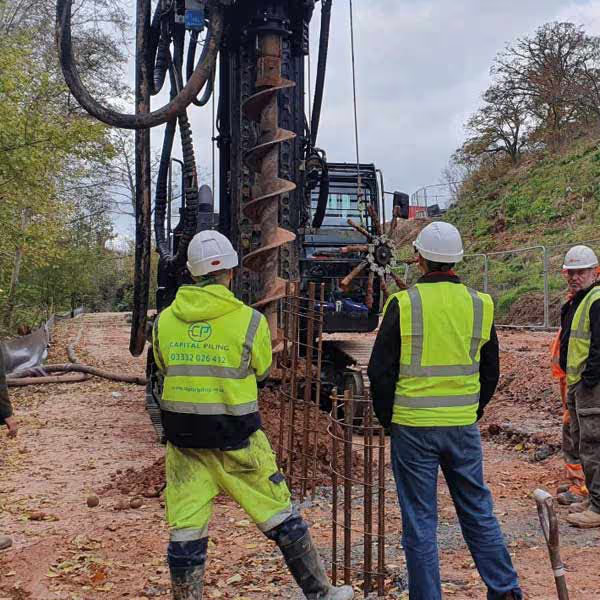
Once CFA piles are installed and cured, the next stage is connecting them to the ground beam structure above. This connection is not a straightforward construction detail that can be left to chance. It is one of the most structurally critical interfaces in the entire foundation system, transferring the loads from the building frame down into the piles and ultimately into the ground. Any weakness or inaccuracy at this interface has consequences that travel upwards through the entire structure, which is why it needs to be understood, designed correctly, and executed with care.
What makes the pile to ground beam connection so important
The connection works by exposing the reinforcement bars projecting from the top of the pile and casting them into the ground beam above. This creates a continuous structural load path from the beam into the pile. The pile head must be cut down to the correct level to remove any poor quality concrete that formed at the top during installation, and the projecting reinforcement must extend far enough into the beam to achieve the lap length specified by the structural engineer.
Pile head level accuracy during installation is critical. If a pile is installed too high, significant concrete must be removed to reach clean material, increasing cost and risk of damage to the pile below the cut. If installed too low, the projecting reinforcement may be insufficient to achieve the required structural connection without remedial work.
The pile head preparation and ground beam construction process
Once the CFA piles have reached sufficient strength, pile head cropping begins. The top section of each pile is broken down to the level shown on the structural engineer's drawings, removing any laitance or contaminated concrete that may have formed during the installation process and exposing the projecting steel reinforcement bars beneath.
The ground beam is then formed around and on top of the prepared pile head. Formwork is set to the beam profile, the beam reinforcement cage is fixed in accordance with the engineer's drawings, and the projecting pile bars are lapped into the beam cage to achieve the required structural continuity. When the beam concrete is poured, the pile and beam become a single integrated structural element capable of transferring loads efficiently from the structure above down into the ground below.
Where individual column loads are concentrated at a single point rather than distributed along a wall line, a pile cap is formed instead of a linear ground beam. The same principles of pile head preparation, reinforcement exposure, and concrete casting apply, but the geometry of the cap is designed to spread the column load across the group of piles beneath it.
Where ground beam connections are relevant across different project types
Ground beam connections are a standard part of virtually every piled foundation project regardless of scale or sector. On a residential extension with six or eight CFA piles, the ground beams tie the pile heads together and provide the bearing surface for the floor slab and wall construction above. On a large commercial development with hundreds of piles, the ground beam layout is more complex but the fundamental connection detail is the same.
The connection detail is particularly important on projects where differential settlement between pile positions needs to be controlled, and where the ground beam is spanning between pile heads rather than bearing directly on the ground. In these situations the structural integrity of the pile to beam connection is carrying real bending and shear forces, not just vertical load, and the detail needs to reflect that.
The technical requirements behind a correct pile to ground beam connection
The length of reinforcement projecting above the pile head is specified by the structural engineer and must be sufficient to achieve the required tension lap length within the ground beam. Lap lengths are typically calculated as a multiple of the bar diameter, commonly between 40 and 50 times depending on the concrete grade, bar size, and the cover conditions within the beam. For a 20mm diameter bar this equates to a lap of 800mm to 1000mm, which determines the minimum projection required above the cut pile head level.
Concrete cover within the ground beam must be maintained to the same standards as the pile itself. The beam reinforcement cage is designed with this in mind, and spacers are used to maintain correct positioning throughout the pour. The concrete specification for the ground beam is coordinated with the pile specification to ensure compatibility and consistent structural performance across the full foundation system.
What can go wrong at the pile to ground beam interface and how to avoid it
Pile head cropping is a more sensitive operation than it might appear. Mechanical breakers used incorrectly can introduce micro cracking into the pile concrete below the cut level, weakening the pile at the very point where it connects to the structure above. Hydraulic pile croppers or controlled hand breaking techniques are preferable and significantly reduce this risk.
Coordination between the piling contractor and the groundworks team is essential. Discrepancies between the piling drawings and the groundworks drawings in terms of pile head levels, beam depths, or reinforcement projections are a common source of problems on site and can be costly to resolve once piling is complete. Capital Piling's in house design service covers both the pile design and the connection details, meaning the pile specification and the ground beam design are developed together from the outset. This removes the coordination risk entirely and ensures the connection between pile and beam is right before a single pile is installed.