Other Servces
Overview
Key Points
How It Works
When & Where It’s Used
Technical Details
Considerations
Contact information
Connecting CFA Piles to the Superstructure
The interface between CFA piles and ground beams or pile caps is a critical part of the foundation system, as it provides the structural link between the deep foundation elements and the load-bearing structure above. This connection ensures that loads transferred through the piles are properly distributed into the superstructure.
In CFA piling systems, piles are typically cast in situ and then cut or trimmed to the required level before ground beams or pile caps are constructed. The interface must be carefully designed to ensure alignment, load transfer, and structural continuity.
At a high level, the effectiveness of this interface depends on accurate pile positioning, correct formation levels, and proper integration with the reinforced concrete elements above.
Role of Ground Beams and Pile Caps in Load Distribution
Ground beams and pile caps are used to connect multiple CFA piles and distribute structural loads evenly across the foundation system. Pile caps typically transfer loads from columns into one or more piles, while ground beams distribute loads along a continuous structural element.
The interface ensures that loads are transferred efficiently from the structure into the piles without excessive stress concentrations. This is particularly important where piles are arranged in groups or where column loads vary.
Proper detailing at this interface is essential, as it governs how effectively the pile system and superstructure behave as a single integrated foundation system.
Forming the Structural Connection Between Piles and Beams
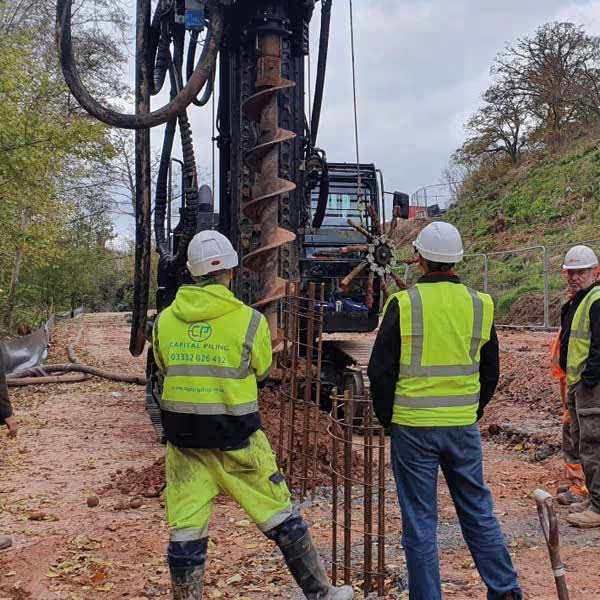
After CFA piles are installed and concrete has set, the pile heads are trimmed to the required cut-off level to expose sound concrete for structural connection. This ensures a clean and uniform surface for integration with the ground beams or pile caps.
Reinforcement from the pile may be left projecting or mechanically connected to reinforcement in the ground beam or pile cap, depending on the structural design. This creates continuity between the vertical load-bearing element and the horizontal structural components.
Once reinforcement is in place, concrete is cast for the ground beams or pile caps, forming a continuous structural system that ties the entire foundation together.
Applications Requiring Integrated Foundation Systems
The pile cap and ground beam interface is commonly used in CFA piling projects where multiple piles are required to support individual columns or load points. This is typical in residential, commercial, and industrial structures.
It is also used where ground conditions require load distribution across several piles to achieve stability and reduce differential settlement. In such cases, pile caps help unify the behaviour of grouped piles.
Ground beams are often used in projects with suspended floors or where structural loads must be transferred across varying column positions, ensuring consistent load distribution.
Structural Design and Load Transfer Mechanisms
The design of the pile cap or ground beam interface is based on structural analysis of load paths between the superstructure and the pile foundation system. Engineers determine how loads are distributed and design reinforcement accordingly.
Shear forces, bending moments, and axial loads must all be considered when detailing the connection between piles and concrete elements above. Reinforcement detailing ensures continuity and prevents stress concentrations at connection points.
Accurate pile positioning and cut-off levels are critical, as deviations can affect reinforcement alignment and reduce the efficiency of load transfer between structural elements.
Construction Accuracy and Detailing Requirements
The performance of the CFA pile interface depends heavily on installation accuracy and correct execution of pile trimming and reinforcement detailing. Misalignment or incorrect levels can complicate the construction of ground beams or pile caps.
Coordination between piling contractors and structural engineers is essential to ensure reinforcement from piles aligns correctly with the superstructure design. Any discrepancies may require site adjustments or redesign.
Ground conditions and excavation quality can also influence interface construction, particularly where water ingress or unstable soils affect the formation of pile head exposure before beam or cap construction.