Why ground investigation is the most important step before any CFA piling design begins
Ground investigation is not a box ticking exercise. It is the single most important piece of work that happens before a CFA pile design can be produced, and without it the design is based on assumptions rather than facts. In foundation engineering, assumptions are expensive. They lead to piles that are deeper than they need to be, or not deep enough, concrete specifications that are wrong for the ground chemistry, and in some cases a piling method being specified that is not suitable for the ground conditions at all. A thorough ground investigation removes that uncertainty and gives the structural engineer the data needed to design the foundation correctly for what is actually in the ground at your specific location.
What ground investigation does and why it cannot be skipped
Ground investigation identifies the soil types present at your site, how deep they extend, where suitable bearing strata begins, what the groundwater conditions are, and whether there are any chemical risks that need to be managed in the concrete specification. For CFA piling specifically, it also confirms whether the ground is suitable for the method at all. If the investigation reveals very hard layers, rock at shallow depth, or significant obstructions, CFA piling may not be viable and a different method will need to be considered before any design work is committed to.
The investigation also provides the soil strength parameters that the structural engineer uses to calculate pile capacity. Without these parameters, pile diameter and depth cannot be accurately determined, and the foundation design will either be over conservative and unnecessarily expensive, or under designed and structurally inadequate.
What a ground investigation for CFA piling typically involves
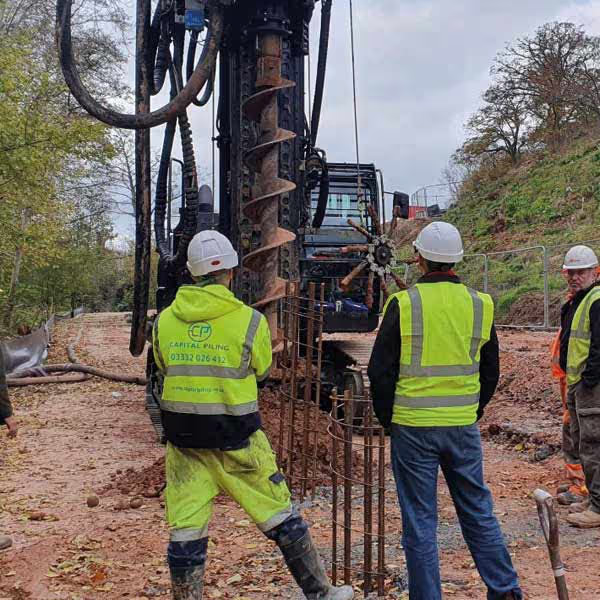
A ground investigation for a CFA piling project typically involves a combination of cable percussion boreholes, rotary boreholes, and window sample probes sunk to a depth of at least one and a half times the anticipated pile length. Soil samples are taken at regular intervals throughout the borehole depth and sent to a laboratory for testing. The laboratory testing provides data on shear strength, plasticity index, moisture content, particle size distribution, and chemical composition including sulphate content and pH levels.
The factual results are compiled into a ground investigation report which is then interpreted by a geotechnical engineer. The geotechnical interpretation report provides the soil parameters and design recommendations that the structural engineer uses to produce the pile design. These two documents together form the basis of every decision made about pile diameter, depth, concrete specification, reinforcement design, and method selection.
When ground investigation is required and what scale is appropriate
Ground investigation is required on virtually every piling project regardless of size. The scale and scope of the investigation should be proportionate to the project. A single residential extension may only require one or two boreholes to characterise the ground to the required depth. A large residential development or commercial scheme will require a grid of boreholes across the full site footprint to capture any variability in the ground profile across the development area.
On brownfield sites, former industrial land, or sites with a history of previous development, additional investigation for contamination is essential. Certain chemicals present in made ground or contaminated soils can attack concrete, requiring a modified concrete specification to protect the piles over their design life. Identifying this risk through the ground investigation allows the concrete specification to be adapted before piling begins rather than after a problem has been identified on site.
The technical outputs of a ground investigation and how they feed into CFA pile design
The key technical output of a ground investigation for CFA piling is a set of soil parameters for each stratum identified in the ground profile. In cohesive soils such as London Clay, undrained shear strength values are used to calculate shaft friction capacity along the pile length. In granular soils, SPT N values or cone resistance values from CPT testing are used to estimate both shaft friction and end bearing contributions to pile capacity.
Groundwater level is recorded during the investigation and factored into both the pile design and the concrete specification. Chemical testing of soil and groundwater samples determines whether the ground is chemically aggressive and informs the choice of cement type and concrete mix. Where sulphate levels exceed certain thresholds defined in BRE Special Digest 1, a sulphate resisting cement or designated concrete mix must be used to protect the pile from chemical deterioration.
What happens when ground investigation is inadequate or skipped entirely
The consequences of inadequate ground investigation are almost always felt on site rather than in the design office, which is where they are most expensive to deal with. Unexpected soil conditions encountered during CFA drilling can cause auger refusal, changes in concrete volume, or pile integrity issues that require investigation, testing, and in some cases remedial piling. Each of these outcomes costs more to resolve on site than the ground investigation that would have identified the risk beforehand would have cost to commission.
If you already have a ground investigation report for your site and are unsure whether it contains sufficient information for a CFA pile design, or whether the ground conditions it describes are suitable for CFA piling, Capital Piling's in house design team can review the data and advise accordingly. Getting that review done before design begins is always more straightforward than dealing with the consequences of proceeding on incomplete information.