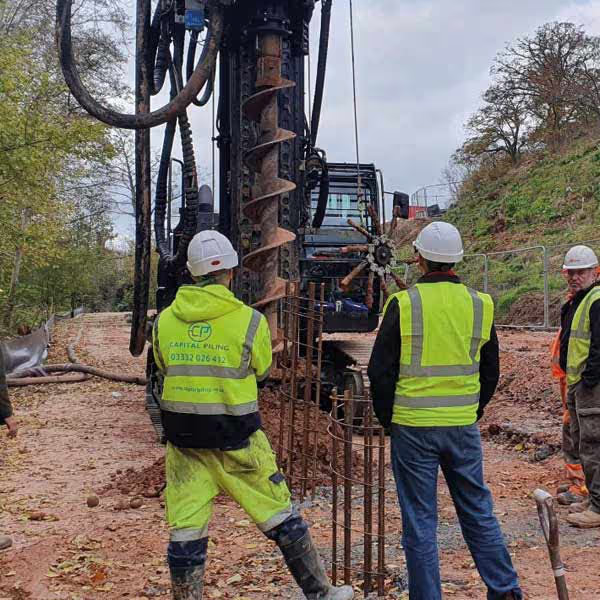
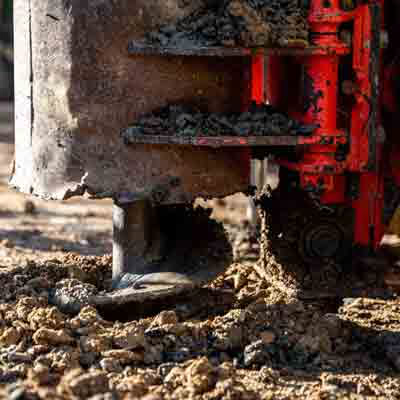
Understanding What Lies Beneath the Surface
Ground investigations and soil reports form the starting point for almost all foundation and groundworks design. They provide essential information about what conditions exist below ground, allowing engineers to design safe and appropriate foundation systems such as piles, ground beams, or slabs.
These investigations assess soil type, strength, density, groundwater conditions, and potential obstructions. Without this data, it would not be possible to accurately predict how the ground will behave under structural loads.
At a high level, ground investigations and soil reports reduce uncertainty by turning unknown ground conditions into measurable engineering data.
What Ground Investigations Identify
Ground investigations determine the composition and behaviour of subsurface soils, including whether they are suitable for supporting structures. This includes identifying soft soils, fill material, rock layers, or variable ground conditions.
They also highlight potential risks such as settlement, ground instability, contamination, or high groundwater levels that may affect construction methods and foundation design.
The findings are summarised in soil reports, which provide engineers with the data needed to select appropriate foundation solutions and construction techniques.
From Site Testing to Engineering Report
Ground investigations are carried out using methods such as boreholes, trial pits, cone penetration testing, and in-situ sampling. These methods collect physical samples and measurement data from different depths across the site.
The collected samples are then analysed in laboratories to determine properties such as moisture content, shear strength, density, and classification of soil types. This helps build a detailed profile of subsurface conditions.
All findings are compiled into a geotechnical or soil report, which includes soil stratification, engineering parameters, groundwater observations, and recommendations for foundation design.
Essential for All Structural and Foundation Projects
Ground investigations are required on virtually all construction projects where foundations are involved, including residential, commercial, industrial, and infrastructure developments.
They are particularly important on sites with previously developed land, variable geology, or suspected contamination, where ground conditions may not be immediately visible or predictable.
Soil reports are used at the early design stage and continue to inform decisions throughout the construction process.
Geotechnical Data and Design Parameters
Soil reports provide key engineering parameters such as bearing capacity, angle of internal friction, cohesion, and compressibility. These values are used to design foundations and predict settlement behaviour.
Stratigraphy data shows the layering of different soil types across the site, helping engineers understand how loads will be transferred through the ground.
Groundwater levels and seasonal variations are also recorded, as they can significantly affect excavation, piling, and long-term foundation performance.
Importance of Accurate Interpretation
The accuracy of foundation design depends heavily on the quality and interpretation of ground investigation data. Misinterpretation can lead to inappropriate foundation selection or unexpected site conditions during construction.
Investigations should be sufficiently detailed to represent the full extent of the site, as localised variations in soil conditions can impact structural performance.
Ultimately, ground investigations and soil reports provide the critical foundation data needed to design safe, efficient, and cost-effective groundworks and foundation systems.