Forming the Structural Link Between Foundations and Superstructure
Ground beams are reinforced concrete elements installed as part of the groundworks phase to connect foundation points such as pile caps or pad foundations. They provide a continuous structural pathway that transfers loads from the building into the supporting foundation system.
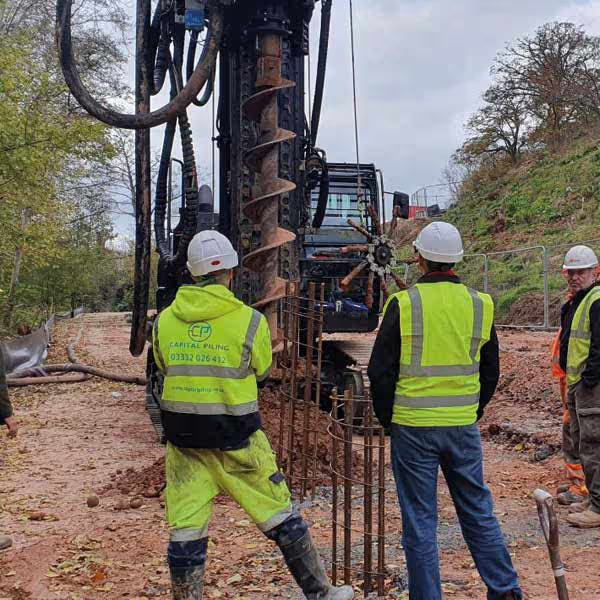
Installing ground beams typically takes place after piling and/or pile cap construction has been completed and the required excavation has been carried out. The beams tie individual foundation points together, creating a unified structural grid.
At a high level, ground beams form the structural framework that supports and stabilises the building above the foundations.
Purpose and Structural Function
Ground beams distribute loads between foundation points, ensuring that structural forces are shared evenly across the system rather than being concentrated in isolated areas. This improves stability and reduces the risk of differential settlement.
They also provide support for walls, floor systems, and load-bearing elements, acting as a bridge between the substructure and the superstructure.
The layout, depth, and reinforcement of ground beams are determined by structural design requirements and the arrangement of piles or foundation supports.
Step-by-Step Installation Process
The installation of ground beams begins with setting out the beam positions according to the structural drawings. Accurate setting out ensures alignment with pile caps and other foundation elements.
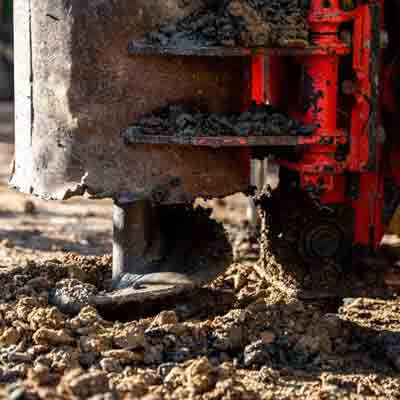
Excavation is then carried out to the required dimensions, creating trenches or voids where the beams will be formed. Pile heads may be exposed within these excavations where integration is required.
Reinforcement is installed and secured in place, often forming prefabricated cages that are positioned within the trench. Once formwork is installed or trench conditions are suitable, concrete is poured and compacted to form the finished beam.
Common in Piled and Shallow Foundation Systems
Ground beams are widely used in both piled foundation systems and traditional shallow foundations where load distribution between multiple points is required.
They are especially common in piled systems where beams connect pile caps and support the structural frame above. This allows loads to be transferred efficiently into the deeper foundation elements.
They are used across residential, commercial, and industrial projects where controlled load transfer and structural continuity are required.
Structural Design and Construction Requirements
Ground beams are designed to resist bending, shear, and axial forces generated by structural loads. Reinforcement is specified based on span lengths, load intensity, and support conditions.
Concrete strength, reinforcement cover, and detailing at connection points are critical to ensuring long-term durability and structural performance.
Coordination with pile positions and pile cap levels is essential to ensure that the ground beam integrates correctly within the overall foundation system.
Accuracy, Sequencing, and Site Conditions
Accurate setting out is essential to ensure ground beams align correctly with foundation points. Any deviation can affect load transfer and structural performance.
Site conditions such as groundwater, unstable soils, or restricted access can influence excavation and installation methods, requiring additional control measures.
Ultimately, successful installation of ground beams depends on precise execution, correct sequencing with other groundworks, and close coordination with structural design requirements.