Other Servces
Overview
Key Points
How It Works
When & Where It’s Used
Technical Details
Considerations
Contact information
Load capacity and design considerations
Load capacity sits at the centre of any piling design, defining how forces from the structure are transferred safely into the ground. At this stage, the focus is not on the piling method itself, but on how the foundation is engineered to perform under real site conditions.
On most projects, this involves more than straightforward calculation. It requires an understanding of how the structure behaves, how the ground responds and how the chosen approach will be delivered in practice. Getting this right early helps avoid unnecessary complexity once work begins.
What drives load capacity decisions
Load capacity is influenced by both structural requirements and ground behaviour.
The loads imposed by the building determine what the piles need to achieve, while the soil profile defines how those loads can be supported. In reality, these two elements rarely align perfectly, which is why design often involves adapting the approach rather than applying a fixed solution.
On projects handled by Capital Piling, this stage typically involves reviewing ground data alongside structural information to determine which approach will deliver the required performance in a practical way.
How load is transferred in practice
In most piling systems, load is transferred into the ground through a combination of base resistance and friction along the length of the pile.
How these mechanisms are used depends on the ground profile and the type of system being applied. Some designs rely more heavily on reaching stronger strata at depth, while others make greater use of the surrounding soil to distribute load.
Understanding how these factors interact is key to developing a solution that performs reliably once installed, rather than one that only works on paper.
Applying these principles on site
In practice, load capacity decisions are shaped by the conditions of the project.
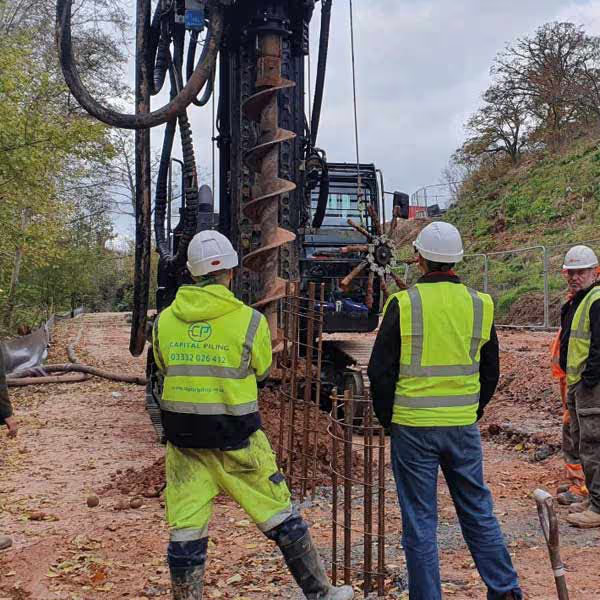
On smaller residential works, the focus is often on achieving an efficient solution that meets the required performance without overcomplicating installation. On more complex sites, varying loads or less predictable ground conditions may require a more considered approach.
This is where experience becomes valuable, as different piling methods can be used depending on what the site demands, rather than forcing a single solution to fit every situation.
Bringing design and delivery together
From a technical perspective, load capacity is determined using ground investigation data alongside structural calculations.
However, these values need to align with how the work will actually be carried out. A design that looks efficient in theory can create challenges if it does not reflect site constraints or installation methods.
By linking design decisions with real delivery experience, it becomes easier to develop solutions that are both technically sound and practical to construct.
Avoiding overdesign and mismatch
A common issue in piling design is specifying solutions that are either more complex than necessary or not fully suited to the site.
Overdesign can increase cost and slow down the programme, while underestimating requirements can lead to changes later in the project. The most effective approach is one that is closely matched to the conditions from the outset.
Taking the time to properly assess both the ground and the structure helps ensure the foundation performs as required, without introducing unnecessary risk or inefficiency.