Why monitoring during driven pile installation is fundamental to quality and compliance
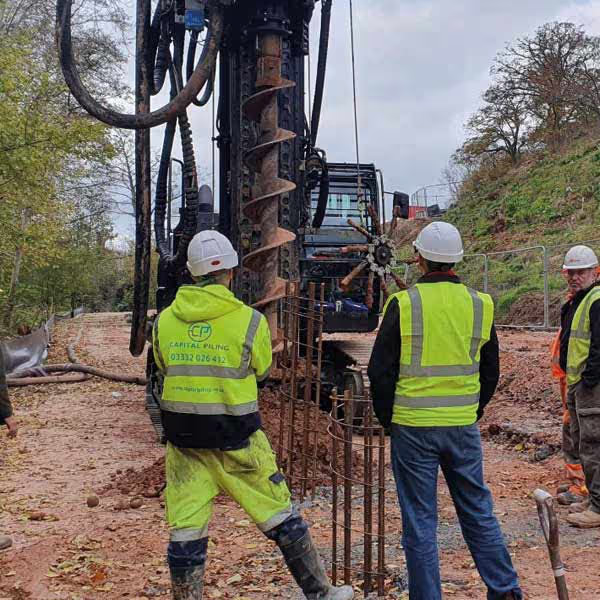
Monitoring during SCD driven pile installation serves a different purpose to monitoring in bored piling. Where bored pile monitoring focuses primarily on concrete volume and auger withdrawal rate as indicators of pile formation quality, driven pile monitoring centres on the driving resistance data that provides real time confirmation of pile capacity during installation. This in-process capacity verification is one of the defining advantages of driven piling over bored methods, and it is only reliable if the monitoring is carried out correctly, the data is reviewed promptly, and the people responsible for that review understand what they are looking at and what action is required when the data raises a concern. Capital Piling operates a structured monitoring and review process on every driven piling project, and for clients who need support understanding what the data means our in house team is available throughout the programme to provide that guidance.
What is monitored during SCD driven pile installation and why each parameter matters
Driving resistance is monitored continuously throughout the driving of each casing, expressed as the penetration of the casing per blow or per set number of blows at each stage of the driving process. The set criterion, derived from wave equation analysis before installation begins, defines the driving resistance that must be achieved before driving stops, and it is the primary in-process indicator that the pile has reached adequate bearing capacity.
Hammer energy is monitored to confirm that the energy being delivered to the casing with each blow is consistent with the value used to derive the set criterion. Any significant variation in hammer energy affects the relationship between measured driving resistance and actual pile capacity, and needs to be identified and investigated before the driving data from affected piles is relied upon.
Pile set and temporary compression are both recorded at the end of driving to provide the data needed to apply the set criterion correctly. Temporary compression is the elastic compression of the pile under the hammer blow, and it needs to be measured and accounted for alongside the permanent set to give an accurate picture of the pile's response to driving at the point of refusal.
How the monitoring process operates during SCD driven pile installation
Before installation begins, the wave equation analysis is carried out using the known hammer characteristics, the pile geometry, and the soil parameters from the ground investigation to derive the set criterion for the specific conditions on site. This criterion is communicated to the installation team before driving starts and is applied consistently to every pile throughout the programme.
During driving, the penetration per blow is measured at regular intervals and recorded in the installation log for each pile. As the casing approaches the design depth the measurements become more frequent, and the final set is measured over a defined number of blows immediately before driving stops. The installation log records the full driving history of each pile, including the depth at which the set criterion was achieved, any anomalies in the driving resistance profile, and the hammer settings used throughout.
Where the driving data shows unexpected behaviour, such as a sudden reduction in resistance at a depth where harder ground was anticipated, or a resistance that does not reach the set criterion at the design depth, the pile is flagged and the structural engineer is notified before driving continues or the pile is accepted. This prompt escalation process is what allows quality issues to be resolved during the programme rather than after it.
When monitoring requirements are most significant and what drives the scope
Monitoring is required on every SCD driven piling project regardless of scale. On a small residential project the monitoring process is straightforward, with the set criterion applied to each pile and the installation log completed by the site supervisor as work progresses. On a larger commercial project the monitoring requirements are more detailed, with a greater volume of data to review and a more formal process for submitting and signing off installation records.
On projects subject to NHBC warranty, the installation records must demonstrate compliance with Chapter 4.4 of the NHBC Standards before the foundation works are accepted. On commercial projects the monitoring and recording requirements are defined in the contract specification, and compliance is verified through the submission and review of installation records during the works. Capital Piling produces installation records that meet the requirements of the relevant standards on every project as a matter of course, and where clients do not have a structural engineer in place to review them our in house team provides that review as part of the design and delivery service.
The technical standards and methods that govern driven pile monitoring
Driven pile monitoring in the UK is carried out in accordance with BS EN 12699, which sets out the requirements for installation records, set measurement, and the documentation of driving data for displacement piles. The standard defines the parameters that must be recorded, the frequency at which measurements must be taken, and the format in which installation records must be produced and submitted.
Dynamic load testing in accordance with BS EN ISO 22477-4 provides a higher level of capacity verification than the set criterion alone, using the stress wave generated by a hammer impact to assess pile capacity and integrity through signal matching analysis. Where dynamic load testing is carried out as part of the monitoring programme, the results supplement the installation records and provide the structural engineer with a more detailed picture of pile performance that can be reviewed against the design assumptions and used to confirm that the foundation is performing as intended.
Restrike testing, carried out after a rest period following initial driving, provides verification that the capacity indicated by the initial set is maintained over time. It is particularly relevant on sites where pile relaxation is a known risk, and the results form part of the monitoring record for the affected piles.
What to plan for when setting up the monitoring programme for a driven piling project
The monitoring programme needs to be agreed and documented before installation begins, not assembled reactively as the programme progresses. The set criterion, the hammer settings, the recording frequency, the escalation process for anomalous results, and the format and submission schedule for installation records all need to be defined in advance and communicated clearly to everyone involved in the installation and review process.
Data review needs to happen in real time during the programme, not at the end of it. Installation records that are filed without review provide no quality benefit, and anomalies in the driving data that are not acted upon promptly become significantly more difficult and costly to address once the programme has moved on. A clear and structured review process, with defined responsibilities for who reviews the data, when they review it, and what action is taken when something requires investigation, is what separates a monitoring programme that genuinely assures quality from one that simply generates paperwork. At Capital Piling this process is embedded in how we deliver every driven piling project, and clients who engage our in house design team benefit from having the same team involved in both the design and the monitoring review, which means the people reviewing the data understand exactly what it should look like and are well placed to identify when it does not.