Other Servces
Overview
Key Points
How It Works
When & Where It’s Used
Technical Details
Considerations
Contact information
Pile diameter and depth selection
Pile diameter and depth selection sit at the core of foundation design, shaping how loads are transferred into the ground and how the piling system performs as a whole. At this stage, the focus shifts away from what the method is and moves toward how it is engineered to suit a specific structure.
These decisions are not fixed or standardised. They are developed in response to the building design, the behaviour of the ground and the constraints of the site, all of which need to be considered together rather than in isolation.
Design is about balance, not maximum size
There is often an assumption that increasing pile size or depth will automatically improve performance. In reality, the most effective solutions tend to come from balance rather than scale.
A larger diameter increases capacity, but also affects installation, material use and cost. Greater depth allows piles to reach stronger strata, but can introduce inefficiencies if it extends beyond what is structurally required.
The role of design is to find the point where these variables work together efficiently, rather than pushing one factor further than necessary.
How decisions are actually made
In practice, selecting pile dimensions is a process of refinement.
Initial calculations define what is required from a structural perspective, but those values are then adjusted based on ground conditions and how the piles will be installed. It is not uncommon for early assumptions to change once site constraints are fully understood.
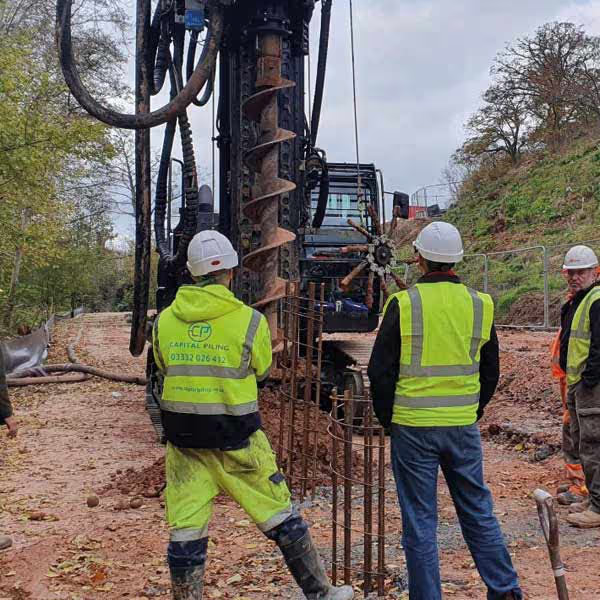
At Capital Piling, this stage is often where practical experience plays a role. Knowing how different sizes behave during installation, particularly on restricted or complex sites, helps shape decisions so they work not just in theory but in reality.
Why this matters on real projects
This level of design thinking becomes particularly important on projects where constraints are present.
On straightforward sites, there may be more flexibility in how piles are sized. On more complex projects, decisions around diameter and depth can have a direct impact on how the work is carried out, including sequencing, access and overall programme.
The more constrained the site, the more important it becomes to align design decisions with how the work will actually be delivered.
Interaction between size, depth and ground behaviour
From a technical perspective, diameter and depth influence both end bearing and shaft interaction with the ground.
Increasing diameter affects how loads are distributed at the base of the pile, while depth determines how much of the load is transferred through the surrounding soil. These two mechanisms need to be considered together, particularly where ground conditions vary with depth.
This is why detailed ground data is critical at this stage, as it allows these relationships to be properly understood and applied.
Avoiding overdesign and reactive changes
One of the common issues at this stage is designing piles that are either more complex than necessary or not fully aligned with site conditions.
Overdesign can lead to unnecessary cost and slower installation, while underestimating requirements can result in changes later in the project. Both scenarios tend to create avoidable disruption.
A well considered approach at the design stage reduces the need for adjustments once work begins, helping the project move forward with greater certainty.