Understanding the equipment used in SCD driven piling and why it matters
The equipment used in SCD driven piling is not incidental to the quality of the finished foundation. The type of rig, the size and energy of the hammer, the specification of the steel casing, and the condition and maintenance of all plant on site all have a direct bearing on how consistently and reliably the piles are installed. Understanding what the key pieces of equipment do and why their selection and condition matter helps clients and project teams ask the right questions before a piling contractor mobilises to site, and gives context to decisions made during installation that might otherwise seem like operational detail with no relevance to the finished foundation.
The main equipment involved in SCD driven piling and what each element contributes
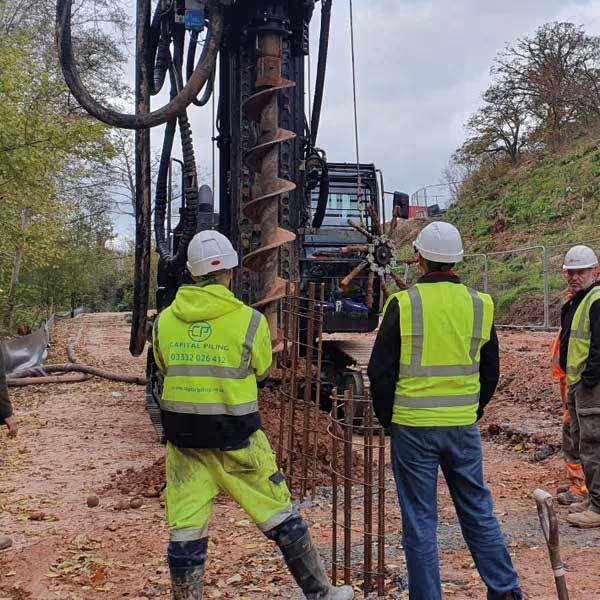
The piling rig provides the leader frame that guides the steel casing during driving and carries the hydraulic hammer that advances it into the ground. The hydraulic drop hammer delivers controlled and repeatable energy to the top of the casing with each blow, and the energy it delivers is a critical input into the set criterion calculation that confirms pile capacity during installation. The steel casing is a structural component of the finished pile as well as the means by which the bore is formed, and its specification in terms of diameter, wall thickness, and steel grade needs to be matched to the driving conditions and the structural requirements of the design. The concrete pump and associated delivery equipment need to be capable of filling the casing reliably after driving is complete. All of these elements need to work together consistently throughout the programme to produce piles of uniform quality.
How the rig and hammer work together during SCD driven pile installation
The piling rig positions the leader frame over the pile location and the steel casing is set into the leader ready for driving. The hydraulic drop hammer is raised to the specified drop height and released, striking the top of the casing and driving it into the ground by a measurable increment with each blow. The drop height and hammer weight together determine the energy delivered to the casing with each blow, and this energy is a known and controlled input that allows the set criterion to be derived and applied consistently throughout the programme.
As driving progresses, the penetration per blow is measured and recorded at regular intervals. Changes in penetration rate reflect changes in the ground resistance being encountered, and these changes are tracked by the monitoring system and reviewed by the site supervisor throughout the driving process. When the measured penetration per blow matches the set criterion, driving stops and the pile is complete at that stage of the process.
The condition and calibration of the hammer are important to the reliability of this process. A hammer that is not delivering the specified energy consistently will produce driving resistance data that does not accurately reflect the ground conditions, which undermines the reliability of the set criterion as a capacity indicator. Capital Piling maintains its equipment to a high standard and ensures that hammer performance is verified before installation begins on every project.
How equipment selection varies across different project types and site conditions
On a straightforward residential project with modest pile sizes and good access, a standard hydraulic drop hammer on a conventional leader rig is typically appropriate. The rig footprint is manageable on most residential sites and the equipment configuration is well matched to the pile sizes and depths commonly encountered in these applications.
On more complex commercial projects, larger rigs with higher energy hammers may be required to drive larger diameter casings to greater depths in denser ground conditions. Where access is restricted or headroom is limited, smaller or more compact rig configurations may be needed, and the equipment selection needs to be confirmed against the site constraints before mobilisation. Capital Piling assesses the equipment requirements for each project during the pre-construction stage, making sure the rig and hammer configuration selected is appropriate for the pile sizes, ground conditions, and site access constraints before the programme begins. For clients working through the design process for the first time, our in house team can advise on what equipment is likely to be needed and what site preparation is required to accommodate it.
The technical parameters that govern equipment selection and hammer performance
The energy delivered by the hydraulic drop hammer is the critical parameter that links the equipment to the set criterion. It is expressed as the product of the hammer weight and the drop height, and it must be consistent and repeatable throughout the driving process for the set criterion to be a reliable indicator of pile capacity. Wave equation analysis, carried out using specialist software before installation begins, models the propagation of the stress wave through the pile during each hammer blow and uses the known hammer energy to derive the set criterion for the specific ground conditions and pile design.
Hammer energy is verified by the piling contractor before installation begins and monitored throughout the programme. Any significant deviation from the specified energy, whether due to equipment wear, incorrect drop height, or hammer malfunction, needs to be identified and corrected before it affects the reliability of the driving resistance data being recorded. This is part of the quality management process that Capital Piling operates on every driven piling project as standard.
What to think about when assessing equipment suitability for an SCD driven piling project
The condition and maintenance history of the equipment are equally important. A rig or hammer that has not been properly maintained introduces variability into the installation process that affects the reliability of the driving resistance data and the consistency of the finished piles. At Capital Piling we maintain all of our equipment to a high standard and verify hammer performance before installation begins on every project as a matter of routine. Our rigs are regularly serviced and inspected, and any equipment that does not meet our performance standards is taken out of service before it reaches site. This is not an optional extra on a driven piling project. It is a fundamental part of delivering a foundation that performs as the design intends, and it is something we take seriously on every contract regardless of size or complexity.