Why quality monitoring is not optional in CFA piling
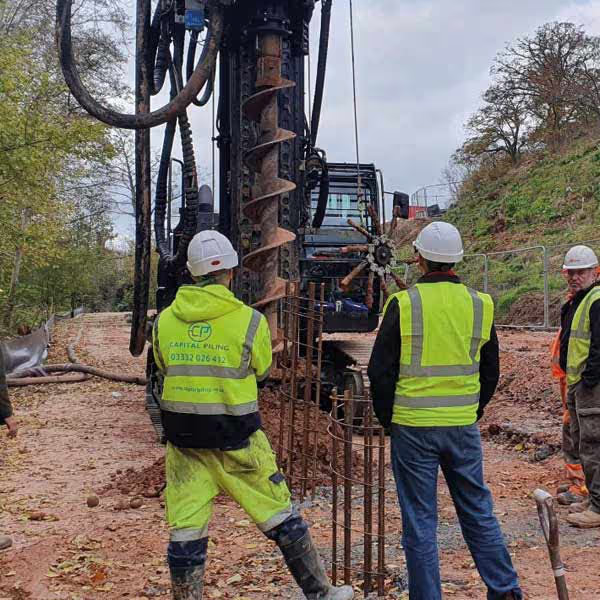
Quality monitoring during CFA piling is not a nice to have. It is a fundamental part of how compliant, structurally sound piles are produced and verified. Unlike some construction activities where quality can be assessed visually after the work is complete, a CFA pile is formed entirely below ground and cannot be inspected once it has cured. The only reliable way to demonstrate that each pile has been installed correctly is through the data recorded during installation, which is why modern CFA rigs are equipped with electronic monitoring systems that log the key installation parameters of every single pile in real time throughout the entire process.
What quality monitoring involves and why it matters for every pile on a CFA project
Electronic monitoring systems fitted to CFA rigs record auger withdrawal rate, rotation speed, concrete volume delivered, and pump pressure continuously throughout each pile installation. This data is displayed in real time on a screen visible to the rig operator, allowing any deviation from the expected parameters to be identified and responded to immediately. At the end of each pile, the system produces an installation record that shows the key parameters plotted against depth, providing an objective and permanent record of how that pile was formed.
These records are reviewed by the site supervisor during the piling programme and submitted to the structural engineer or client representative as part of the quality documentation for the works. On projects subject to NHBC warranty or third party structural warranty, pile installation records are a mandatory submission and must demonstrate compliance with the relevant standards before the warranty is issued.
How the monitoring system records and responds to what is happening during installation
As the CFA auger advances into the ground, the monitoring system records the drilling parameters including rotation speed and crowd force, building a picture of the ground resistance being encountered at each depth. When concrete pumping begins and the auger is withdrawn, the system switches to tracking concrete volume delivered against the theoretical volume of the bore at each depth increment.
If the actual concrete volume being delivered significantly exceeds the theoretical bore volume at a given depth, it may indicate that the surrounding ground is taking concrete, suggesting the presence of a void, a loose zone, or a permeable layer that was not identified in the ground investigation. If the volume falls short of the theoretical requirement, it may indicate that the bore diameter is smaller than intended or that the concrete is not flowing freely. Both scenarios generate an alert that the operator and supervisor need to assess and respond to before moving on.
Withdrawal rate is one of the most critical parameters monitored during CFA installation. If the auger is withdrawn too quickly relative to the concrete delivery rate, the concrete may not fill the bore fully, leaving voids or necking in the pile. The monitoring system tracks this relationship continuously and the operator adjusts the withdrawal rate in real time to maintain the correct balance throughout the installation.
When quality monitoring is required and what standards govern it
Quality monitoring is required on all CFA piling works carried out in accordance with BS EN 1536, which is the British and European standard for the execution of bored piles. The standard sets out the minimum monitoring and recording requirements for CFA installation and defines the parameters that must be recorded and the format in which installation records must be produced.
For residential projects subject to NHBC Building Control or NHBC Buildmark warranty, Chapter 4.4 of the NHBC Standards sets out specific requirements for pile installation records and quality assurance documentation. These requirements must be met before NHBC will accept the foundation works, and non-compliance can result in the warranty being withheld until remedial action is taken.
On commercial projects, the monitoring and recording requirements are typically specified by the structural engineer or employer's agent in the contract documents, and compliance is verified through the submission and review of installation records during the works.
The technical parameters recorded during CFA monitoring and what they tell you
The installation record produced for each CFA pile typically shows concrete volume plotted against depth alongside the key installation parameters. The concrete volume graph is one of the most informative outputs. A smooth, consistent increase in volume with depth indicates a well formed pile of consistent cross section. Sudden increases in volume at a particular depth indicate abnormal ground conditions at that level. Plateaus or reductions in volume can indicate problems with concrete delivery or bore formation that need to be investigated.
Integrity testing provides a further layer of quality verification beyond the installation records. Sonic logging, in which a sound wave is transmitted down a tube cast into the pile and the return signal is analysed for anomalies, can identify defects within the pile shaft that are not apparent from the installation data alone. Low strain impact testing, carried out from the pile head after curing, uses stress wave analysis to assess pile integrity and can identify major defects, inclusions, or variations in cross section. Both methods are used where the installation data raises concerns or where the project specification requires a proportion of piles to be tested as a matter of routine.
What to be aware of when relying on quality monitoring data
Monitoring data is only useful if it is reviewed promptly and any anomalies are acted upon. Collecting installation records and filing them without review provides no quality benefit at all. The value of the monitoring system lies in the combination of real time response during installation and post installation review of the records by someone who understands what the data means and what action is required when it deviates from expectations.
It is also worth understanding that monitoring data records what the instrumentation measures, not what the pile looks like. Anomalies in the data indicate that something unexpected happened during installation and that further investigation may be warranted. They do not always mean the pile is defective, and equally a set of records that looks entirely normal does not guarantee a perfect pile if the monitoring equipment was not calibrated correctly or was not functioning properly during the installation. Ensuring that monitoring equipment is regularly calibrated and that the operatives and supervisors responsible for reviewing the data are competent to do so is as important as having the equipment on the rig in the first place.