Why reinforcement cage placement is one of the most time critical steps in CFA pile installation
Placing the reinforcement cage into a freshly concreted CFA pile sounds straightforward but it is one of the most time sensitive and technically important steps in the entire installation process. The cage must go into the wet concrete within a specific window of time, to the correct depth, in the correct orientation, and without disturbing the concrete in a way that introduces air voids or segregation. Once the concrete begins to stiffen, that window closes and the opportunity to place the cage correctly is gone. Understanding what good cage placement looks like, what can go wrong, and why the preparation that happens before the cage goes in is just as important as the placement itself is essential for anyone involved in managing or specifying CFA piling works.
The essentials of reinforcement cage placement in CFA piling
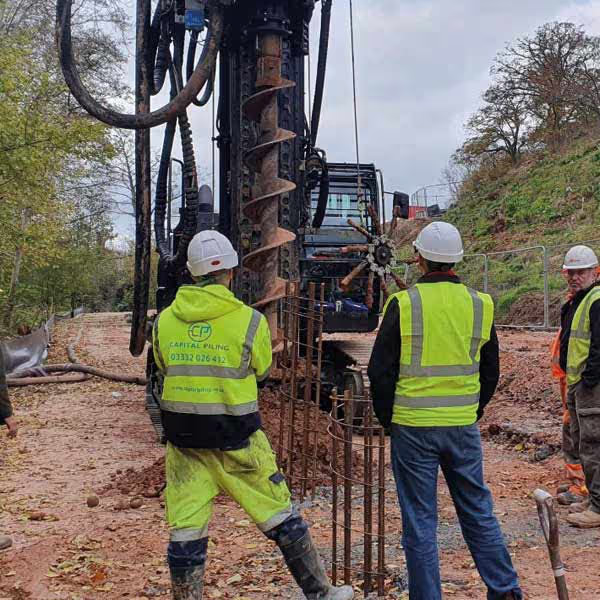
The cage must be placed immediately after the auger is withdrawn while the concrete is still fully workable. Cage dimensions must be correct before arrival on site, the right diameter to fit within the pile with adequate cover on all sides, and the right length to reach the specified depth and project sufficiently above the pile head for the ground beam or slab connection above. The orientation of the projecting bars at the top of the cage must align with the ground beam or pile cap layout. Cover spacers must be correctly fitted around the outside of the cage before placement to maintain the minimum 75mm cover specified in BS EN 1536. Where the cage is long or heavy, a vibrator attached to the cage top is used to aid penetration into the concrete without causing segregation.
The cage placement process from preparation to completion
Once the CFA auger has been fully withdrawn and the bore is filled with concrete to the correct level, the reinforcement cage is lifted into position directly over the pile using either the rig itself or a separate crane or excavator depending on the cage size and site configuration. The cage is then lowered steadily into the wet concrete under its own weight.
For shorter and lighter cages in fluid concrete, gravity is usually sufficient to achieve the required penetration depth without assistance. For longer, heavier, or stiffer cages, or where the concrete has begun to lose some workability due to delays between concreting and cage placement, a vibrator clamped to the top of the cage is used to assist penetration. The vibration reduces the resistance of the concrete to cage penetration without causing the segregation that would result from vibrating the concrete itself at this stage.
Once the cage reaches the specified depth, it is held in position and checked for level and orientation before being released. The projecting bars at the top are checked to confirm they align correctly with the ground beam or pile cap layout shown on the structural drawings. Any misalignment at this stage is far easier to address than after the concrete has cured.
How cage placement requirements vary across different project types and pile configurations
On a straightforward residential project with short, lightly reinforced cages, placement is a quick and routine operation. The cages are typically delivered to site pre-fabricated, lifted into position, and placed within a few minutes of the auger being withdrawn. On a larger commercial project with long, heavily reinforced cages carrying significant bending and shear reinforcement, the operation requires more planning, larger lifting equipment, and more careful management of the concrete workability window.
Where piles are subject to lateral loading, uplift, or significant bending moments, the cage may need to extend over a greater proportion of the pile length, making it heavier and more difficult to handle. In these situations the logistics of cage delivery, storage, and lifting need to be planned in detail before piling begins to ensure the cage can be placed within the available workability window without delays.
On projects where Capital Piling is delivering the full foundation package including ground beams and RC slabs, the cage projection lengths and orientations are coordinated with the ground beam and slab reinforcement layout as part of the design process, so that by the time the cage goes into the pile the connection details above have already been resolved.
The technical requirements that govern cage placement in CFA piles
Concrete cover to the reinforcement cage is specified as a minimum of 75mm in BS EN 1536 for CFA piles. This cover must be maintained around the full perimeter of the cage throughout the pour using correctly sized and positioned spacers. Spacers that are too small, incorrectly positioned, or missing entirely will result in inadequate cover in those areas, which affects the durability of the pile over its design life and can lead to corrosion of the reinforcement if groundwater or aggressive soils are present.
The concrete mix used for CFA piling must remain workable for long enough to allow cage placement after the auger is withdrawn. This is managed through the concrete specification, particularly the water to cement ratio, the use of retarding admixtures where necessary, and the timing of concrete delivery to site. In hot weather or where placement is delayed for any reason, the workability window shortens and the risk of the concrete stiffening before the cage is fully placed increases significantly.
What can go wrong during cage placement and how to avoid it
The most common problem during cage placement is the concrete beginning to stiffen before the cage reaches the required depth. This can happen because of delays between concreting and cage placement, because the concrete mix was not correctly specified for the site conditions, or because the cage was not ready in time. All of these are avoidable with adequate preparation and coordination. The cage should be fabricated, checked, and positioned ready for immediate placement before concreting of each pile begins, not prepared while the concrete is waiting.
Cage misalignment is another issue that is straightforward to prevent but costly to deal with after the fact. If the projecting bars are not correctly oriented relative to the ground beam layout, the connection detail above cannot be formed as designed. Checking orientation before the cage is released takes seconds. Addressing a misaligned cage after the concrete has cured is a significantly more involved exercise. Preparation, communication between the piling team and the groundworks team, and attention to detail at the point of placement are what separate a clean, efficient cage placement operation from one that creates problems further down the programme.