Why reinforcement design in SCD driven piling involves considerations that go beyond a standard bored pile
Reinforcement design for SCD driven piles follows the same fundamental structural principles as any cast in-situ pile, but the driven installation method introduces additional considerations that need to be factored into the design from the outset. The dynamic stresses generated during driving, the permanent contribution of the steel casing to the finished pile, and the range of forces the pile needs to resist in service all influence how the reinforcement is specified and detailed. Capital Piling works closely with structural engineers on this process, and for clients who do not yet have a structural engineer in place, our in house design team can manage the full foundation design from the outset, making sure every element of the reinforcement specification is right for the ground conditions and the structural requirements of the project.
The key factors that influence reinforcement design in SCD driven piling
The reinforcement cage in an SCD driven pile is designed to resist the forces the pile will experience in service, including axial compression, bending moments, shear forces, and in some cases tension or lateral loading. The steel casing remains in place permanently after installation and forms part of the structural cross section of the finished pile. The structural engineer accounts for this contribution in the design, which can allow a more efficient reinforcement specification than would be required for an equivalent bored pile of the same diameter without a permanent casing.
Concrete cover requirements for driven piles are consistent with those for bored piles, with a minimum of 75mm to the outside face of the reinforcement cage as specified in BS EN 12699. Spacers are used to maintain this cover consistently around the full perimeter of the cage, and their correct specification and positioning is as important in a driven pile as in any other cast in-situ foundation element.
How the reinforcement cage is designed, fabricated, and placed in an SCD driven pile
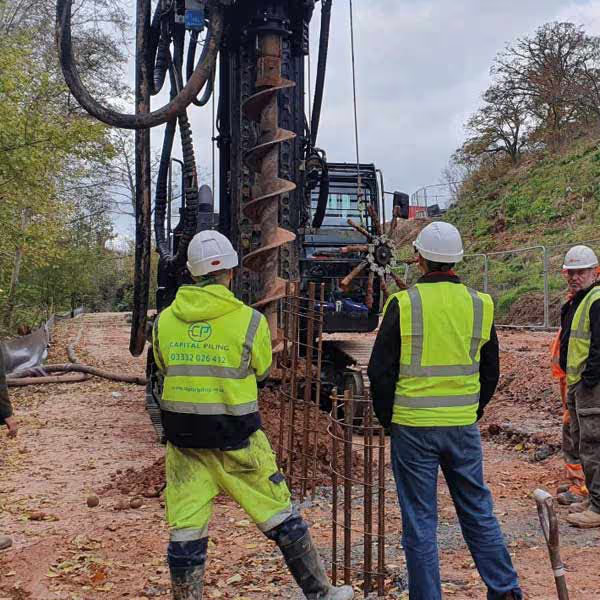
The structural engineer calculates the reinforcement requirements based on the loads and forces the pile needs to resist in service, taking into account the structural contribution of the permanent steel casing. For a straightforward axially loaded pile in a residential or light commercial application, the cage is typically relatively simple, with a modest number of longitudinal bars at moderate diameter held in position by helical binding wire at regular intervals. Where the pile is subject to lateral loading, bending moments from retained ground or wind loading, or tension forces from uplift, the reinforcement requirements increase and the cage design becomes more detailed.
Once the steel casing has been driven to the required depth and the set criterion has been achieved, the reinforcement cage is lowered into the casing before concreting begins. Because the permanent casing provides a clean, stable bore that is entirely independent of the surrounding ground conditions, cage placement in an SCD driven pile is more straightforward than in a bored pile. There is no workability window to manage in the same way because the cage is placed before concreting rather than into wet concrete. The cage is positioned to the correct depth and orientation, checked against the structural drawings, and concrete is then poured to fill the casing around it, with the casing remaining in place as a permanent structural component of the finished pile.
How reinforcement requirements vary across different applications and loading conditions
On a residential project with modest vertical loads, a straightforward cage with a small number of longitudinal bars is typically sufficient. The permanent casing contributes to the structural capacity of the pile, and the engineer accounts for this in the design, which often results in a lighter reinforcement specification than would be needed for a bored pile carrying the same load.
On a commercial project with significant column loads, lateral forces, or piles supporting retaining structures, the reinforcement design is considerably more involved. Capital Piling works closely with structural engineers on these projects to make sure the cage specification is practical to fabricate and install within the constraints of the casing diameter and the site conditions, as well as being structurally adequate for the loads involved. For clients who do not have a structural engineer appointed, Capital Piling's in house design team can take on the full reinforcement and foundation design, coordinating the pile specification with the ground beam and RC slab design above as a single integrated exercise rather than separate workstreams that need to be reconciled later.
The technical specifications that govern reinforcement design for SCD driven piles
Reinforcement bars in SCD driven pile cages are typically high yield steel to Grade 500B in accordance with BS 4449. Bar diameters for the main longitudinal bars commonly range from 16mm to 40mm depending on the structural loads, with helical binding wire typically between 8mm and 12mm diameter. The number of longitudinal bars and their spacing around the perimeter are determined by the structural design in accordance with the minimum and maximum reinforcement ratios specified in BS EN 12699 and the relevant Eurocode.
Because the steel casing remains permanently in the ground, the engineer needs to confirm that the casing material specification and wall thickness are consistent with the assumptions made in the structural calculations. The long term performance of the casing in the specific ground chemistry identified by the ground investigation also needs to be considered. Where the investigation identifies aggressive ground conditions such as elevated chloride or sulphate levels, the implications for the long term integrity of the steel casing need to be assessed and factored into the design before installation begins.
What to watch out for in reinforcement design and cage installation for SCD driven piles
Cage fabrication quality needs to be checked before installation begins. Bars out of position, incorrect spacers, wrong cage diameter, or insufficient projection above the pile head are all issues that are straightforward to identify and correct before the cage goes into the casing and considerably more difficult to address afterwards. Capital Piling carries out a pre-installation check of the cage dimensions and detailing against the structural drawings as standard before any cage is placed.
The projection of reinforcement above the pile head after cropping is a detail that needs to be confirmed before installation begins rather than measured up afterwards. The projecting bars must achieve the required lap length within the ground beam or RC slab above, and if the projection is insufficient the connection cannot be formed as designed without remedial work. Capital Piling works closely with structural engineers to make sure these details are resolved before installation begins, and for clients who do not yet have a structural engineer in place, our in house design team can take care of the full foundation design from ground investigation review through to pile specification and groundworks detailing, keeping everything under one roof and removing the coordination risk entirely.