Other Servces
Overview
Key Points
How It Works
When & Where It’s Used
Technical Details
Considerations
Contact information
Role of Reinforcement in CFA Piles
Reinforcement in CFA (Continuous Flight Auger) piling is used to enhance the structural capacity of the pile and ensure it can safely transfer loads from the structure into the ground. While the concrete provides the main compressive strength, steel reinforcement is introduced where additional tensile, bending, or shear resistance is required.
The need for reinforcement depends on factors such as structural loading, ground conditions, and pile depth. In many cases, CFA piles are lightly reinforced, but heavily loaded or structurally demanding applications may require full-length reinforcement cages.
At a high level, reinforcement is not a fixed requirement for every CFA pile, but a design decision based on geotechnical and structural engineering input.
Why Reinforcement Is Used in CFA Piling
Reinforcement is typically included in CFA piles to improve resistance against bending moments and tensile forces, particularly in conditions where lateral loads or structural movement may occur. This is especially important in taller buildings or structures subject to uneven loading.
In many cases, CFA piles rely primarily on concrete for compressive strength, with reinforcement added only in the upper section of the pile where stresses are highest. This allows for efficient use of materials while still maintaining structural performance.
The extent of reinforcement is always determined by design requirements and ground conditions, meaning there is no universal reinforcement pattern across all CFA piling projects.
Installing Reinforcement into Fresh Concrete
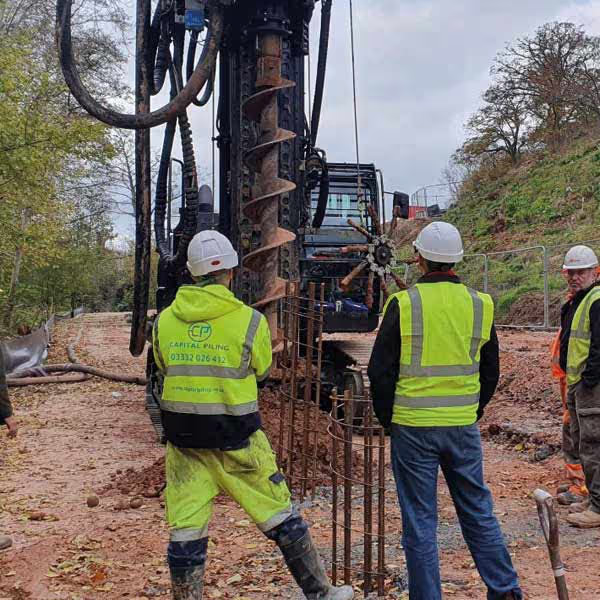
In CFA piling, reinforcement is typically installed immediately after the concrete has been placed through the hollow auger stem. As the auger is withdrawn and the pile is formed, a steel reinforcement cage is inserted into the wet concrete before it sets.
The timing of insertion is critical to ensure the reinforcement is fully embedded and correctly positioned within the pile. In deeper piles, guidance systems or vibration methods may be used to assist placement.
Because CFA piles are formed in a continuous process, reinforcement design must account for the speed of installation and the setting characteristics of the concrete to ensure proper integration.
Structural Conditions Requiring Reinforced CFA Piles
Reinforcement is commonly required in CFA piling where piles are subjected to bending forces, such as in structures with eccentric loading or lateral ground movement. This includes retaining structures, basements, and multi-storey buildings.
It is also used where ground conditions may introduce variable loading along the pile length, requiring additional structural resistance in specific zones of the pile.
In simpler applications with predominantly axial loading and stable ground conditions, reinforcement may be reduced or limited to the pile head, depending on engineering design.
Design and Structural Considerations
The design of reinforcement in CFA piles is governed by structural load calculations and geotechnical data. Engineers determine where tensile and bending stresses are likely to occur and design reinforcement cages accordingly.
Reinforcement may be full-length or partial, depending on whether loads are distributed evenly or concentrated near the pile head. The diameter, spacing, and configuration of steel bars are specified to meet structural performance requirements.
Proper coordination between concrete placement and reinforcement installation is essential, as delays or misalignment can affect pile integrity and load transfer performance.
Practical and Installation Constraints
While reinforcement improves structural performance, its installation must be carefully managed within the CFA process. Difficulties can arise if the reinforcement cage is too large or rigid to be inserted into freshly cast concrete.
Ground conditions and drilling stability can also influence reinforcement effectiveness, particularly if the bore collapses or concrete flow is inconsistent during installation.
Ultimately, reinforcement requirements must balance structural demand with practical installation constraints to ensure the CFA pile performs as intended in real site conditions.