Structuring the Order of Foundation Activities
Sequencing groundworks and piling is the process of planning and organising the order in which site preparation, piling, excavation, and foundation construction activities take place. The correct sequence is essential to ensure that each stage is completed safely, efficiently, and in line with the structural design.
Because piling and groundworks are closely linked, the sequence determines how smoothly the transition occurs from ground preparation to foundation installation. Poor sequencing can lead to delays, rework, or safety risks on site.
At a high level, sequencing ensures that all foundation-related activities happen in the correct order to support safe and efficient construction delivery.
Dependency Between Construction Stages
Groundworks and piling activities are interdependent, meaning one stage often cannot proceed without the completion of another. For example, piling must usually be completed before excavation for pile caps or ground beams begins.
Site preparation, setting out, and working platforms typically come first, followed by piling operations, and then subsequent excavation and concrete works.
Understanding these dependencies is critical to avoid clashes between trades and to maintain a smooth construction programme.
Establishing the Construction Flow
The sequencing process begins with a construction programme that outlines each stage of groundworks and piling. This programme is based on the design requirements, ground conditions, and project constraints.
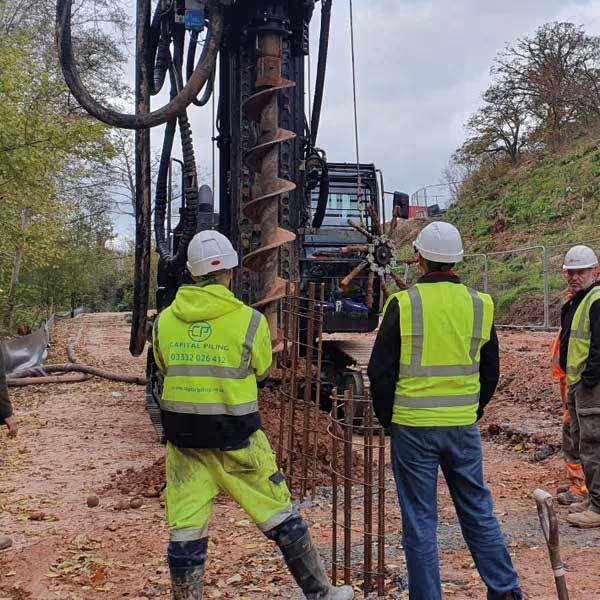
Initial activities include site clearance, ground preparation, and setting out of pile positions. Once the site is ready, piling operations are carried out according to the foundation design.
After piling is complete, excavation, pile caps, ground beams, and slab construction follow in a structured order, ensuring that each element is built on a stable and prepared base.
Applied Throughout Foundation Construction Projects
Sequencing is used on all projects involving piling and groundworks, from small residential developments to large commercial and infrastructure schemes.
It is particularly important on complex sites where multiple foundation areas are being constructed simultaneously or where access and logistics are limited.
Proper sequencing is essential from the earliest planning stages through to final foundation completion.
Programme Logic and Construction Constraints
Sequencing is influenced by technical constraints such as curing times for concrete, ground stability requirements, and equipment access limitations.
Critical path activities, such as piling and excavation, must be carefully managed to avoid delays that can impact the overall project timeline.
Coordination between design requirements and construction methodology ensures that sequencing aligns with both engineering intent and site realities.
Efficiency, Safety, and Coordination
Poor sequencing can lead to site congestion, rework, or unsafe working conditions, particularly where multiple foundation activities overlap.
Effective coordination between engineers, site managers, surveyors, and subcontractors is essential to maintain a safe and efficient workflow.
Ultimately, correct sequencing of groundworks and piling ensures that foundation construction progresses in a controlled, logical, and efficient manner from start to finish.