Other Servces
Overview
Key Points
How It Works
When & Where It’s Used
Technical Details
Considerations
Contact information
Determining whether a site is suitable for SFA piling is a key step in planning any foundation works. While the method is widely used across residential and urban construction, its effectiveness depends on how well it aligns with the specific conditions of the site.
Suitability is not based on a single factor. It involves understanding access, ground conditions, structural requirements and how the work will be carried out in practice. Taking all of these into account helps ensure that the method is not only technically appropriate, but also practical to deliver.
What defines a suitable site
A suitable site for this type of piling is one where the installation can be carried out in a controlled and efficient way.
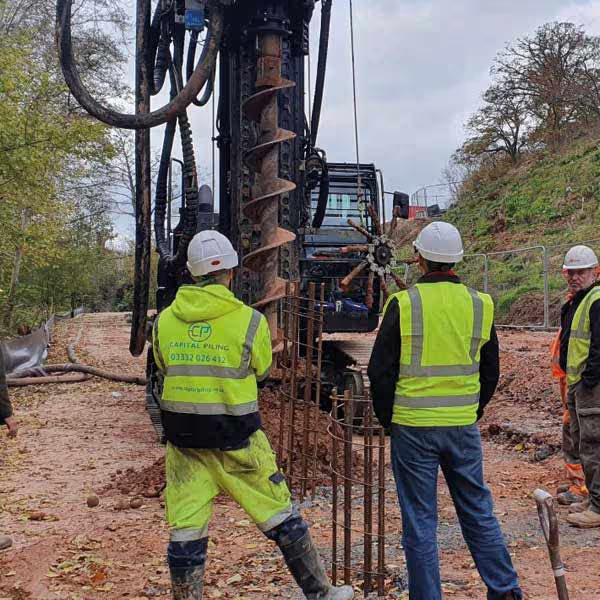
Access is often a key factor. Sites that are restricted or difficult to reach are often well suited to the use of sectional equipment, as it allows the work to be adapted to the available space.
Ground conditions are equally important. The soil needs to be capable of maintaining a stable bore during drilling, allowing the piles to be formed without the need for more complex support systems.
The overall layout of the site, including proximity to existing structures, also plays a role in determining whether this approach is appropriate.
Assessing suitability in practice
Assessing whether a site is suitable typically involves reviewing available information and understanding how the piling process will interact with the conditions on site.
This may include looking at ground investigation data, structural drawings and access constraints. From there, a judgement can be made on whether the method can be carried out efficiently and safely.
In many cases, the decision is not simply whether the system can be used, but whether it offers the most practical solution compared to other available approaches.
Types of sites where it works well
This method is commonly suited to residential and urban environments, where space is limited and construction is taking place close to existing buildings.
It is often used on sites with restricted access, such as rear gardens or infill plots, where larger piling systems would not be practical. It also works well in locations where controlling noise and vibration is important.
Where these conditions are present, the method provides a reliable way of installing foundations without introducing unnecessary disruption.
Ground and structural considerations
From a technical perspective, suitability depends on how the ground behaves during drilling and how loads will be transferred into deeper layers.
This includes confirming that the soil can support an open bore, identifying suitable founding depths and ensuring that the piles can be designed to meet the structural requirements of the project.
These factors need to be considered together, as they influence both the design and how the work is carried out on site.
Making the right decision early
Assessing site suitability early in the process helps avoid complications later on.
If the method is not well suited to the site, it can lead to delays, additional costs or the need to change approach during construction. By understanding the site conditions in advance, it becomes much easier to select a solution that can be delivered efficiently.
For many projects, particularly those with access constraints or existing structures, this type of piling offers a practical and reliable option when the conditions are right.