Other Servces
Overview
Key Points
How It Works
When & Where It’s Used
Technical Details
Considerations
Contact information
Understanding Spoil Generation in CFA Piling
In CFA (Continuous Flight Auger) piling, spoil—also referred to as arisings—is the soil that is removed from the ground during the drilling process. As the auger penetrates the ground, it continuously brings soil to the surface, which must be managed throughout the installation.
Because CFA piling is a displacement and extraction-based method, it typically generates a steady flow of spoil rather than large excavated volumes at once. This requires ongoing handling and coordination during piling operations to keep the site efficient and safe.
At a high level, spoil management is an important part of CFA piling logistics, as it directly affects site cleanliness, access, productivity, and environmental compliance.
Continuous Generation of Excavated Material
CFA piling produces spoil continuously as the auger is drilled and withdrawn from the ground. The volume and consistency of this material can vary depending on soil type, with clay, sand, or mixed ground producing different characteristics of arisings.
Because the process is ongoing, spoil must be managed in real time rather than in isolated excavation cycles. This requires careful planning of site layout, plant movement, and storage or removal routes.
Effective spoil management helps prevent site congestion and ensures that piling operations can continue without interruption.
Handling and Removing Arisings During Installation
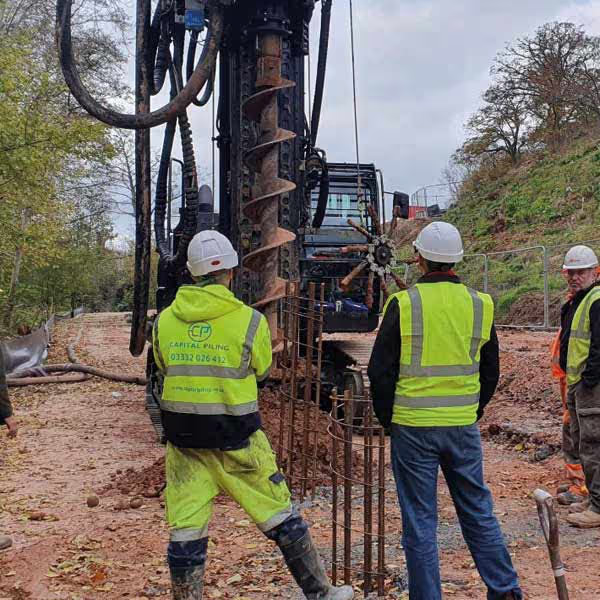
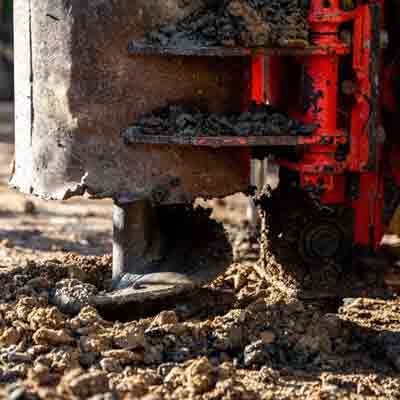
As the auger rotates and advances into the ground, soil is transported upward along the flight of the auger and deposited at the surface. This material is typically collected close to the piling rig for immediate handling.
From there, spoil is either temporarily stockpiled in designated areas or loaded directly into haulage vehicles for removal from site. The method used depends on site constraints, access conditions, and project logistics.
Because CFA piling is a continuous process, spoil removal must be closely coordinated with drilling activity to ensure that material does not obstruct equipment or restrict movement around the working area.
Managing Spoil on Constrained and Urban Sites
Spoil management is particularly important on urban and restricted-access sites where available space is limited. In these environments, efficient handling of arisings is essential to maintaining safe and productive working conditions.
CFA piling is frequently used on residential and commercial developments where multiple piles are installed in sequence, generating a consistent stream of spoil that must be carefully controlled throughout the programme.
It is also relevant on sites with environmental restrictions, where spoil disposal must comply with local regulations and material classification requirements.
Soil Type and Volume Considerations
The nature of spoil generated during CFA piling is directly influenced by ground conditions. Cohesive soils such as clay tend to produce more uniform arisings, while granular or mixed soils may result in more variable material.
Spoil volume is generally related to pile diameter and depth, with deeper or larger-diameter piles producing higher quantities of excavated material. This must be accounted for in logistics planning and disposal arrangements.
In some cases, spoil may require testing or classification before disposal, particularly on brownfield sites where contamination risks may be present.
Logistics, Safety, and Environmental Control
Spoil management must be carefully planned to avoid site congestion and maintain safe working conditions around the piling rig. Poor handling of arisings can restrict access and slow down installation progress.
Environmental compliance is also a key consideration, as spoil may need to be transported and disposed of in accordance with local regulations. This is especially important on contaminated or previously developed land.
Ultimately, effective spoil management ensures that CFA piling operations remain efficient, compliant, and safe, while minimising disruption to the wider construction programme.