Other Servces
Overview
Key Points
How It Works
When & Where It’s Used
Technical Details
Considerations
Contact information
CFA Piling Across Varying Ground Conditions
CFA (Continuous Flight Auger) piling is a foundation method that can be used in a wide range of ground conditions where bored piles are required. It is particularly effective in soils where maintaining bore stability is important during installation, as the auger supports the ground while it advances.
The method is commonly used in both cohesive and granular soils, provided the ground conditions allow for continuous drilling without collapse. This makes CFA piling suitable for many urban, commercial, and infrastructure projects where ground conditions may vary across a site.
At a high level, CFA piling is selected when deeper foundations are needed and where ground conditions require a controlled, vibration-free installation process that can adapt to different soil layers.
Ground Conditions Typically Suited to CFA Piling
CFA piling is generally suitable for cohesive soils such as clays, as well as certain granular soils where the bore can remain stable during continuous drilling. These conditions allow the auger to advance smoothly while maintaining support to the surrounding ground.
The method is also effective in variable ground conditions where soil layers change with depth. Because the pile is formed continuously during extraction and concrete placement, it can adapt to differing resistance levels encountered during installation.
However, CFA piling may be less suitable in very unstable, water-bearing, or obstruction-heavy ground without additional engineering controls. Site-specific investigation is essential to confirm feasibility.
Ground-Driven Installation Behaviour
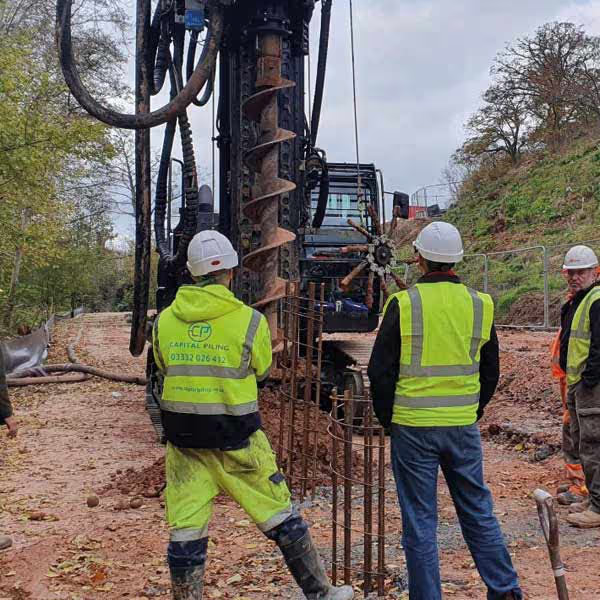
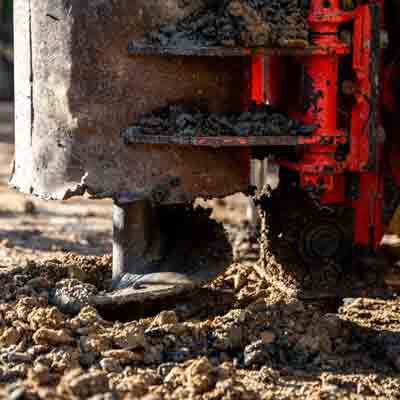
CFA piling works by drilling a continuous flight auger into the ground to the required depth. As the auger penetrates the soil, it supports the bore walls, reducing the risk of collapse in suitable ground conditions.
Once the target depth is reached, concrete is pumped through the hollow stem of the auger as it is slowly withdrawn. This process ensures the bore remains filled and stable throughout installation.
Because the method relies on continuous support of the soil, its suitability is closely linked to how the ground responds during drilling, particularly in terms of stability and groundwater conditions.
Sites Requiring Deep Foundations in Variable Soils
CFA piling is commonly used on sites where ground conditions are not suitable for shallow foundations due to weak or compressible soils. It is particularly effective where deeper load-bearing strata must be reached.
The method is widely used in residential developments, commercial buildings, and infrastructure projects where soil conditions vary across the site footprint. Its adaptability makes it suitable for both uniform and inconsistent ground profiles.
It is also frequently selected for urban environments where vibration control is important and where ground conditions must be managed without disturbing surrounding structures.
Soil Interaction and Structural Formation
The performance of CFA piling is influenced by how the surrounding soil behaves during auger penetration and concrete placement. Stable soils allow for consistent bore formation, while weaker or variable soils require careful control of drilling and extraction rates.
Load transfer is achieved through both shaft friction and end bearing, depending on the ground conditions and pile design. The balance between these mechanisms is determined by the geotechnical profile of the site.
Ground investigation data is essential in determining whether CFA piling is suitable and in defining parameters such as pile depth, diameter, and reinforcement requirements.
Ground Stability and Installation Constraints
Although CFA piling is suitable for many ground types, its success depends on maintaining bore stability during drilling and concrete placement. Highly unstable or water-logged soils may require additional engineering controls or alternative methods.
Obstructions such as old foundations, rubble, or buried services can impact installation and may limit the effectiveness of the continuous auger process. Early site investigation helps identify these risks.
Ultimately, CFA piling suitability is determined by matching ground conditions with the installation method’s ability to maintain stability and achieve consistent pile formation throughout the depth of the pile.