Why ground conditions determine whether CFA piling is right for your site
Not every site is suitable for CFA piling, and understanding why comes down to what is in the ground. The soil type, its strength, its variability, and whether groundwater is present all have a direct bearing on whether a continuous flight auger can advance consistently, form a stable bore, and produce a pile that performs as designed. Getting this assessment right before design begins is what separates a smooth piling programme from an expensive one.
The soil types where CFA piling is most effective
CFA piling performs best in cohesive soils such as soft to firm clays and silts. London Clay, which is widespread across the south east of England, is one of the most common and well suited ground conditions for this method. The auger advances smoothly through cohesive soils, the bore remains naturally stable during drilling, and the finished pile develops strong shaft friction capacity along its full length. In cohesive ground, shaft friction is typically where the majority of the pile's load carrying capacity comes from, and CFA piling mobilises this effectively.
Loose to medium dense sands and gravels are also well suited to CFA piling. Because concrete is pumped under pressure through the hollow auger stem as it is withdrawn, the bore never needs to remain open and unsupported. This is a critical advantage in granular soils where an open bore would be at serious risk of collapse, particularly below the water table. CFA handles these conditions reliably where open bore methods like SFA piling would struggle.
Mixed and variable ground profiles, where different soil types are encountered at varying depths, are also manageable with CFA piling. The method does not depend on the ground maintaining a stable open bore, so it adapts well to changing conditions as the auger advances through the profile.
How CFA piling works in relation to the ground
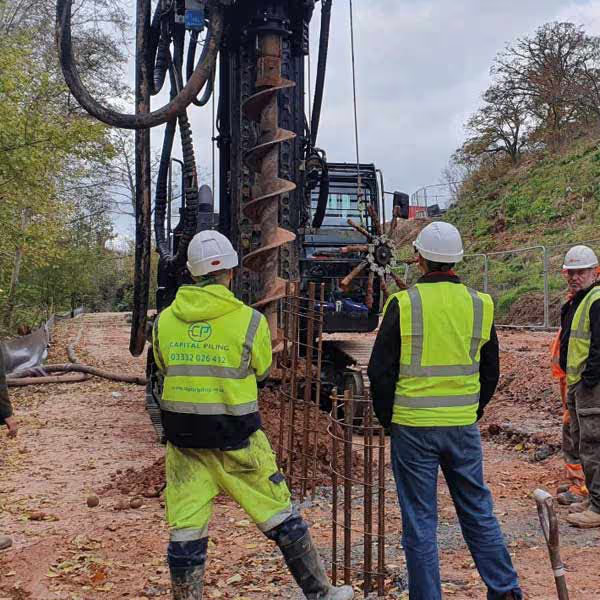
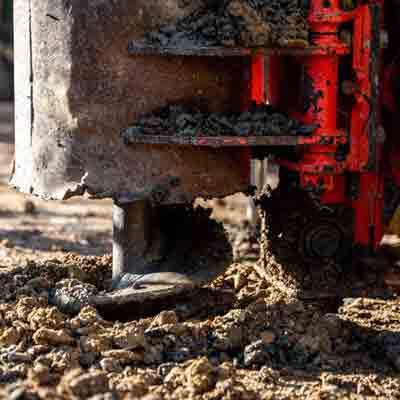
As the auger rotates into the ground, the soil type it encounters directly affects how the installation proceeds. In cohesive soils, the auger advances under rotation with the soil retained on the flights, keeping the bore stable. In granular soils, the pressurised concrete pumped through the hollow stem as the auger is withdrawn compensates for the lack of natural bore stability, filling the void before any collapse can occur. In variable ground, the rig operator and monitoring system respond to changes in drilling resistance and concrete volume, adjusting the installation parameters to maintain pile quality throughout.
The projects and sites where ground conditions make CFA the right choice
CFA piling is regularly specified on new build housing developments, apartment schemes, commercial buildings, and residential extensions across the UK, particularly where London Clay or granular soils are present. It is the go to method on urban sites across the south east where cohesive soils dominate the ground profile and low vibration is essential. On brownfield sites underlain by made ground, CFA piling can be used effectively provided the ground investigation has characterised the made ground composition, depth, and any chemical risks present. Where sulphate bearing soils or contaminated ground is identified, the concrete specification is adapted accordingly and CFA piling remains a viable and practical solution.
The technical factors ground conditions influence in CFA pile design
Ground conditions determine pile diameter, depth, concrete specification, and reinforcement design. In strong cohesive soils, shorter piles at smaller diameters can achieve the required load capacity. In weaker or more variable ground, greater depth is needed to develop sufficient shaft friction. Where the ground investigation identifies chemically aggressive soils, such as those with elevated sulphate content common on brownfield sites, a sulphate resisting cement or modified concrete mix is specified to protect the pile from chemical attack over its design life. Groundwater level, soil permeability, and soil chemistry are all factored into the concrete specification and cover requirements, and all of this is informed directly by the ground investigation data specific to your site.
What to watch out for when assessing ground suitability for CFA piling
Very hard ground, rock, or cemented soil layers can prevent the auger from reaching the design depth, making CFA piling unworkable and potentially requiring a change of method mid programme. Buried obstructions including old foundations, dense brickwork, and large boulders cause auger refusal and cannot be bypassed by CFA equipment. Very fine running sands below the water table, while manageable in many granular conditions, can be so unstable that consistent drilling and a well formed pile become difficult to achieve. Made ground with uncharacterised composition carries the risk of unexpected obstructions or chemical aggression if a thorough ground investigation has not been carried out first. None of these issues are insurmountable, but all of them need to be identified through investigation before the design is finalised rather than discovered once the rig is on site.