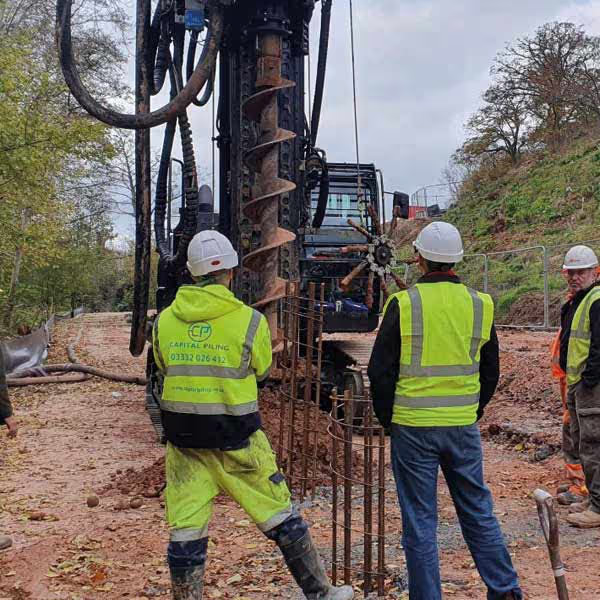
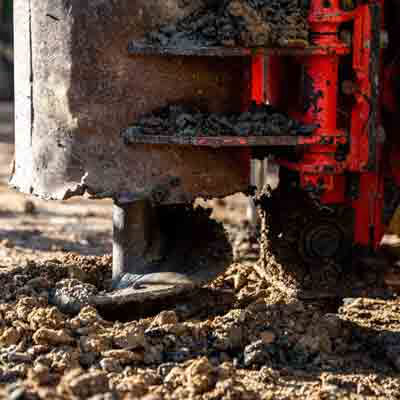
Why ground conditions are particularly important when considering SCD driven piling
Every piling method has ground conditions where it performs at its best and conditions where it is less suitable or completely unworkable. For SCD driven piling the ground conditions are especially significant because the method was specifically developed to address situations where bored piling techniques struggle. Understanding which ground types suit SCD driven piling, and why, is the starting point for any informed conversation about whether it is the right method for your site.
The ground conditions where SCD driven piling is most effective
SCD driven piling performs best in loose to medium dense granular soils including sands, gravels, and mixed alluvial deposits where maintaining a stable open bore would be unreliable. The steel casing eliminates the bore stability problem entirely by providing a continuous rigid liner that holds the profile of the pile open regardless of what the surrounding ground wants to do. Sites with a persistently high water table, which would cause significant problems for open bore methods, are well suited to SCD piling for the same reason.
Made ground of variable composition, commonly encountered on brownfield and previously developed urban sites, is another ground type where SCD driven piling can be an effective solution. Where the made ground contains rubble, voids, or pockets of loose material that would cause problems for a bored auger, the driven casing advances through it by displacement rather than excavation, which is a more reliable approach in these conditions.
Soft alluvial deposits, river gravels, and coastal sands are all ground types where SCD piling has a strong track record. These are the kinds of conditions found on waterside developments, riverside regeneration projects, and low lying urban sites across the UK, and SCD piling is regularly specified on these projects precisely because the ground conditions demand a method that does not rely on bore stability.
How the steel casing interacts with different soil types during driving
As the steel casing is driven into the ground the soil around it is displaced outwards rather than removed. In granular soils this displacement compacts the surrounding material and increases the lateral stress in the ground around the pile shaft, which enhances the shaft friction capacity of the finished pile compared to what a bored pile of the same diameter in the same ground would achieve. This is one of the reasons SCD piling can deliver strong load carrying performance in granular ground conditions where bored methods might produce more modest results.
In loose fills and made ground the driving process pushes obstructions and voids aside rather than having to drill through or around them. The casing advances progressively with each blow of the hammer, and the driving resistance recorded at each stage gives the installation team a continuous picture of what the casing is passing through. Changes in driving resistance signal transitions between different materials or the presence of unexpected conditions, allowing the team to respond before the pile reaches its final depth.
The site types and locations where SCD piling is most regularly specified for ground condition reasons
SCD driven piling is regularly specified on waterside and riverside development sites where alluvial deposits, river gravels, and soft silts are the dominant ground conditions. It is also common on former industrial sites where made ground of unknown composition overlies natural soils and where the risk of encountering obstructions, voids, or contaminated material makes a bored approach less reliable.
Sites in low lying areas with a high seasonal water table, coastal development sites with sandy or shelly ground conditions, and urban brownfield sites with a history of multiple phases of development are all locations where the ground conditions frequently point towards SCD driven piling as the most appropriate foundation method.
How ground conditions affect pile design and driving criteria for SCD piling
The ground investigation data determines the pile diameter, design depth, and the expected driving resistance profile for SCD piling on a specific site. In granular soils the geotechnical engineer uses SPT N values or CPT cone resistance values from the investigation to estimate shaft friction and end bearing capacity and to predict the driving resistance the casing should encounter at various depths.
The set criterion, which is the measured penetration of the casing per a defined number of hammer blows at the end of driving, is derived from these calculations and confirmed before installation begins. It provides the installation team with an objective and measurable indicator of when each pile has reached adequate bearing resistance, which is particularly valuable in variable ground where the design depth alone may not be a reliable indicator of pile performance.
Ground conditions that make SCD driven piling difficult or unsuitable
Whilst SCD driven piling handles a wide range of challenging ground conditions effectively, it has its own limitations. Very hard ground, rock, or heavily cemented layers can prevent the casing from advancing, causing driving refusal before the design depth is reached. Unlike a bored auger which can sometimes cut through moderately hard material, a driven casing has no mechanism to penetrate rock or very dense cemented soils without specialist rock breaking equipment.
Highly organic soils such as peat present a different challenge. The compressible and variable nature of peat means that driven piles in these conditions may be subject to negative skin friction, where the settling peat exerts a downward drag force on the pile shaft that adds to the structural load rather than contributing to its capacity. Where significant peat layers are identified in the ground investigation, the pile design needs to account for this effect explicitly. A thorough ground investigation is always the right starting point for confirming whether SCD driven piling is appropriate for the specific conditions at your location.