Other Servces
Overview
Key Points
How It Works
When & Where It’s Used
Technical Details
Considerations
Contact information
Understanding Tolerances and Quality Control in CFA Piling
Tolerances and testing in CFA (Continuous Flight Auger) piling are used to ensure that installed piles meet the required design specifications and perform as intended under structural loads. Because CFA piles are formed in situ during drilling and concrete placement, maintaining control over position, depth, and alignment is essential.
Tolerances define the acceptable limits for variation in pile position, verticality, diameter, and depth. These limits help ensure that even with minor site variations, the pile still performs safely within its design assumptions.
At a high level, testing provides verification that the installed piles achieve the required load-bearing capacity and that construction quality is consistent across the project.
Key Installation Tolerances in CFA Piling
CFA piling must be installed within defined tolerances for position and vertical alignment to ensure the pile remains within the structural footprint and load path of the design. Small deviations are expected during drilling, but these must remain within allowable engineering limits.
Depth tolerance is also critical, as piles must reach the correct founding level or bearing stratum to achieve their designed capacity. Inadequate depth can significantly reduce performance and must be carefully controlled during installation.
Diameter and concrete consistency are also monitored to ensure the pile maintains its intended structural properties throughout its length.
Monitoring Accuracy During Installation
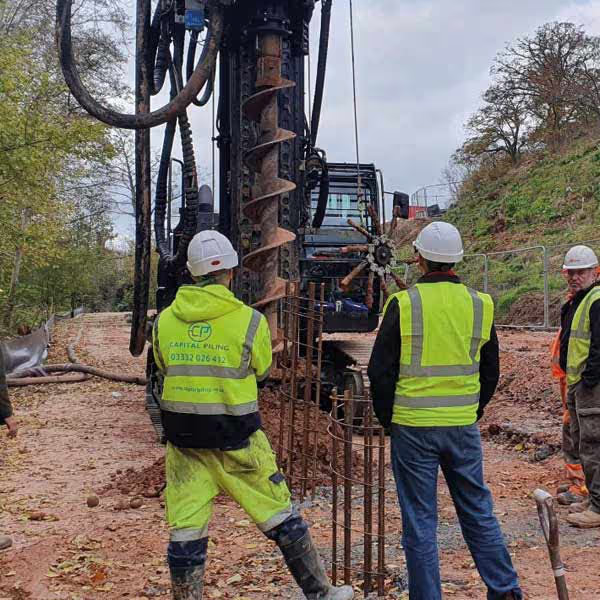
During CFA piling, tolerances are controlled through continuous monitoring of rig position, auger penetration depth, and rotation during drilling. Modern piling rigs often include electronic systems that track and record these parameters in real time.
As concrete is pumped through the hollow auger, pressure and volume are also monitored to ensure the bore remains fully filled and no voids are created. This helps maintain pile integrity during extraction of the auger.
Any deviation outside allowable tolerances is recorded and assessed, with corrective action taken if necessary to ensure compliance with design requirements.
Projects Requiring Verified Structural Performance
Tolerance control and testing are required on all CFA piling projects, but they become especially important in developments where structural loads are high or where ground conditions vary significantly.
They are commonly applied in multi-storey buildings, infrastructure projects, and developments where piles must transfer loads into deeper or variable strata with high reliability.
Testing requirements are also critical in urban environments where adjacent structures may be sensitive to ground movement or where construction quality assurance is closely regulated.
Load Testing and Verification Methods
CFA piles are typically verified through load testing methods such as static load tests, dynamic load tests, or integrity testing. These tests confirm that the pile can safely carry the design load without excessive settlement or structural failure.
Pile integrity testing may also be used to assess the uniformity of concrete placement and identify any potential defects such as voids or inclusions within the pile shaft.
The frequency and type of testing are defined by project specifications, design requirements, and relevant engineering standards.
Factors Affecting Tolerance Compliance and Testing
Ground conditions can significantly influence the ability to maintain tight tolerances during CFA piling. Variable soils, obstructions, or groundwater conditions may impact drilling accuracy and concrete placement.
Equipment calibration and operator skill also play an important role in maintaining installation quality, as CFA piling relies on continuous control during drilling and extraction.
Testing requirements must balance assurance of quality with project efficiency, ensuring that sufficient verification is carried out without unnecessary delays or cost increases.