Where SCD driven piling is used and why it is specified
SCD driven piling is not a niche or specialist method reserved for unusual situations. It is a practical, versatile foundation solution that is regularly specified across a broad range of construction projects in the UK. Understanding the typical applications helps project teams identify early whether SCD driven piling is likely to be relevant to their project and what the method can deliver in the contexts where it is most commonly used.
The project types and situations where SCD driven piling is most frequently specified
SCD driven piling is regularly used on residential developments, commercial buildings, infrastructure projects, and waterside or riverside schemes where ground conditions favour a driven over a bored approach. It is specified when the ground investigation reveals conditions that make bored piling unreliable, when programme requirements demand a method that can confirm pile capacity through measurable driving resistance during installation, and when the structural loads and ground profile together point towards driven piling as the most efficient and reliable foundation solution.
It is also used as a practical alternative when bored piling has encountered unexpected ground conditions on site that prevent successful installation, making it a method that solves problems as well as one that is planned from the outset.
How the method is applied across different project types
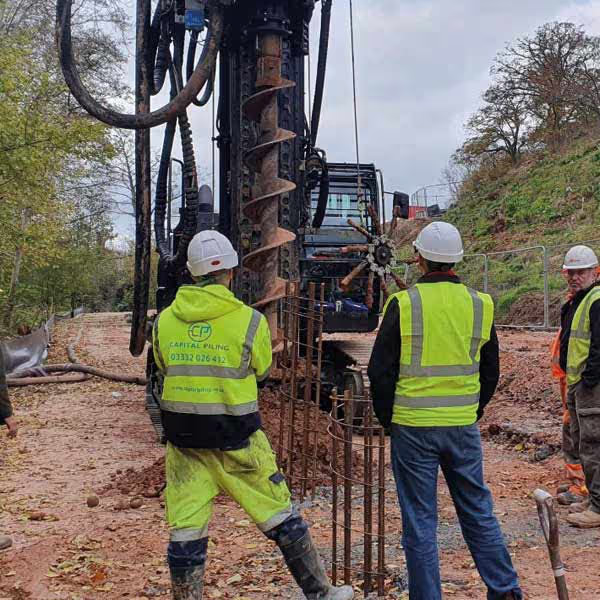
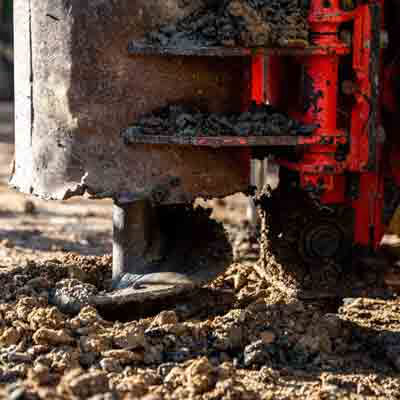
The application of SCD driven piling follows the same fundamental process regardless of the project type. The steel casing is driven to the required depth or set, the reinforcement cage is placed, and concrete is poured to form the structural pile. What changes across different applications is the scale of the operation, the pile sizes and depths involved, the layout and spacing of the piles, and the specific ground conditions being addressed.
On a residential development the piles may be relatively modest in diameter and depth, arranged in rows beneath load bearing walls and connected by ground beams and RC slabs above. On a commercial project with significant column loads the piles may be larger and deeper, arranged in groups beneath pile caps at each column position. On an infrastructure project such as a bridge abutment or retaining wall, the pile layout and loading conditions may be more complex, with lateral loads and bending moments playing a more significant role in the design alongside the vertical axial loads.
The specific contexts where SCD driven piling is most commonly encountered
Waterside and riverside developments are one of the most common contexts for SCD driven piling. The soft alluvial soils, river gravels, and high water tables typically found in these locations create ground conditions that are well suited to the method. Residential and mixed use regeneration projects on former docklands, riverside industrial sites, and coastal development plots regularly specify SCD piling for this reason.
Brownfield and previously developed urban sites with made ground of variable composition are another common application. Where the made ground contains rubble, voids, buried structures, or pockets of loose material, the driven casing advances through these conditions more reliably than a bored auger, making SCD piling a more dependable choice on sites with an uncertain below ground history.
New build housing on low lying sites with poor near surface soils, commercial developments on former industrial land, and infrastructure works in areas with variable or difficult ground conditions are all project types where SCD driven piling appears regularly. Capital Piling carries out SCD piling across residential and commercial projects and the method is one we recommend where the ground conditions and project requirements genuinely suit it.
How pile specifications are matched to different application requirements
The pile specification for any SCD driven piling application is determined by the structural engineer based on the ground investigation data and the loads the pile needs to carry. Pile diameter, design depth, casing specification, reinforcement design, and concrete mix are all tailored to the specific requirements of the project rather than selected from a standard menu.
For applications involving lateral loading, such as piles supporting retaining walls, bridge abutments, or structures subject to significant wind or seismic loading, the reinforcement cage is designed to resist bending moments as well as axial loads. The pile depth in these applications may be governed by the lateral load requirements as much as by the vertical capacity, and the design process needs to consider both simultaneously.
Where driven piles are used in groups beneath pile caps, the group capacity and the interaction between adjacent piles in the group need to be assessed as part of the design. This is particularly relevant in granular soils where the compaction effect of driving one pile can affect the driving resistance and capacity of adjacent piles installed afterwards.
How pile specifications are matched to different application requirements
The pile specification for any SCD driven piling application is determined by the structural engineer based on the ground investigation data and the loads the pile needs to carry. Pile diameter, design depth, casing specification, reinforcement design, and concrete mix are all tailored to the specific requirements of the project rather than selected from a standard menu.
For applications involving lateral loading, such as piles supporting retaining walls, bridge abutments, or structures subject to significant wind or seismic loading, the reinforcement cage is designed to resist bending moments as well as axial loads. The pile depth in these applications may be governed by the lateral load requirements as much as by the vertical capacity, and the design process needs to consider both simultaneously.
Where driven piles are used in groups beneath pile caps, the group capacity and the interaction between adjacent piles in the group need to be assessed as part of the design. This is particularly relevant in granular soils where the compaction effect of driving one pile can affect the driving resistance and capacity of adjacent piles installed afterwards.