Other Servces
Overview
Key Points
How It Works
When & Where It’s Used
Technical Details
Considerations
Contact information
What is SFA piling
SFA piling, or sectional flight auger piling, is a foundation method used to form reinforced concrete piles within the ground by drilling with a sectional auger. The process creates a borehole which is then filled with concrete and reinforcement to form a structural element capable of supporting building loads.
The use of sectional equipment allows the system to be adapted to sites where access or working space is limited, which is one of the main reasons it is widely used across residential and urban construction projects.
Unlike driven piling systems, SFA piling is installed through a controlled drilling process. This reduces vibration and allows work to be carried out in closer proximity to existing structures, making it a practical option where site conditions are more sensitive.
Understanding the method
SFA piling is often selected because it provides a balance between structural performance and practical installation.
It allows piles to be installed in locations where larger systems may not be suitable, while still achieving the load capacity required for most residential and light commercial projects. The method is also adaptable, meaning it can be used across a range of ground conditions where a stable bore can be maintained.
Because of this flexibility, it is commonly used on projects where access, surrounding buildings or site layout would otherwise limit foundation options.
How SFA piling is carried out
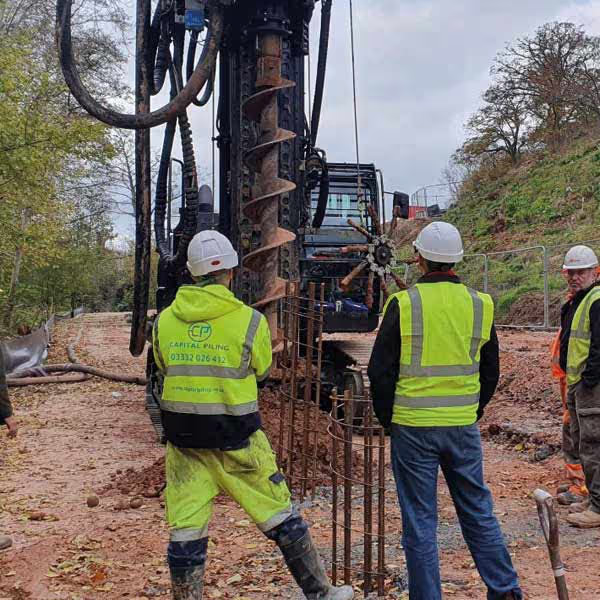
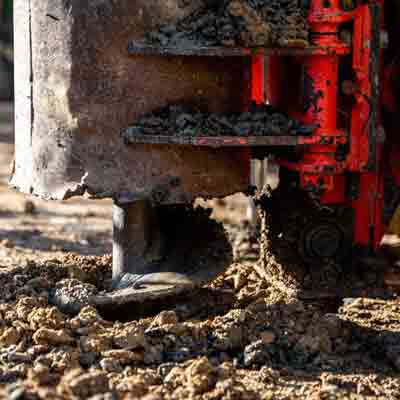
The process begins with a sectional auger drilling into the ground to the required depth. As the auger rotates, it removes soil and forms a borehole.
Once the design depth is reached, the bore is prepared and a reinforcement cage is installed. Concrete is then placed into the bore, forming a reinforced pile that transfers loads into the ground.
The sequence needs to be carried out in a controlled and continuous way to ensure that the bore remains stable and that the finished pile performs as intended.
On many projects, this process is adapted to suit site conditions, particularly where access is restricted or working space is limited.
Typical use of SFA piling
SFA piling is commonly used across residential developments, extensions and low rise commercial projects.
It is particularly well suited to urban environments where reducing vibration is important, and to sites where access restrictions prevent the use of larger piling rigs. The ability to work within tighter spaces makes it a practical solution for projects involving existing structures or constrained layouts.
Where ground conditions are suitable, it provides a reliable method of forming foundations without the disruption associated with more intensive piling techniques.
Practical design and delivery considerations
The performance of SFA piling depends on several factors, including pile diameter, depth and the ground conditions on site.
Rather than relying on standard sizes, these elements are typically determined based on the specific requirements of the project. This allows the foundation to be designed in a way that is both efficient and appropriate for the structure being built.
In practice, the design and installation need to align closely. This is where experience becomes important, as decisions made at the design stage have a direct impact on how the work is carried out on site.
Suitability and project fit
While SFA piling is a versatile method, it is not suitable for every situation.
The ground needs to be capable of maintaining a stable bore during installation, and this may limit its use in certain soil conditions. Access, load requirements and site constraints also need to be considered when deciding whether it is the right approach.
For many projects, particularly in residential and constrained environments, it offers a practical and effective solution. Where there is uncertainty, reviewing the site conditions early and understanding the available options helps ensure the right method is selected.