Understanding when CFA piling is the right foundation solution
CFA piling is not specified on every project, and knowing when it is the right choice comes down to a combination of ground conditions, structural loads, site constraints, and programme requirements. It is typically brought into consideration when near surface soils are too weak or variable to support a shallow foundation, and the building loads need to be transferred to more competent ground at depth. But the decision goes beyond that single trigger, and understanding the full picture of when and why CFA piling is specified helps project teams make better informed decisions at the earliest stages of design.
The situations that most commonly lead to CFA piling being specified
CFA piling is most commonly specified when a ground investigation confirms that near surface soils cannot safely support the structural loads from the building above using conventional shallow foundations. It is also specified when the site environment makes low noise and low vibration essential, when programme efficiency is a priority, and when ground conditions including soft clays, loose sands, or made ground are present at the location.
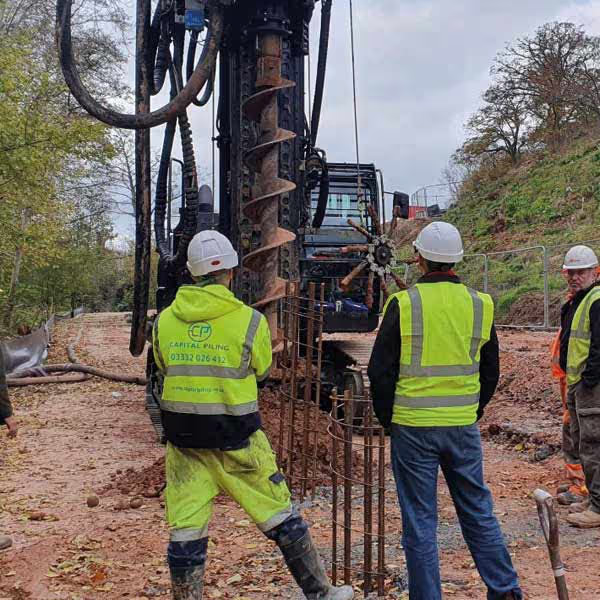
It is the method of choice when the ground profile suits bored cast in-situ construction and when the site has sufficient working space and access for a CFA rig and its associated concrete supply equipment to operate effectively. Where these conditions are met, CFA piling consistently delivers reliable structural performance with minimal disruption.
How the decision to use CFA piling is reached
The decision to specify CFA piling begins with the ground investigation. The geotechnical data gathered from boreholes and soil testing tells the structural engineer what is in the ground, how deep the weak upper soils extend, where suitable bearing strata begins, and what the groundwater conditions are. From this the engineer determines whether piling is required, and if so which method is most appropriate for the ground profile and the structural loads involved.
Where the ground investigation confirms soft to firm cohesive soils, loose to medium dense granular soils, or variable made ground, and where the structural loads exceed what a shallow foundation can carry safely, CFA piling is typically the first method evaluated. If the site access and working space requirements can be met and no significant obstructions or very hard layers are present at depth, CFA piling is usually confirmed as the method of choice.
The project types and locations where CFA piling is most regularly specified
CFA piling is used extensively across new build housing developments, apartment and residential schemes, commercial office and retail buildings, mixed use urban developments, and residential extensions. It is particularly prevalent across London and the south east where London Clay is the dominant soil type and urban development density means low vibration methods are consistently required.
On brownfield sites and previously developed land, CFA piling is regularly specified to deal with made ground of variable composition overlying natural soils. It is also commonly used on sites close to existing structures, party walls, or sensitive buildings where the low vibration characteristics of the method are essential to avoid damage or disturbance during installation.
Capital Piling carries out CFA piling across residential and commercial projects throughout London and the south east, and it is the method we install most regularly across the region.
The technical thresholds that determine when CFA piling becomes necessary
The point at which CFA piling becomes necessary is determined by the relationship between the structural loads imposed by the building and the bearing capacity of the near surface soils. Where the soil bearing capacity is insufficient to support a conventional strip or pad foundation at an economic depth, piling transfers those loads to deeper, more competent ground.
In London Clay, which has a relatively consistent and well understood shear strength profile, CFA piles are typically designed for shaft friction capacity and installed to depths of between six and fifteen metres for residential and light commercial loads. For heavier commercial loads, depths of fifteen to twenty five metres or more may be required. Ground investigation data and structural load calculations together define exactly when and at what specification CFA piling is needed for a specific project.
What to be aware of when assessing whether CFA piling is appropriate
CFA piling is not always the most appropriate method even when ground conditions are broadly suitable. Sites with very restricted access, low headroom, or insufficient working space for a full size CFA rig may be better served by SFA piling or another alternative. Ground containing significant obstructions, rock at shallow depth, or very hard cemented layers can prevent the CFA auger from advancing to the design depth and may require a different approach.
The most important thing is to make sure the method selection is based on a thorough ground investigation and a proper assessment of site constraints rather than assumption or convention. Capital Piling's in house design team can review your ground investigation data, assess the site conditions, and confirm whether CFA piling is the right method for your project before any design work is committed to. Getting that confirmation early is the most straightforward way to avoid method changes and programme disruption further down the line.