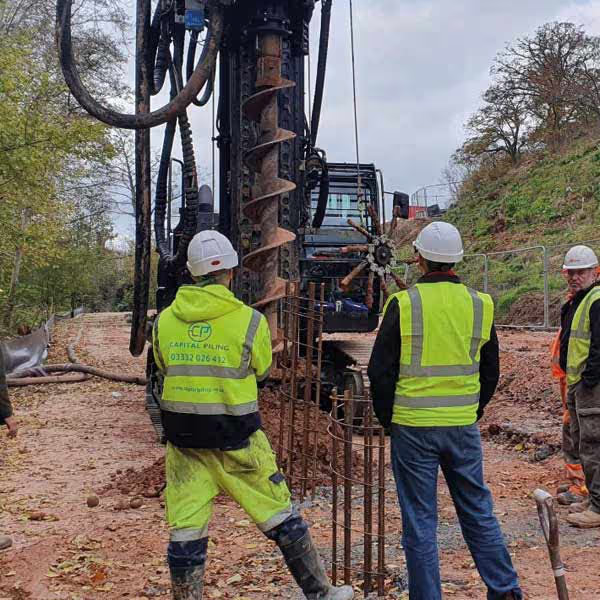
Why urban sites present specific challenges for driven piling and how they are managed
Urban sites are where the constraints on construction activity are greatest and where the consequences of getting things wrong are most immediately felt. Neighbouring properties are close, existing services are dense and not always well documented, working space is limited, and the tolerance of the surrounding community for noise, vibration, and disruption is lower than on an open development site. SCD driven piling is a method that can and does work effectively in urban environments, but doing it well requires more detailed planning, more careful coordination, and a greater awareness of the surrounding context than a straightforward open site demands. We have extensive experience of delivering driven piling in urban and constrained environments, and for clients navigating these challenges for the first time our in house team can provide the support and guidance needed to plan the work properly before it begins.
The specific challenges that urban sites present for SCD driven piling
Working space is typically the most immediately limiting factor on an urban site. The piling rig, the leader frame, the hammer, the concrete pump, and the delivery vehicles all need space to operate, and on a constrained urban plot that space may be significantly less than a standard driven piling setup requires. Equipment selection needs to be confirmed against the actual available working area before mobilisation, and in some cases a compact or low headroom rig configuration is needed to make the method workable within the site constraints.
Proximity to existing structures introduces the risk of vibration induced damage or disturbance during driving, and this risk needs to be assessed and managed before installation begins. Underground services are present in greater density on urban sites than on greenfield locations, and the consequences of striking an unlocated service during driving are severe. Noise is more immediately impactful on urban sites where occupied buildings are close, and working hour restrictions are more likely to apply and more likely to be enforced.
How the challenges of urban driven piling are addressed in practice
Equipment selection is the starting point. We assess the site constraints during the pre-construction stage and select the rig and hammer configuration that is appropriate for the available working space, the required pile sizes, and the access conditions. Where standard equipment cannot fit or operate safely within the site constraints, alternative configurations are evaluated before mobilisation rather than discovered as a problem on the day the rig arrives.
Services detection is carried out comprehensively before any driving begins, combining CAT scanning, GPR survey, and a review of all available utility records. Safe working distances from identified services are established and communicated to the rig operator, and no driving takes place within the exclusion zones without prior agreement with the relevant service authority. On sites where service records are incomplete or unreliable, exploratory excavations may be needed to physically verify the position of critical services before the pile layout is finalised.
Vibration management follows the process set out in the noise and vibration article, with a pre-construction assessment, agreed trigger levels, and real time monitoring at sensitive receptors during driving. On particularly sensitive urban sites, a pre-construction condition survey of neighbouring properties provides a documented baseline that protects all parties in the event of a dispute about damage during the works.
The urban project types where SCD driven piling is regularly carried out
SCD driven piling is regularly carried out on urban infill development sites, brownfield regeneration projects, residential developments in built up areas, and commercial schemes in city centres and established commercial districts. It is used on sites where the ground conditions make bored methods unreliable and the urban constraints need to be managed alongside the technical requirements of the piling programme.
Waterside and riverside urban regeneration projects are a particularly common context, combining the soft alluvial ground conditions that favour driven piling with the dense urban environment that demands careful management of noise, vibration, and access. We have delivered projects in these conditions across London and the south east, and the experience we have built up in managing the specific combination of technical and logistical challenges involved is something we bring to every urban driven piling project we undertake.
The technical standards and assessments that apply to urban driven piling
Noise and vibration from urban driven piling are assessed in accordance with BS 5228 Parts 1 and 2. Vibration levels are expressed as peak particle velocity and compared against the guidance values in BS 5228 and the damage risk criteria in BS 7385 Part 2. Where sensitive structures are present, a structural engineer may be asked to assess the specific vulnerability of those structures to vibration at the predicted levels before driving begins.
Working hour restrictions on urban sites are typically defined by the local planning authority and form part of the planning consent for the development. Compliance with these restrictions is a contractual and legal requirement, and any request to work outside agreed hours needs to be discussed with the local authority and agreed in writing before out of hours driving takes place. Vibration monitoring records produced during the programme provide the documented evidence of compliance that may be required by the planning authority or other regulatory bodies during or after the works.
What to think about when planning SCD driven piling on an urban site
The time invested in pre-construction planning for urban driven piling is never wasted. The more thoroughly the site constraints are understood and addressed before the rig arrives, the more smoothly the programme runs once it begins. Access routes, working platform design, services clearances, vibration assessment, neighbour notification, and equipment selection are all activities that are far more straightforward to deal with on paper than on site under programme pressure, and none of them should be left to be picked up once the contract has started.
Neighbour relations deserve particular attention on urban sites. Proactive communication before work begins, clear information about what the work involves and how long it will last, and a named point of contact for concerns and questions during the programme all contribute to a more cooperative and less contentious working environment. Neighbours who feel informed and respected are considerably less likely to escalate concerns to the planning authority or seek to have work stopped than those who feel ignored or treated as an inconvenience. This is not just good manners. It is good project management, and it is an approach we take seriously on every urban project we deliver. If you are planning driven piling on a constrained urban site and are unsure where to start with the pre-construction planning process, our team is here to help and our in house design service means we can support you from the very first conversation through to a completed foundation.