Other Servces
Overview
Key Points
How It Works
When & Where It’s Used
Technical Details
Considerations
Contact information
Managing Construction Near Existing Buildings
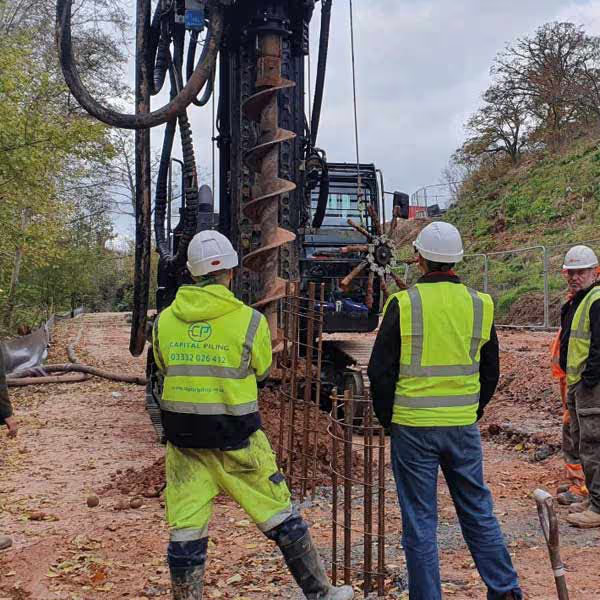
CFA (Continuous Flight Auger) piling is often used in environments where construction takes place close to existing structures. Because the method produces low vibration compared to driven piling systems, it is commonly selected for urban or constrained sites where surrounding buildings must be protected from ground movement.
Even though CFA piling is relatively low-impact, working near structures still requires careful planning and monitoring to manage potential settlement or movement. The interaction between the piling works and nearby foundations must be fully understood before installation begins.
At a high level, working near structures involves controlling installation effects and using monitoring systems to ensure surrounding buildings remain within safe movement thresholds.
Why CFA Piling Is Suitable Near Existing Buildings
CFA piling is widely used near existing structures because it generates minimal vibration during installation. This reduces the risk of disturbance to adjacent foundations compared to impact-driven piling methods.
However, vibration is not the only factor to consider. Ground displacement, soil relaxation, and changes in pore water pressure can also influence surrounding structures, particularly in sensitive ground conditions.
For this reason, even low-vibration piling methods require a structured monitoring and control approach when working in close proximity to existing buildings.
Monitoring Movement and Controlling Installation Impact
Before piling begins, surrounding structures are typically assessed to determine their sensitivity to movement. This includes identifying foundation types, building condition, and proximity to proposed pile locations.
During installation, monitoring systems such as settlement markers, inclinometers, or optical targets may be used to track any movement in nearby structures. These readings help ensure that ground response remains within acceptable limits.
If movement is detected or thresholds are approached, installation parameters such as drilling rate, concrete pressure, or sequencing may be adjusted to reduce impact and maintain stability.
Urban and Sensitive Construction Environments
CFA piling near structures is commonly used in dense urban environments where buildings are closely spaced and construction must occur adjacent to existing foundations. This includes residential developments, commercial extensions, and basement works.
It is also used on redevelopment sites where new structures are added to previously built-up areas, requiring careful integration with existing infrastructure.
Projects involving hospitals, schools, or heritage buildings may also require enhanced monitoring due to the sensitivity and importance of surrounding structures.
Ground Response and Structural Interaction
The interaction between CFA piling and nearby structures is influenced by soil type, pile depth, and installation technique. Cohesive soils may transmit movement differently compared to granular or mixed ground conditions.
Monitoring typically focuses on both vertical settlement and horizontal displacement, as both can affect structural integrity. Trigger levels are established in advance to define acceptable movement thresholds.
Data from monitoring systems is often reviewed in real time to allow immediate response if ground or structural movement exceeds predicted behaviour.
Risk Management and Monitoring Strategy
Working near structures requires a clear monitoring strategy that aligns with the predicted ground response and construction methodology. Without proper monitoring, even low-vibration methods like CFA piling can pose risks in sensitive environments.
The condition and age of adjacent structures must also be considered, as older buildings may have reduced tolerance to ground movement compared to modern construction.
Ultimately, successful CFA piling near existing structures depends on combining controlled installation methods with proactive monitoring to ensure both safety and structural protection throughout the works.