Ground beams & RC slabs guides
Clear, practical guidance on piling methods, groundworks, site preparation and technical advice.
%20-%20Copy.jpg)
Ground Conditions
Weak ground can cause settlement and reduce the stability of surface structures. Ground beams and RC slabs distribute loads evenly to reduce stress on weak soil conditions.
Settlement risks can lead to uneven ground movement and structural cracking over time. Ground beams and RC slabs help bridge weak areas and provide uniform load distribution.
Groundwater can weaken soil strength and affect slab or beam stability during construction. Ground beams and RC slabs are designed to perform effectively even in moisture-affected ground conditions.
Variable soil conditions can cause uneven support and unpredictable foundation performance. Ground beams and RC slabs help distribute loads evenly across changing ground conditions.
Site Constraints
Tight construction sites limit space for equipment, materials, and safe working operations. Ground beams and RC slabs are designed for efficient installation in confined site conditions.
Integrating with existing structures can be challenging due to level differences and connection constraints. Ground beams and RC slabs are designed to tie new foundations seamlessly into existing structural elements.
Access limitations can restrict the movement of equipment and materials on site. Ground beams and RC slabs can be constructed using flexible methods suited to restricted access conditions.
Programme constraints can limit available time for groundworks and slab construction. Ground beams and RC slabs allow efficient installation to help meet tight project schedules.
Installation Challenges
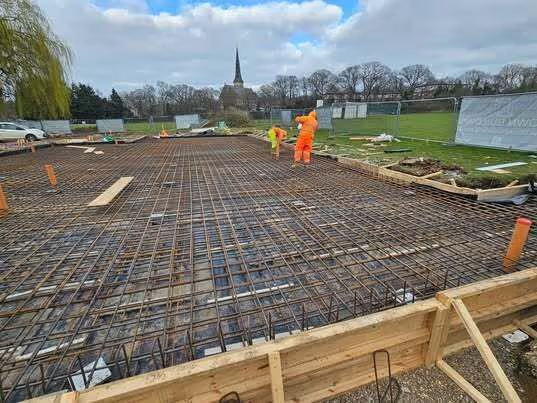
Reinforcement placement issues can reduce structural performance if steel is incorrectly positioned. Ground beams and RC slabs use precise fixing and inspection methods to ensure correct reinforcement alignment.
Formwork instability can lead to movement, deformation, or dimensional inaccuracies during concrete pours. Ground beams and RC slabs use properly designed and supported formwork systems to ensure accurate construction.
Poor concrete curing can reduce strength, durability, and long-term performance. Ground beams and RC slabs use controlled curing practices to achieve the required concrete quality.
ncorrect alignment or levels can affect structural performance and downstream construction works. Ground beams and RC slabs are set out and checked carefully to achieve required tolerances.
What is piling, and why is it required?
Piling is a foundation solution used to transfer structural loads to deeper, stronger ground. In these cases, traditional shallow foundations are not suitable. It is commonly required where ground conditions are poor, loads are high, or nearby structures limit excavation.
How do I know if piling is the best solution for my project?
This is determined by a structural engineer based on ground investigation results, trial pits, and design loads. If piling is specified, it is to ensure the structure is safe, stable, and compliant with Building Regulations.
Do I really need piling, or can it be avoided?
In some cases, foundation designs can be adjusted, but piling cannot be avoided. For instance, where ground conditions or loads make shallow foundations unsafe. Any changes must be agreed by the structural engineer and approved by Building Control.