Why mini piling delivers practical and structural advantages that go beyond simply being a smaller version of conventional piling and why those advantages are most significant on the projects where access and programme matter most
The benefits of mini piling are most clearly understood in the context of the projects where it is specified. On a site where the working area is accessible only through a narrow passage, where the structure above requires a deep foundation to bypass poor ground, and where the programme does not allow for extended foundation works, mini piling delivers a verified structural foundation with compact equipment, minimal disruption, and a fast installation cycle that few other methods can match in the same conditions. The advantages are not theoretical. They are practical outcomes that directly affect what is possible on constrained sites, how quickly the foundation programme can be completed, and what the total cost of the foundation works looks like relative to the alternatives.
Understanding the specific benefits of mini piling helps clients, architects, and structural engineers identify projects where the method is likely to offer genuine advantages over other foundation approaches, and engage with their foundation contractor from the outset of the design process rather than after a more conventional method has already been specified and found to be impractical for the site conditions involved.
The principal advantages of mini piling and why each one is significant on the projects where the method is most commonly used
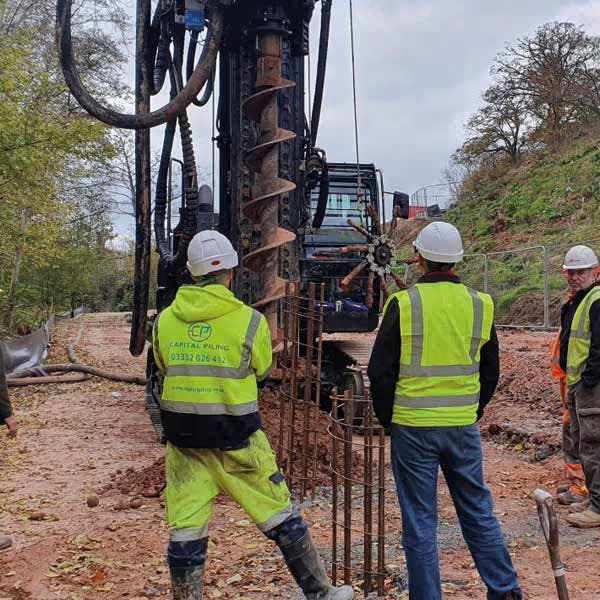
The most significant practical advantage of mini piling is the compact size of the installation equipment. A mini pile rig operating in its narrowest tracked configuration can pass through access openings as narrow as 700mm to 800mm and work in areas where the total available working space is a fraction of what a standard piling rig requires. This access capability is not a marginal improvement over conventional methods on tight sites. It is frequently the difference between a project that can proceed with a deep foundation and one that cannot, because no other piling method can physically reach the pile positions within the constraints the site imposes.
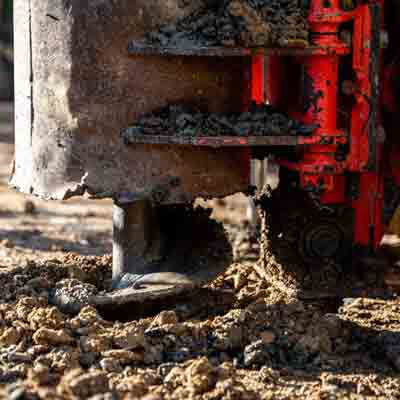
The absence of large volumes of spoil is another significant benefit. Mini pile bores are small in diameter, and the volume of arisings produced during installation is correspondingly low relative to the bored pile methods that generate larger quantities of spoil requiring management, containment, and removal from site. On urban residential sites where there is no room for a spoil skip adjacent to the working area, and where material cannot be wheeled out across a finished garden or through a neighbouring property, the reduced spoil volume associated with mini piling is a genuine programme and logistics advantage.
Mini piling also delivers load capacity that is immediately available on completion of installation without a curing period for grouted tube piles designed to bear structurally through the steel tube rather than through the grout alone. On projects where the programme requires the following trades to start as quickly as possible after the foundation works are complete, this immediacy of structural availability reduces the total programme duration for the substructure package and keeps the project on schedule.
How the benefits of mini piling translate into practical outcomes on site and why the method consistently delivers programme and access advantages on constrained projects
The access benefits of mini piling are a direct consequence of the equipment size. Mini pile rigs are purpose designed or adapted from compact tracked excavators to minimise the machine width and working weight while maximising the torque or percussive energy available at the drill head. The result is a machine that can reach pile positions through access routes that would stop a standard piling rig before it had travelled ten metres from the site entrance, and that can work in the confined space between existing structures, boundary walls, and underground services without the clearance requirements that larger machines impose.
The programme benefits follow from the installation cycle time per pile and from the absence of activities that add duration to the programme without adding piles to the ground. Mini piles do not require the setup and breakdown of a large rig between positions, the management of large concrete volumes, or the waiting periods associated with concrete curing before load can be applied. Each pile is installed, grouted or concreted, and the rig moves to the next position in a cycle that keeps the programme moving continuously rather than in the intermittent bursts that characterise methods with longer setup and breakdown requirements between piles.
The spoil management benefit becomes most apparent on sites where the access route from the pile positions to the nearest skip or disposal point is long, narrow, or restricted. On these sites the reduced volume of arisings from mini pile bores means fewer barrow runs, less disruption to adjacent areas, and a cleaner working environment than a larger diameter bore of equivalent depth would produce.
The project types and site configurations where the benefits of mini piling are most clearly demonstrated and where alternative methods would struggle to deliver the same outcomes
The benefits of mini piling are most clearly demonstrated on inner city residential projects where the working area is a rear garden or courtyard accessible only through the existing building or via a narrow side passage. On these projects every advantage the method offers, compact equipment, low spoil volumes, fast installation cycles, and immediate structural availability, contributes directly to a foundation programme that can be completed within the access and programme constraints the site imposes without requiring modifications to the access route, extended programme durations, or additional logistics management that adds cost without adding value.
Basement underpinning and retro fit foundation strengthening projects are another category where the benefits of mini piling are particularly significant. On these projects the working environment is already constrained by the existing structure above, the access opening is fixed by the building geometry, and the headroom within the working area is determined by the floor to ceiling height of the existing basement or undercroft. Mini piling equipment configured for low headroom working delivers the structural foundation within those fixed constraints without requiring structural alterations to the existing building to create access for larger plant.
On commercial projects where the site is open but the programme is tight, the fast installation cycle of mini piling and the absence of extended curing periods contribute to a foundation programme that can be completed and handed over to the following trades more quickly than concrete based alternatives of equivalent capacity in the same ground conditions.
The specific technical advantages of mini piling in terms of installation efficiency, load verification, and adaptability to variable ground conditions
Mini piling offers technical advantages in terms of adaptability to variable ground conditions that are particularly valuable on brownfield and urban sites where the soil profile cannot be reliably predicted across the full pile layout from a limited ground investigation. Because mini pile bores are advanced incrementally with continuous monitoring of the ground resistance, the installation team can identify changes in the soil profile as each bore progresses and respond in real time by adjusting the bore depth, the installation method, or the pile specification at individual positions without requiring a full design review before installation can continue at adjacent positions.
The range of installation methods available within the mini piling category, covering rotary boring, percussive casing, continuous flight auger, and hollow bar techniques, means that the method can be adapted to a wider range of ground conditions than a single installation technique can accommodate. Where the ground conditions vary across the site, different installation approaches can be used at different pile positions to suit the specific conditions encountered, producing a consistent structural outcome across the full pile layout despite the variation in the ground.
Load verification for mini piles can be achieved through a combination of installation records, grout or concrete volume monitoring, and where required by the design or the client, static or dynamic load testing on selected piles. The choice of verification method depends on the pile type, the ground conditions, and the level of confidence required in the installed capacity, and it is agreed between the structural engineer and the piling contractor at the design stage rather than determined on site after installation is complete.
What the benefits of mini piling do not eliminate and what still needs to be properly addressed regardless of the practical advantages the method offers
The practical benefits of mini piling do not reduce the need for a proper ground investigation, a properly coordinated structural design, or careful pre-construction planning of the access arrangements and installation methodology. A compact rig that can reach the pile positions does not automatically produce a foundation that is adequate for the structural loads if the pile specification has not been derived from proper geotechnical analysis of the ground conditions on the specific site. The access advantage is only valuable if the piles that are installed within that constrained access are correctly designed and properly verified.
The reduced spoil volumes associated with mini piling do not eliminate the need to manage and dispose of arisings correctly, particularly on contaminated urban sites where the material brought to the surface during boring must be handled, tested, and disposed of in accordance with the applicable waste management and environmental regulations. The quantity is lower than for larger diameter bores, but the regulatory requirements are the same regardless of volume, and they must be addressed as part of the project planning rather than assumed to be insignificant because the bore diameter is small.
Capital Piling delivers the full range of benefits that mini piling offers on the projects where the method is appropriate, using in-house designed foundation packages, equipment matched to the specific access and torque requirements of each project, and installation teams experienced in working within the constrained conditions that mini piling projects typically present. Where mini piling is the right solution for your project we will tell you so clearly and explain why. Where it is not the most appropriate method for your specific ground conditions, loads, and site constraints we will tell you that too, and recommend the approach that will deliver the best outcome for your project.