Why screw piling offers advantages that no other foundation method can match
Every foundation method has a set of conditions where it delivers its best results, but screw piling has a combination of benefits that genuinely sets it apart from bored and driven alternatives in the right circumstances. Speed, minimal ground disturbance, no concrete, low noise and vibration, suitability for environmentally sensitive and TPO restricted sites, and the ability to verify capacity in real time during installation are all advantages that individually would make a method worth considering. Together they make screw piling a compelling choice on the projects where the ground conditions and structural requirements align with what the method can deliver.
The practical benefits screw piling delivers on the right project
Screw piling installs without excavation and without concrete, which means there are no arisings to manage, no concrete to cure, and no waiting before the connecting structure above can be formed. Once the piles are installed and the pile caps or brackets are fixed, ground beams or RC slabs can follow immediately, making the overall foundation programme significantly faster than any cast in-situ method.
The installation process produces minimal noise and vibration compared to driven methods and causes far less ground disturbance than bored methods, making it suitable for urban and residential environments and for sites where planning or environmental constraints restrict the level of disturbance permitted. On sites subject to Tree Preservation Orders or protected land designations, screw piling is often the only foundation method that satisfies the root protection area requirements set by the local planning authority or arboriculture consultant, making it not just a preferred option but in many cases the only viable one.
Installation torque is monitored continuously and correlates directly to pile capacity, providing real time verification of performance for every pile without the need for post installation load testing in most cases. And where a temporary or demountable structure is involved, the piles can be extracted and reused, which no concrete based foundation method can offer.
How the installation process delivers the benefits of screw piling
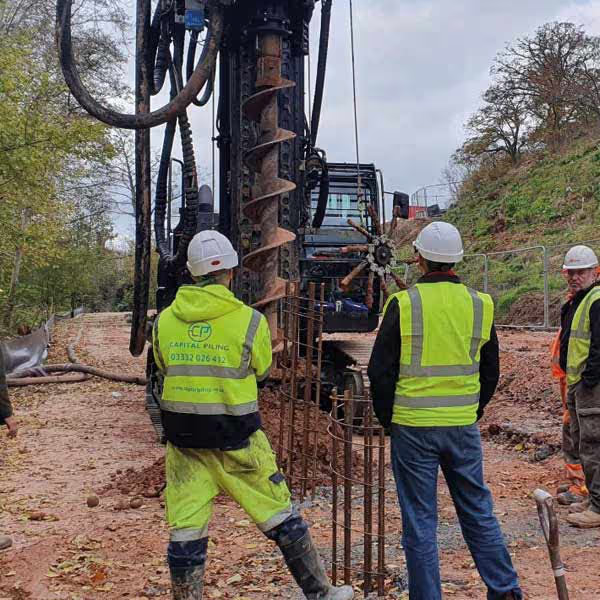
The benefits of screw piling flow directly from how the method works. Because the helical plates cut into the soil by rotation rather than displacement or excavation, the ground disturbance is minimal and confined to the immediate vicinity of the pile shaft. There is no open bore to maintain, no concrete to pump or cure, and no spoil to remove and dispose of. The installation equipment is compact and manoeuvrable, which is what allows it to work in restricted access locations, within root protection areas, and on environmentally sensitive sites where larger equipment could not operate without causing unacceptable disturbance.
The torque monitoring system records the resistance to rotation throughout the installation of each pile, building a continuous picture of ground conditions from the surface to the final depth. When the required torque is achieved at or beyond the minimum design depth, the pile has developed the capacity the design requires and installation is complete. This real time verification is immediate, objective, and documented for every pile on the project, which is a level of in-process quality assurance that cast in-situ methods cannot replicate in the same way.
The situations where the benefits of screw piling are most clearly realised
The benefits of screw piling are most clearly realised on projects where one or more of the following conditions apply. Access is restricted and compact equipment is needed. The programme is tight and a concrete curing period would cause unacceptable delay. The site is in an urban or residential environment where noise and vibration must be minimised. The project is subject to TPO restrictions, protected land designations, or council requirements that limit ground disturbance. The structure is temporary or demountable and the foundation needs to be removable. The ground conditions are cohesive and the torque to capacity relationship can be reliably applied to verify pile performance during installation.
We work across all of these project types regularly throughout London and the south east, and the experience we have built up in delivering screw piling within the specific constraints they present is something we bring to every project we take on.
The technical performance characteristics that underpin the benefits of screw piling
The torque to capacity relationship is the technical foundation on which the in-process verification benefit of screw piling rests. It is derived during the design process using the soil parameters from the ground investigation and the specific geometry of the pile being installed, and it gives a consistent and reliable basis for confirming pile capacity during installation across all three of the shaft diameters we work with, 60mm, 76mm, and 89mm, with helix configurations tailored to the specific ground conditions and load requirements of each project.
The absence of concrete in the pile itself removes a significant logistical and programme dependency from the foundation process. There is no batch plant to coordinate, no pump to set up and maintain, no curing period to plan around, and no risk of concrete supply interruption affecting pile quality mid installation. These are not marginal advantages on a tight urban programme. They are meaningful reductions in complexity and risk that translate directly into a more predictable and manageable foundation delivery.
Making sure the benefits of screw piling are fully realised on your project
The benefits of screw piling are fully realised only when the method is matched correctly to the ground conditions, the structural loads, and the site constraints. In ground conditions that are not suited to helical installation, or where the structural loads exceed what the method can achieve in the specific soil profile on site, the advantages disappear and the method becomes a liability rather than an asset.
A ground investigation and a proper structural assessment are the starting point for confirming that the benefits of screw piling are genuinely available on your project rather than assumed. We are happy to review your ground investigation data and structural requirements and advise on whether screw piling is the right method, and for clients who do not yet have a structural engineer in place our in house design team can manage the full process from assessment through to completed foundation design, making sure the method selection and the design are right for your specific project from the very beginning.