What installation torque monitoring is in screw piling and why it is the foundation of the quality assurance process on every project
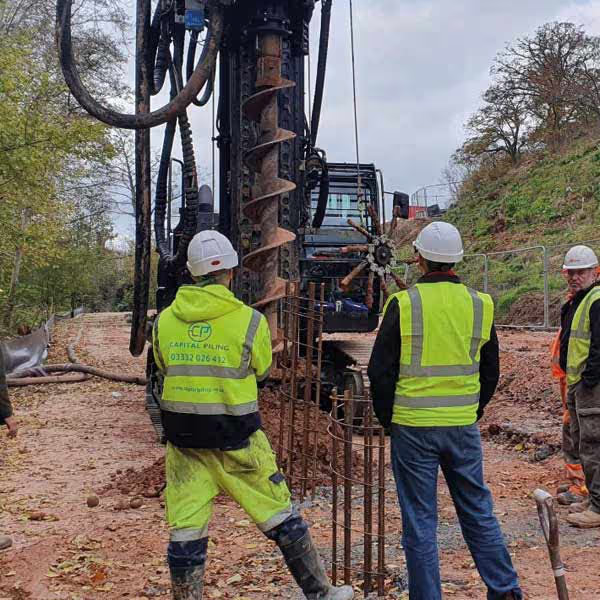
Installation torque monitoring is the continuous measurement and recording of the rotational force applied to a screw pile as it is advanced through the ground. It is carried out on every pile throughout the full depth of installation, producing a depth correlated record of how the torque varied as the pile progressed from the ground surface to its founding level. That record is not a secondary quality check applied after the fact. It is the primary means by which the structural capacity of each installed pile is verified, and without it there is no reliable basis on which to confirm that the foundation has been built to the specification the structural engineer produced.
The importance of torque monitoring goes beyond compliance. A properly recorded torque profile tells the story of how the ground behaved as the pile was installed, revealing whether the soil conditions matched the design assumptions, whether the pile advanced cleanly through the founding strata, and whether the capacity required at the design depth was actually achieved. This information is valuable not just for the pile being installed but for understanding how the ground is performing across the site as a whole, and it provides the structural engineer with the evidence needed to confirm the foundation design with confidence rather than on the basis of assumed ground conditions that have not been tested during the works.
Why continuous depth correlated torque monitoring produces a fundamentally different quality record to a single end of installation torque reading
The distinction between continuous torque monitoring and a single torque reading taken at the end of installation is not a technical refinement. It is the difference between a verified pile and an unverified one. A single torque value recorded at the moment the pile reaches its target depth tells the engineer only what the torque was at that instant. It says nothing about whether the torque was consistent through the founding stratum, whether it dropped briefly before recovering, or whether the pile encountered a hard spot that produced a high reading without the sustained resistance that genuine capacity requires.
A continuous depth correlated record shows the full torque profile from surface to founding level. It confirms that the required torque was not just reached but sustained over the depth increment specified in the acceptance criteria. It identifies anomalies in the torque profile that indicate unexpected ground conditions, obstructions, or installation problems that need to be assessed before the pile is accepted. And it provides the structural engineer with a complete audit trail for every pile in the foundation that can be reviewed, interrogated, and retained as part of the permanent project record.
How torque monitoring equipment works during installation and how the recorded data is used to accept or reject each pile
Torque is measured by a pressure transducer connected to the hydraulic circuit supplying the rotary drive head. The transducer measures the hydraulic pressure in the drive circuit and converts it to a torque value in kilonewton metres using the known relationship between hydraulic pressure and output torque for the specific drive head being used. This value is displayed to the operator in real time on a display unit mounted in the cab and simultaneously logged by a data recorder at intervals that typically correspond to every 250mm of pile advance.
The data logger stores the torque and depth values for the full installation and produces a printed or electronic record at the end of each pile that can be reviewed immediately against the acceptance criteria. Where the minimum torque threshold has been met and sustained over the required depth increment, the pile is accepted and the installation moves to the next position. Where the threshold has not been met, the pile is extended or the situation is referred to the design engineer before installation continues.
The calibration of the torque monitoring system is critical to the reliability of the data it produces. The pressure transducer and the data logger must be calibrated against a known standard before use on each project, and the calibration certificate must be retained as part of the project quality records. Torque data from an uncalibrated system is not reliable and cannot be used to verify pile capacity regardless of what values it displays or how plausible those values appear.
The circumstances in which torque monitoring is most critical and why it should never be treated as optional on any screw piling project
Torque monitoring is required on every screw piling project without exception. It is not a measure reserved for complex or heavily loaded foundations, and it is not something that can reasonably be omitted on small or straightforward projects on the basis that the ground conditions are well understood or the loads are modest. The torque record is the verification of the installed capacity, and a pile without a torque record is a pile without verified capacity regardless of its depth or the ground conditions it was installed into.
Torque monitoring is particularly critical on sites with variable ground conditions, where the soil profile changes between pile positions and the torque profile for each pile needs to be assessed individually rather than assumed to be consistent across the site. On brownfield sites with variable made ground, on sites where the ground investigation identified significant lateral variation in the soil profile, and on sites where obstructions or buried structures are known or suspected to be present, the torque record for each pile is the primary tool for identifying where the ground conditions have departed from the design assumptions and where a design review is needed before installation continues.
The technical requirements for torque monitoring equipment, calibration standards, and the acceptance criteria that the recorded data is assessed against
The torque monitoring system used on a screw piling project must be capable of measuring and recording torque continuously throughout the installation of each pile, with a logging frequency sufficient to capture the torque profile at depth increments of no more than 250mm. The measurement range of the system must be appropriate to the torque outputs of the installation equipment being used, and the accuracy of the system must be sufficient to distinguish reliably between torque values that meet the acceptance criteria and those that fall marginally short.
Calibration of the torque monitoring system should be carried out before the start of each project and at intervals during the project if there is any reason to suspect that the accuracy of the system has been affected by damage, wear, or environmental conditions. The calibration procedure involves comparing the output of the transducer against a known reference standard and adjusting the system to correct any deviation from the true value. The calibration certificate records the date of calibration, the reference standard used, and the deviation found before and after adjustment, and this certificate must be available for inspection throughout the project.
The acceptance criteria against which the torque records are assessed are set in the pile design and state the minimum torque that must be achieved and the depth increment over which it must be sustained for the pile to be accepted at the target depth. These criteria are project and pile position specific, derived from the torque factor and the design load applicable to each pile, and they must be stated clearly in the installation specification before works begin rather than determined on site by the installation team.
What can undermine the reliability of torque monitoring data and what the consequences are for the verified status of the installed foundation
Several factors can undermine the reliability of torque monitoring data even where the equipment is present and operating throughout the installation. An uncalibrated system produces values that cannot be relied upon. A system that logs data at intervals too infrequent to capture the full torque profile may miss anomalies that a more detailed record would have revealed. A system that measures hydraulic pressure without accounting correctly for the mechanical efficiency of the drive head will systematically overestimate or underestimate the actual torque at the pile shaft. And a system that produces data which is not reviewed against the acceptance criteria until after all piles have been installed provides no opportunity to address non-compliant piles before the layout is complete.
The consequences of unreliable torque monitoring data are significant. Where the data cannot be used to verify capacity, the foundation is unverified and the structural engineer cannot confirm compliance with the design without additional evidence, typically in the form of load testing that adds cost and programme time to the project. Where unreliable data has been used to accept piles that did not actually meet the acceptance criteria, the foundation may be carrying loads it cannot support, and the consequences of that underperformance may not become apparent until the structure above is loaded and settlement or movement begins.
Capital Piling uses calibrated torque monitoring equipment on every project, records torque and depth data continuously for every pile, and reviews the records against the acceptance criteria before moving to the next pile position. The complete torque records for every pile are compiled into the project completion documentation and issued to the structural engineer and client at the end of the works, providing a full and auditable record of how every pile in the foundation was installed and verified. This is the standard that every screw piling project should meet, and it is the basis on which Capital Piling stands behind the foundations it installs.