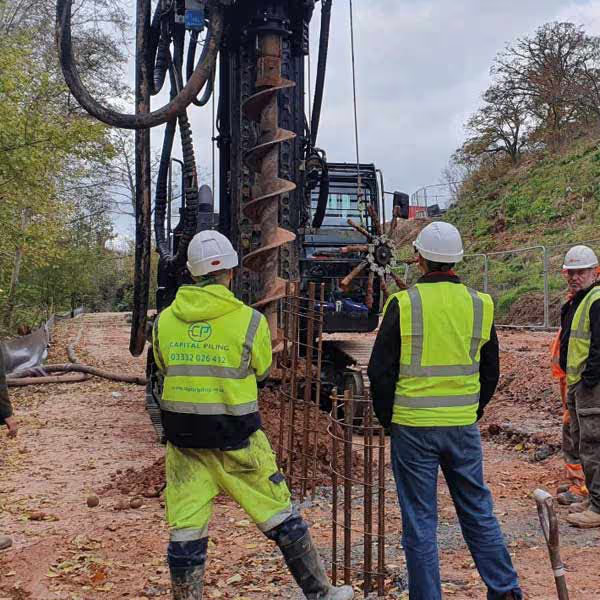
Understanding Mini Pile Spacing and Layout
Mini pile spacing and layout refer to how piles are positioned across a site to support the structure above. This is a key part of foundation design, as it determines how loads are distributed and transferred into the ground.
Spacing is not fixed. It is calculated based on structural loads, ground conditions, and the type of foundation system being used. The aim is to achieve consistent support while maintaining an efficient and practical layout.
How Pile Spacing is Determined
Pile spacing is influenced by the loads acting on the structure and the capacity of each individual pile. Heavier loads or weaker ground conditions will typically need piles to be spaced closer together. Meanwhile, lighter loads or stronger ground may allow for wider spacing.
In all cases, spacing is designed to ensure that loads are distributed and that no individual pile is overstressed.
Typical Spacing in Mini Piling
In practice, mini piles are installed at relatively close centres compared to larger piling systems.
On underpinning or domestic projects, piles are often installed at approximately 1.0m to 1.5m centres. On larger layouts, spacing may increase where load distribution allows.
There is no single standard spacing. It is always determined by design rather than a fixed rule.
Relationship Between Spacing and Diameter
Pile spacing is related to pile diameter. As a general engineering principle, piles are typically spaced at least two to three times their diameter. This is to avoid interaction between adjacent piles and ensure they perform well.
If piles are placed too close together, the surrounding ground can become overstressed. This reduces efficiency. If they are spaced too far apart, the structure above may not be adequately supported.
Pile Layout and Structural Design
The layout of piles is designed to align with the structure they are supporting.
Three layouts are common. Linear layouts sit beneath load-bearing walls. Grid layouts suit slabs and larger footprints. Paired or grouped piles work for underpinning.
The layout works in conjunction with ground beams or slabs. These span between piles and distribute loads across the foundation system.
The Influence of Ground Conditions
Ground conditions play a major role in determining both spacing and layout.
Weak or variable soils may demand closer spacing to distribute loads more effectively. Meanwhile, stronger ground conditions may allow for wider spacing. Where conditions vary across a site, spacing may be adjusted to suit local ground conditions.
Interaction Between Piles
When piles are installed, the surrounding ground is affected by each individual pile. If piles are spaced too close to one another, their stress zones can overlap, reducing capacity.
Proper spacing ensures that each pile performs independently. In doing so, it contributes effectively to the foundation system.
Balancing Performance and Efficiency
Spacing is always a balance between structural performance and efficiency.
Closer spacing increases capacity but also increases cost and installation time. Wider spacing reduces the number of piles required but may demand greater depth or larger diameters.
The design process aims to achieve the most efficient solution without compromising performance.
Integration with Ground Beams and Slabs
Mini piles are connected by ground beams or slabs, which distribute loads between them.
Ground beams span between piles and influence spacing based on their structural capacity. Piled slabs distribute loads more evenly across the foundation. This can allow for different layout configurations.
This ensures the foundation system works as a single, integrated structure.
A Designed Foundation System
Mini pile spacing and layout are determined through design, not guesswork. Loads, ground conditions, and structural requirements are all considered. These work to ensure the foundation performs as intended.
This approach provides consistent support across the structure. At the same time, it maintains efficiency in both design and construction.
Do You Need More Information?
Do you need further guidance on mini pile spacing and layout? If so, a specialist contractor such as Capital Piling can review your drawings. We'll recommend the most suitable foundation arrangement for your project.