Why noise and vibration performance is one of the most practically significant advantages of screw piling on constrained urban and residential sites
Noise and vibration are among the most consequential practical constraints on foundation works in urban and residential environments. Driven piling generates significant ground vibration and high impact noise that can damage adjacent structures, disturb occupants of neighbouring properties, trigger complaints, and in some cases cause local authorities or planning conditions to restrict or suspend works entirely. Bored piling is quieter than driven piling but still generates noise from the rig engine, the auger, and the concrete pump, and on sites close to occupied buildings or sensitive uses the cumulative noise level across a full working day can be enough to require mitigation measures or restricted working hours.
Screw piling generates neither impact noise nor ground vibration. The installation process is rotational rather than percussive, and the forces involved are transferred into the ground gradually through the helical plates rather than in repeated high energy impacts. The result is a foundation installation method that can operate in environments where driven piling would not be permitted and where bored piling would require careful management to avoid complaints or enforcement action. This is not a marginal benefit. On the right project it is the difference between a foundation programme that can proceed without restriction and one that cannot proceed at all.
What makes screw piling inherently low noise and low vibration and how this compares to other foundation methods
The noise and vibration characteristics of a foundation method are determined by the mechanism through which the pile is installed. Driven piling uses repeated high energy impacts to force the pile into the ground, and each impact generates a pressure wave that propagates through the ground as vibration and through the air as noise. The vibration levels generated by driven piling at distances of five to ten metres from the source are sufficient to cause cosmetic damage to older or poorly maintained structures and are perceptible as a physical sensation inside adjacent buildings. The airborne noise levels are high enough to be clearly audible at distances well beyond the immediate site boundary.
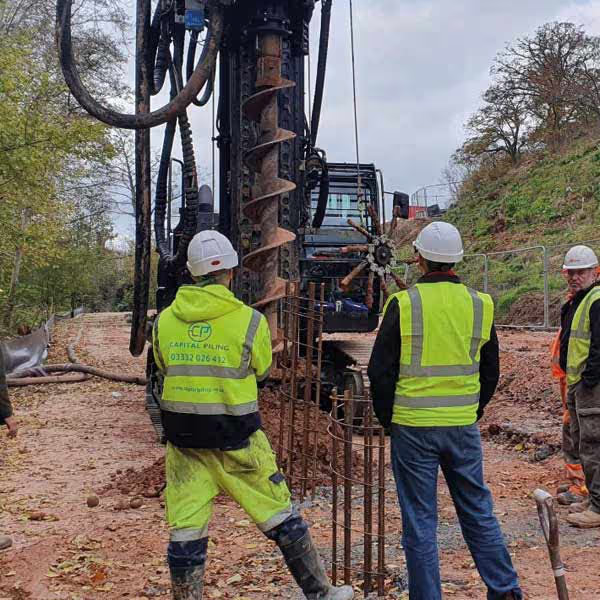
Screw piling uses continuous rotation under hydraulic torque. There are no impacts and no sudden energy releases. The forces applied to the ground are steady and progressive rather than repetitive and impulsive, and the vibration levels generated during installation are negligible at distances beyond the immediate vicinity of the pile being installed. The primary noise source during screw pile installation is the engine of the tracked excavator or piling rig providing the hydraulic power, which generates noise at a level comparable to other tracked plant operating on a construction site rather than the significantly higher levels associated with percussive piling.
How the rotational installation mechanism eliminates the vibration and noise mechanisms that affect other pile types
When a screw pile is installed, the hydraulic rotary head applies torque to the pile shaft at a controlled rate while the helical plates thread progressively through the soil. The soil is not displaced suddenly or impacted. It is engaged gradually as each point on the helical plate passes through it, and the force applied at any instant is a fraction of the total resistance the ground is providing. This distribution of force over time and over the area of the helical plates is what prevents the generation of vibration waves in the surrounding ground.
The absence of ground vibration is significant not just for the comfort of neighbouring occupants but for the structural integrity of adjacent buildings and infrastructure. Older masonry buildings, buildings with existing cracking or settlement, and structures founded on shallow or deteriorated foundations are all potentially vulnerable to damage from ground vibration generated by percussive piling at close range. Where screw piling is used instead, this risk is effectively eliminated, and the need for pre-construction condition surveys, vibration monitoring during works, and post-construction inspections to defend against damage claims is significantly reduced compared to driven piling operations in the same location.
The site types and project circumstances where the noise and vibration characteristics of screw piling are most important
Screw piling is regularly specified on inner city residential projects where the site boundary is immediately adjacent to occupied dwellings, on projects within conservation areas or near listed buildings where vibration damage to historic fabric is a serious concern, on hospital and school sites where noise restrictions during operational hours are strict, and on projects in areas where local planning conditions impose limits on permissible noise levels during construction.
It is also the preferred method on sites where existing structures adjacent to the works are in poor condition or have known foundation problems that make them more susceptible to vibration damage than a typical well maintained building. Where a pre-construction condition survey identifies cracking, settlement, or other vulnerability in neighbouring structures, the use of a non-vibrating foundation method removes a significant category of risk from the project and from the contractor's exposure to damage claims during and after the works.
On projects near railway infrastructure, underground tunnels, or buried services where vibration limits are set by the infrastructure owner as a condition of approval to work in the vicinity, screw piling can often satisfy those limits without additional mitigation measures that would be required with a percussive or even a bored pile method.
Vibration levels generated during screw pile installation and how they compare to the thresholds set by relevant standards and planning conditions
Ground vibration is measured in terms of peak particle velocity, expressed in millimetres per second, and the thresholds above which vibration is considered likely to cause cosmetic damage to buildings are set out in British Standard BS 7385 and in the guidance published by the Construction Industry Research and Information Association. For residential buildings the threshold for the onset of cosmetic damage is typically in the range of 5 to 15 millimetres per second peak particle velocity depending on the frequency of the vibration and the construction type of the building.
Vibration levels measured adjacent to screw pile installation operations are consistently well below these thresholds at distances of more than a few metres from the pile being installed. Published monitoring data from screw piling projects in urban environments shows peak particle velocity values at distances of three to five metres from the installation point that are an order of magnitude below the cosmetic damage threshold for residential construction. This means that screw piling can proceed without vibration monitoring in most situations where driven piling would require a full monitoring programme as a condition of the works.
Airborne noise levels during screw pile installation are similarly low relative to the levels generated by percussive piling. The dominant noise source is the plant engine rather than the installation process itself, and the noise profile is continuous rather than impulsive, which makes it less intrusive to neighbouring occupants and less likely to trigger complaints or enforcement action than the repetitive impact noise of a driven pile installation.
What to be aware of when relying on the noise and vibration advantages of screw piling as part of the project planning and neighbour management strategy
The noise and vibration advantages of screw piling are genuine and well evidenced, but they should not be used as a reason to skip the pre-construction preparation that good practice requires on any piling project near occupied or sensitive properties. A pre-construction condition survey of adjacent structures remains good practice regardless of the foundation method being used, because it establishes a documented baseline against which any claims of construction related damage can be assessed objectively. Without that baseline, a damage claim cannot be properly defended even where the vibration levels generated during the works were negligible.
Where planning conditions impose specific noise level limits during construction, the compliance of screw piling with those limits should be confirmed before works begin rather than assumed. In most cases screw piling will comply comfortably, but the confirmation should be documented so that it is available if the planning authority or a neighbouring occupant raises a query during the works.
Capital Piling has extensive experience of working in noise and vibration sensitive environments across London and the south east, including projects adjacent to occupied residential properties, listed buildings, hospital sites, and railway infrastructure. Where the noise and vibration performance of the installation method needs to be demonstrated to a planning authority, an infrastructure owner, or a client's project team, we can provide technical information on the vibration and noise levels associated with our installation equipment to support that assessment.