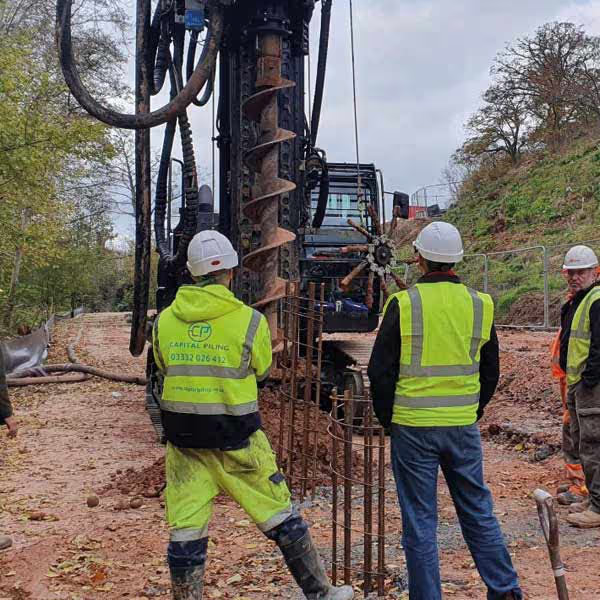
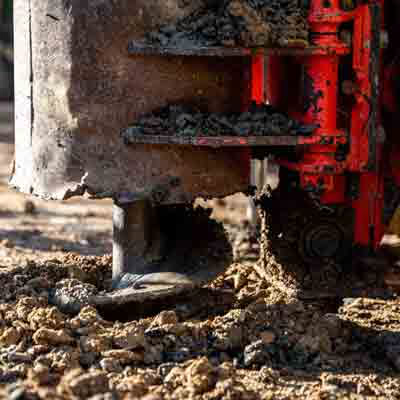
Pile Depth and Diameter Selection
Selecting the correct pile depth and diameter is a fundamental part of designing an effective piling solution. These two factors work together to determine how loads are transferred into the ground and how the foundation performs over time.
In SFA open bore piling, depth and diameter are not chosen independently. They are designed as part of a wider foundation strategy, based on ground conditions, structural loads and the constraints of the site.
At Capital Piling, this process is managed in-house, allowing pile dimensions to be coordinated directly with both the design requirements and the practical realities of installation.
How Depth and Diameter Work Together
Pile depth and diameter both influence load capacity, but in different ways.
Increasing the diameter of a pile increases its surface area and end-bearing capacity, while increasing depth allows the pile to reach stronger, more stable ground layers. In many cases, the most efficient solution is achieved by balancing these two factors rather than maximising one alone.
This approach allows the foundation to be designed in a way that is both structurally effective and practical to install.
How Dimensions Are Determined
The selection of pile depth and diameter is based on a combination of structural calculations and ground investigation data.
By understanding the soil profile, engineers can identify the depth at which suitable bearing strata are located. From there, the diameter can be selected to provide the required load capacity, taking into account both end bearing and shaft friction.
Because these decisions directly affect installation, having design and delivery aligned ensures that what is specified can be carried out efficiently on site.
Application Across Different Site Conditions
On residential and restricted access projects, pile dimensions are often influenced by both structural requirements and site limitations.
Where access is limited, there may be practical constraints on the size of equipment that can be used, which in turn influences the achievable pile diameter. In these situations, depth and pile layout can be adjusted to achieve the required performance without relying on larger diameters.
On more open sites, there may be greater flexibility, but the same principle applies, the aim is always to find the most efficient solution for the specific conditions.
Design Coordination and In-House Capability
Determining pile depth and diameter requires a coordinated design approach.
At Capital Piling, our in-house design team assesses ground investigation data, structural loads and site constraints to define the most appropriate pile dimensions. This includes considering how the piles will be installed, ensuring that the design is not only structurally sound but also practical to deliver.
By managing this process internally, it becomes easier to adapt designs where needed and respond to site-specific challenges without delay.
Finding the Right Balance
There is no single “standard” depth or diameter that applies to every project. Oversizing piles can increase cost and installation time without adding value, while undersizing can lead to performance issues.
The most effective solution is one that balances structural requirements with ground conditions and site constraints.
Early involvement in the design process can help ensure that these decisions are made correctly, reducing the risk of changes later on and supporting a smoother overall project delivery.