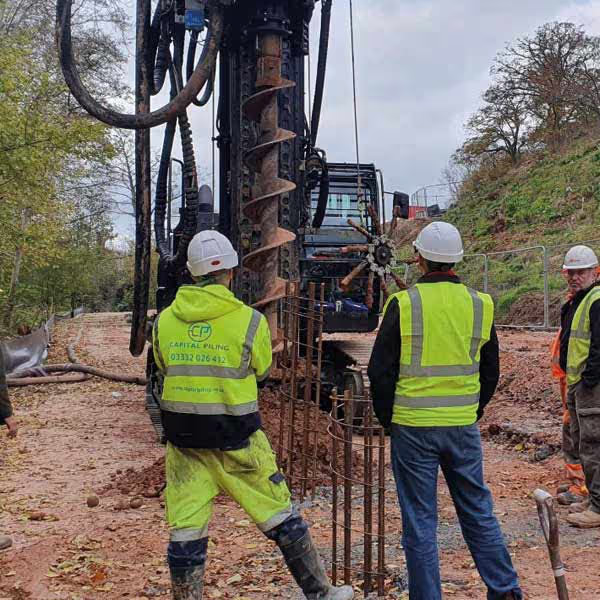
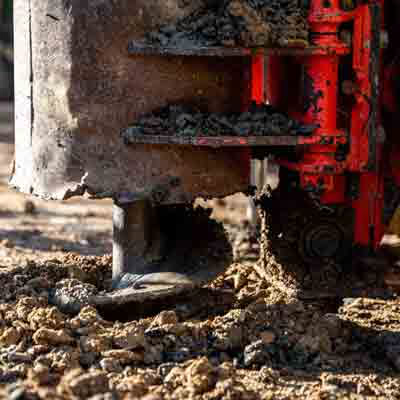
What a piled raft system is and why it represents a more sophisticated foundation solution than a simple pile and ground beam arrangement on certain projects
A piled raft is a foundation system that combines a reinforced concrete raft slab with piles beneath it, working together as a single integrated structural element to carry loads from the building above into competent ground below. Unlike a conventional piled foundation where discrete ground beams span between individual pile heads and a separate slab spans between those beams, a piled raft uses the full area of the raft slab as both the load collecting element and the ground floor structural platform, with piles positioned beneath it at the locations where the loads and the ground conditions require additional support.
The piled raft is not simply a raft foundation with some piles added to it, and it is not simply a piled foundation with a thicker slab. It is a system in which the interaction between the raft and the piles is explicitly accounted for in the structural design, and where the distribution of loads between the raft bearing on the ground and the piles bearing at depth is calculated rather than assumed. This interaction is what makes the piled raft a more efficient foundation solution than either a raft or a piled foundation alone in certain ground conditions, and it is also what makes its design more complex and more demanding of the structural engineer responsible for it.
Why piled raft systems are specified and what structural and geotechnical conditions make them the most appropriate foundation solution
Piled raft systems are specified when the ground conditions and the structural loads combine in a way that makes neither a raft foundation nor a conventional piled foundation the most efficient or cost effective solution on its own. A raft foundation without piles can carry significant loads across a large area but is vulnerable to differential settlement where the ground conditions vary beneath the raft or where the loads are unevenly distributed. A conventional piled foundation with discrete ground beams and a suspended slab can carry heavy concentrated loads efficiently but may be over-engineered for situations where the ground has some useful bearing capacity that could contribute to the foundation performance if it were properly mobilised.
A piled raft uses both mechanisms together. The raft bears on the ground across its full area, mobilising whatever bearing capacity the ground can provide. The piles carry the remainder of the load that the raft alone cannot transfer to the ground without excessive settlement. The combination allows a smaller number of piles, or shorter piles, than a fully piled solution would require, because the raft is contributing to the load carrying capacity of the system as a whole. The design challenge is to quantify the respective contributions of the raft and the piles accurately enough to ensure the system performs as intended without over-relying on the ground bearing contribution in conditions where that contribution is uncertain.
How a piled raft system is designed to account for the interaction between the raft and the piles and how that interaction affects the load distribution within the foundation
The design of a piled raft begins with an assessment of the ground conditions beneath the raft and the loads applied to it from the structure above. The structural engineer calculates the settlement that the raft would experience if it were bearing on the ground alone without piles, and compares that to the allowable settlement limit for the structure. Where the ground bearing settlement exceeds the allowable limit, piles are added beneath the raft at the positions where the loads are highest or the ground is weakest, and the number and capacity of those piles are calculated to reduce the settlement to within the acceptable range.
The interaction between the raft and the piles means that the load carried by each pile is not simply the applied load at that pile position divided by the number of piles. As the raft settles under load, the ground beneath it provides a reaction that reduces the load going into the piles. As the piles carry load and compress slightly, the raft settles with them, maintaining contact with the ground and continuing to mobilise ground bearing resistance. The design must model this interaction to arrive at reliable estimates of pile loads, raft moments, and foundation settlement under all load combinations.
In practice the level of analytical sophistication applied to this interaction varies with the complexity and scale of the project. On smaller residential piled raft schemes a simplified approach using conservative assumptions about the ground bearing contribution may be adequate. On larger commercial projects where the loads are higher, the ground conditions are more variable, or the settlement tolerances are tighter, a more detailed analysis using finite element methods or interaction factor approaches may be required to produce a design that is both safe and economical.
The project types and ground conditions where piled raft systems are most commonly encountered and what drives the decision to use this approach over alternatives
Piled raft systems are most commonly used on medium to large residential developments, commercial buildings, and infrastructure projects where the ground has some bearing capacity but not enough to carry the full structural loads within acceptable settlement limits without piles. They are also used on projects where the structural loads are relatively uniform across a large plan area, making a raft a natural load collecting element, but where local variations in ground conditions or load concentrations at column positions require pile support at specific locations.
In the UK, piled raft foundations are frequently encountered on sites with stiff over-consolidated clays that have adequate bearing capacity for light loads but consolidate under heavier loads to a degree that exceeds acceptable settlement limits without pile support. They are also used on sites with loose to medium dense sands where the raft can mobilise useful skin friction and end bearing across its area but where deeper piles are needed to control settlement under the heaviest loads.
On residential apartment and mixed use developments where the building footprint is large and the structural loads are relatively uniform across the plan, a piled raft can offer significant economies over a fully piled solution by reducing pile numbers while still controlling differential settlement to within the limits required for the structure and its finishes.
The structural and geotechnical parameters that govern piled raft design and the analytical methods used to establish load distribution between raft and piles
The key parameters governing piled raft design are the stiffness of the raft, the stiffness of the piles, the bearing capacity and compressibility of the ground beneath the raft, and the loads applied by the structure above. The relative stiffness of the raft and the piles determines how loads are shared between them, with a stiffer raft redistributing loads more effectively from heavily loaded areas to lightly loaded areas and reducing the peak loads in individual piles.
Raft thickness on piled raft schemes typically ranges from 300mm to 600mm for residential and light commercial applications, increasing to 800mm or more on heavily loaded commercial or infrastructure schemes where the raft must carry significant bending moments between pile positions. The reinforcement in the raft is designed for the bending moments and shear forces arising from the interaction analysis, with heavier reinforcement concentrated in the zones of highest moment over and between pile positions.
Pile spacing in a piled raft is typically wider than in a conventional fully piled foundation, because the raft is contributing to the load carrying capacity of the system and the piles do not need to carry the full load independently. Pile spacing of four to six pile diameters or helix diameters is common on piled raft schemes, compared to the three diameter minimum spacing used for screw piles in a conventional layout. The wider spacing reduces the total number of piles and the associated installation cost while still providing the settlement control the foundation requires.
What the design and construction risks are on piled raft projects and what needs to be in place to ensure the system performs as the design intends
The primary design risk on a piled raft project is over-reliance on the ground bearing contribution of the raft in conditions where that contribution is less reliable than the design assumes. Where the ground beneath the raft is susceptible to consolidation settlement under sustained load, to volume change due to moisture variation, or to disturbance during construction, the ground bearing component of the raft capacity may reduce over time, transferring more load into the piles than the design anticipated. Where the piles have not been designed with sufficient reserve capacity to carry this additional load, the foundation may settle more than the allowable limit as the ground bearing contribution diminishes.
Construction quality is also critical on piled raft projects. The raft must be cast to the specified thickness and reinforcement arrangement throughout, the piles must be installed to the specified depth and verified to the required torque, and the connection between the pile heads and the raft reinforcement must be properly made so that load is transferred efficiently between the two elements. Shortfalls in any of these areas affect the performance of the system as a whole rather than just the individual component that was not built to specification.
Capital Piling designs and constructs piled raft foundations as part of its integrated foundation service, with the raft design, the pile design, and the construction methodology developed together as a single coordinated package. The interaction between the raft and the piles is accounted for in the design, the construction is carried out to the specification that the design requires, and the completion documentation provides the client and the structural engineer with a full record of what was built and how it was verified. This integrated approach is what gives a piled raft foundation the best possible chance of performing exactly as the design intends throughout the life of the structure it supports.