What project timelines mean in screw piling and why the method consistently delivers programme advantages over other foundation types
Project timeline in the context of screw piling refers to the total time from mobilisation of the installation equipment to completion of the piling works and handover to the next trade. It covers the time taken to install each pile, the number of piles that can be completed in a working day, the programme from first pile to last, and the point at which the foundation is ready to receive the ground beams, pile caps, or steelwork that follows. Understanding what drives the timeline on a screw piling project and how it compares to other foundation methods is relevant to every project where programme is a constraint, which on most construction projects it is.
The most significant programme advantage of screw piling over concrete based foundation methods is the absence of any curing period. A bored pile or a CFA pile is not structurally active until the concrete placed during installation has achieved sufficient strength, which typically takes a minimum of several days and in some ground and weather conditions longer. A screw pile is structurally active the moment installation is complete. The steel shaft is in the ground, the helical plates are bearing against undisturbed soil, and the pile is ready to receive load. The next trade can follow immediately without waiting for a wet trade to cure.
The factors that determine how long a screw piling programme takes and why the timeline is shorter than most clients expect
The installation rate for screw piles depends on the ground conditions, the pile length, the pile diameter, and the number of extension sections required to reach the founding depth. In favourable ground conditions with relatively shallow founding depths, an experienced crew can install between fifteen and twenty-five piles per day on a straightforward residential or light commercial project. On projects with deeper piles, harder ground, or more complex pile layouts the daily output will be lower, but even on these projects the installation rate per pile is generally faster than the equivalent operation with a bored or CFA pile of comparable capacity.
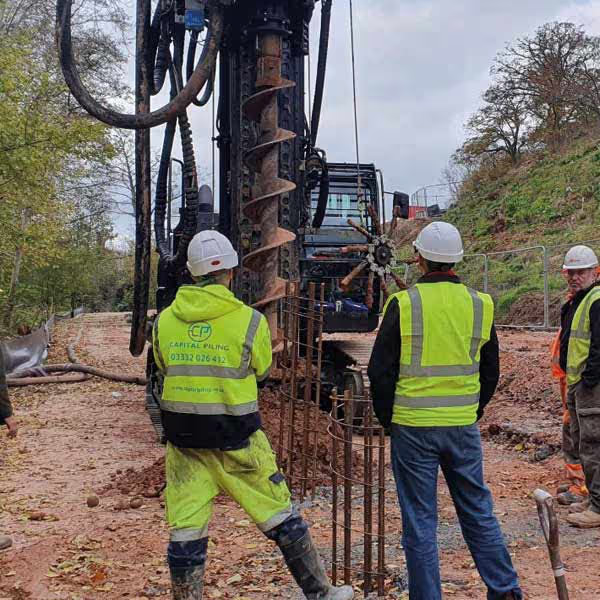
Mobilisation and demobilisation of screw piling equipment is faster than for larger bored pile rigs because the equipment is compact and does not require the same level of site preparation. A tracked mini excavator fitted with a hydraulic rotary head can be working on the first pile within hours of arriving on site, and can be demobilised and off site within the same working day as the last pile is completed. There is no concrete pump to set up, no spoil to manage, and no bore support equipment to assemble and dismantle.
How a screw piling programme is structured from mobilisation through to completion and handover
A screw piling programme begins with a pre-start meeting or site visit to confirm access arrangements, agree the pile setting out with the main contractor or client, and identify any underground services or obstructions that need to be avoided during installation. The setting out is marked on site from the pile layout drawing, either by the Capital Piling team or by the main contractor's setting out engineer, and the installation sequence is agreed to minimise rig movements and maximise daily output.
Installation proceeds pile by pile through the agreed sequence, with the torque and depth recorded continuously for each pile and reviewed against the acceptance criteria before the rig moves to the next position. Where a pile does not meet the acceptance criteria at the target depth it is extended or referred to the design team before the position is signed off, ensuring that every completed pile in the sequence meets the specification before installation moves on.
On completion of the last pile the pile heads are cut to finished level, connection brackets or cap plates are fitted where specified, and the completion documentation including the torque and depth records for every pile is compiled and issued. The foundation is then ready for the ground beam, pile cap, or steelwork contractor to follow, with no waiting period required before loading can begin.
The project types and circumstances where the programme advantages of screw piling are most valuable
The programme advantages of screw piling are most significant on projects where the overall construction timeline is tight, where the foundation needs to be completed and handed over quickly to keep the superstructure programme on track, or where delays to the foundation works would have a disproportionate impact on the project completion date. Fast track residential developments, modular construction projects with fixed delivery windows for structural modules, and commercial projects with lease or handover deadlines all fall into this category.
Screw piling is also programme efficient on projects where access constraints or restricted working hours limit the time available for foundation works each day. Because the installation equipment is compact and the working cycle for each pile is short, more piles can be completed within a restricted working window than would be possible with a larger, slower method. On inner city residential projects where working hours are limited by planning conditions or neighbour agreements, this can make the difference between a foundation programme that fits within the permitted hours and one that requires a variation or an extension of the working period.
Installation rates, programme durations, and the factors that affect daily output on a screw piling project
Installation cycle time per pile varies with ground conditions and pile length. In soft to firm cohesive soils at depths of five to eight metres, a single pile installation cycle including setting up, advancing the leading section, adding extension sections, completing to depth, recording the torque data, and cutting the pile head typically takes between twenty and forty minutes. At depths of ten to fifteen metres in variable or denser ground the cycle time increases, but even at these depths two to three piles per hour is achievable on a well run project with good ground conditions.
Factors that reduce daily output include hard or obstructed ground that slows the rate of advance, pile layouts with widely spaced positions that require significant rig repositioning between piles, restricted access that limits the working area available to the rig, and complex connection details that require additional time to fit at each pile head. These factors should be identified during the pre-construction planning stage and reflected in the programme rather than treated as unknowns that will be resolved on site.
The programme for a typical residential extension of six to twelve piles can usually be completed in a single working day. A small residential development of thirty to fifty piles typically takes two to four days depending on pile length and site conditions. A larger commercial project of one hundred or more piles will be programmed over a longer period, but the daily output achievable with screw piling equipment means that the foundation programme for most commercial projects of this scale can be completed within two to three weeks.
What needs to be in place before mobilisation to make sure the programme runs as planned and what can disrupt the timeline if it is not
The most common cause of programme delay on screw piling projects is inadequate pre-construction preparation. Pile positions that have not been properly set out before the rig arrives, connection details that have not been finalised, underground services that have not been located and marked, and access arrangements that have not been confirmed all cost time on site that could have been avoided with proper coordination beforehand. On a project where the piling programme is tight, a half day lost to avoidable preparation issues can mean a pile sequence that was planned to complete in one day running into a second, with knock on effects for every trade that follows.
Ground conditions that differ materially from those anticipated in the design can also affect the programme. Obstructions that prevent piles from reaching the target depth, variable strata that require design reviews before installation can continue, and groundwater conditions that affect the performance of the equipment all have programme implications that need to be managed in real time rather than absorbed silently into the installation sequence.
Capital Piling manages the pre-construction coordination process as part of its standard project delivery, confirming access arrangements, service locations, setting out requirements, and connection details before mobilisation so that the installation programme can proceed without avoidable interruptions. Where ground conditions encountered during installation require a design review or a change to the installation sequence, our in-house design team is available to respond immediately rather than the project waiting for a third party engineer to be consulted and instruction issued.