What installation torque is in screw piling and why it is the primary method of verifying pile capacity
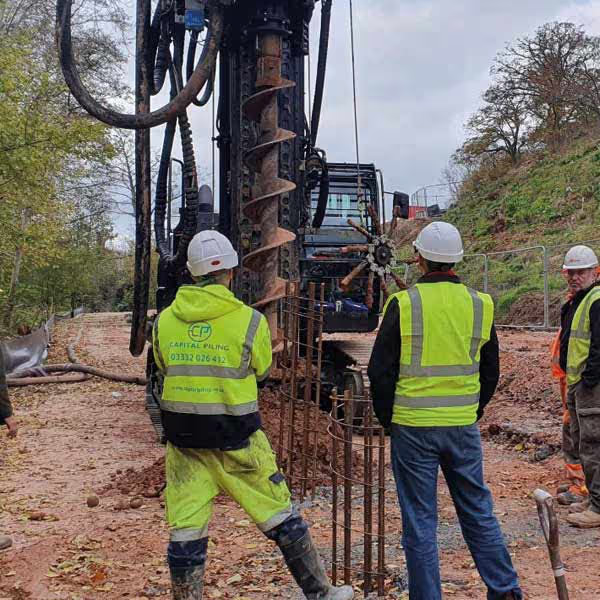
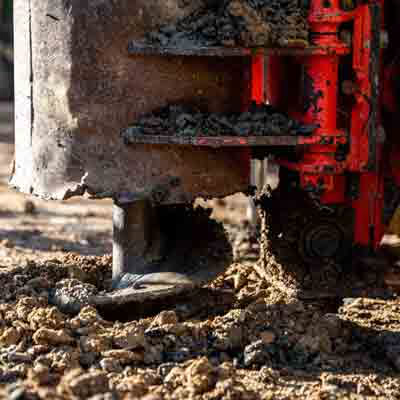
Installation torque is the rotational force measured at the pile head as a screw pile is advanced through the ground. It is recorded continuously during installation and expressed in kilonewton metres. As the helical plates thread through the soil, the resistance the ground offers to their rotation increases as the soil becomes denser or stronger with depth, and that resistance is what the torque measurement captures. The higher the torque required to turn the pile at a given depth, the greater the resistance the ground is providing, and the greater the load capacity the pile is developing at that depth.
This relationship between installation torque and pile capacity is what makes screw piling uniquely verifiable among foundation methods. Most pile types require separate load testing to confirm that the installed capacity matches the design intent, which adds cost, time, and programme risk to the project. With screw piles, the torque record produced during installation is itself the verification, provided the torque to capacity relationship has been correctly established in the design and the measurement equipment is properly calibrated. Every pile installed by Capital Piling is torque monitored throughout, and the records form part of the completion documentation issued to the structural engineer and client at the end of the project.
Why torque monitoring is not an optional quality check but a fundamental part of the foundation verification process
The minimum installation torque required to accept a pile at a given depth is set during the design process. It is derived from the torque to capacity relationship applicable to the pile geometry and soil conditions on the specific project, working back from the design load to the torque value that confirms the required capacity has been achieved. Once set, that minimum torque value becomes the acceptance criterion for every pile on the project, and no pile should be accepted at its target depth if the required torque has not been reached and sustained.
Torque monitoring also provides continuous information about how the ground is behaving as the pile advances. A torque profile that builds steadily with depth and reaches the required threshold at or near the target depth indicates that the ground conditions match the design assumptions. A torque profile that remains low at depth, or that drops suddenly after an initial rise, indicates that the soil conditions may not be as anticipated, and that the design team needs to be consulted before the pile is accepted or the installation continues.
How torque is measured during installation and how the recorded values are used to confirm pile capacity
Torque is measured by a calibrated pressure transducer connected to the hydraulic circuit of the rotary drive head. The transducer converts the hydraulic pressure in the drive circuit to a torque value in kilonewton metres, and this value is displayed to the operator in real time and logged at regular depth intervals throughout the installation. The logging interval is typically every 250mm of pile advance, giving a detailed record of how torque varied with depth across the full installed length.
At the end of installation the logged data is reviewed against the minimum torque acceptance criteria set in the design. Where the required torque has been achieved and sustained over the specified number of revolutions or depth increment, the pile is accepted. Where it has not, the pile is either extended to a greater depth in the expectation that denser or stronger ground will be encountered, or the situation is referred to the design engineer for a formal assessment of how to proceed.
The torque measurement system must be calibrated before use on each project and the calibration certificate retained as part of the quality records. An uncalibrated system cannot produce reliable torque data, and torque data from an uncalibrated system cannot be used to verify pile capacity regardless of what values it displays.
How torque requirements vary across different ground conditions, pile geometries, and project types
The minimum torque required to verify capacity varies with the pile geometry, the design load, and the torque factor applicable to the soil conditions on the specific site. A lightly loaded residential pile with a modest helix diameter founded in firm London Clay will have a lower minimum torque requirement than a heavily loaded commercial pile with a larger helix configuration founding in the same material at greater depth. The torque requirement is project and pile position specific, and must be calculated and stated clearly in the design before installation begins.
On sites with variable ground conditions, the torque profile will vary between pile positions as the soil conditions change across the site. This is normal and expected, and it is one of the reasons continuous torque monitoring throughout installation is valuable. Where one pile requires significantly more or less torque to reach the acceptance criteria than adjacent piles, that divergence is a signal that the ground conditions at that position may differ from the rest of the site, and that further investigation or a design review may be warranted.
The torque factor, the torque to capacity relationship, and the technical basis for using installation torque to verify pile capacity
The torque to capacity relationship for screw piles is expressed through a torque factor Kt, which relates the measured installation torque T in kilonewton metres to the ultimate axial capacity Qu of the pile in kilonewtons according to the relationship Qu equals Kt multiplied by T. The value of Kt is not a universal constant. It varies with the pile shaft diameter, the helix configuration, the soil type, and the installation method, and it must be established on the basis of the specific ground conditions and pile geometry applicable to the project rather than assumed from published default values.
In cohesive soils such as London Clay, Kt values for typical residential and commercial screw pile geometries generally fall in the range of 9 to 15 per metre, with the specific value selected based on the soil properties and the pile geometry. In granular soils the relationship is less well constrained and the appropriate value of Kt requires more careful assessment. Where uncertainty exists about the appropriate Kt value for a given project, a programme of installation and load testing on preliminary piles can be used to calibrate the relationship before production piling begins.
The torque measurement must also account for the contribution of shaft friction between the pile shaft and the soil during installation, which adds to the measured torque without contributing to the axial load capacity in the same proportion as helical plate bearing. This is factored into the Kt calculation and is one of the reasons the torque factor must be derived specifically for each pile geometry rather than applied generically.
What can go wrong when torque monitoring is inadequate and what the consequences are for the installed foundation
Torque monitoring that is not continuous, not calibrated, or not properly recorded does not provide reliable verification of pile capacity. A torque value noted by the operator at the end of installation without a depth correlated record of how torque varied throughout does not tell the design engineer what they need to know about how the pile behaved. It provides a single data point where a full profile is required, and that single point cannot be used to confirm that the pile developed capacity consistently through the founding stratum rather than briefly touching a hard spot before the torque dropped away.
Where torque records show that the required acceptance criteria was not met and the pile was nonetheless accepted without a formal design review, the foundation is unverified. The consequences of an unverified foundation are potentially serious and the cost of addressing foundation problems after the structure is built is many times greater than the cost of getting the verification right during installation.
Capital Piling installs calibrated torque monitoring equipment on every project and produces a full depth correlated torque record for every pile as a matter of course. These records are reviewed against the acceptance criteria before the pile position is signed off, and any pile that does not meet the criteria is referred to the design team for assessment before installation moves on. This is not an optional quality measure. It is the basis on which the installed foundation can be demonstrated to comply with the design intent, and it is what gives the structural engineer and the client the confidence that the foundation will perform as designed throughout the life of the structure.