What the screw piling installation process involves from initial site setup through to completed foundation and why understanding each stage matters for everyone involved in the project
The screw piling installation process is the sequence of operations that takes a foundation design from a drawing and a specification to a completed, verified, in-ground foundation ready to receive the structure above. It begins before the equipment arrives on site and ends after the last pile head has been cut to level, the connection details have been fitted, and the completion documentation has been compiled and issued. Every stage in that sequence has a purpose, and every stage depends on the one before it having been carried out correctly.
Understanding the installation process matters not just for the piling contractor but for everyone involved in delivering the project. The main contractor needs to know what site preparation is required before mobilisation, what the working area requirements are during installation, and when the foundation will be ready for the following trades. The structural engineer needs to know how the design intent is being translated into installed piles and how the verification data produced during installation relates to the capacity assumptions in the design. And the client needs to understand what is happening on site, why each stage takes the time it does, and what the completion documentation they receive at the end of the works actually tells them about the foundation that has been built.
The stages that make up the screw piling installation process and what each one is intended to achieve
The installation process divides into three broad stages. The pre-installation stage covers everything that needs to be in place before the equipment arrives on site, including confirmation of the pile layout and connection details, location and marking of underground services, assessment of the access route and working area, and agreement of the installation sequence with the main contractor or client. The installation stage covers the mobilisation of equipment, the setting out of pile positions, the installation of each pile with continuous torque monitoring, and the review of the torque records against the acceptance criteria before each position is signed off. The post-installation stage covers the cutting of pile heads to finished level, the fitting of connection details, the compilation of the completion documentation, and the handover of the foundation to the following trade.
Each of these stages requires preparation, coordination, and clear communication between the parties involved. Stages that are rushed, poorly coordinated, or skipped entirely are the most common source of problems on screw piling projects, and the problems they create are almost always more expensive to resolve after installation than they would have been to prevent before it.
How the installation process unfolds in practice from mobilisation to handover and what happens at each stage
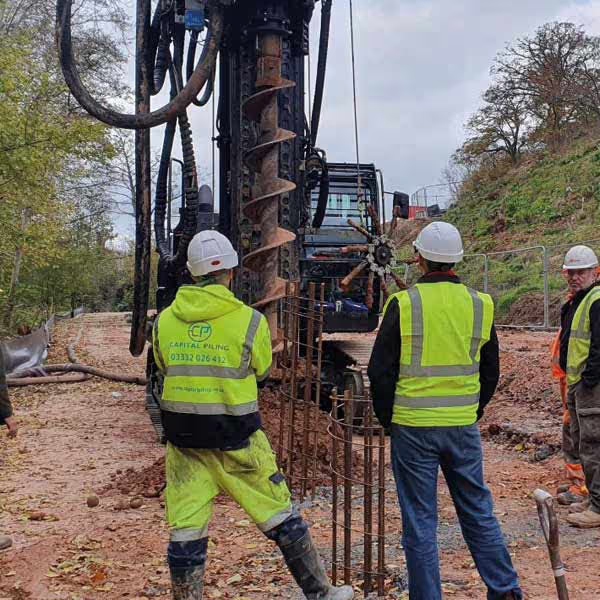
Mobilisation begins with the delivery of the installation equipment to site and the setup of the working area. The tracked rig or excavator is unloaded, the rotary drive head is attached and the hydraulic connections made, the torque monitoring system is connected and its calibration confirmed, and the pile sections and extension couplings are positioned within reach of the working area. The setting out of the first pile position is checked against the layout drawing and confirmed before installation begins.
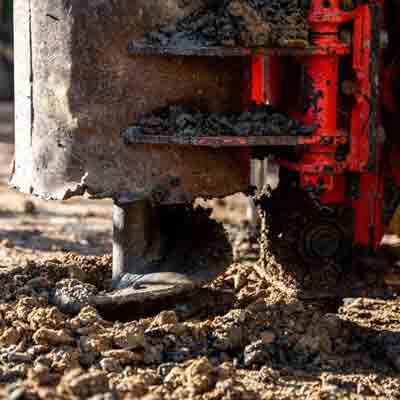
Each pile installation begins with the leading section being positioned vertically at the marked pile location, the drive socket engaged in the rotary head, and the operator applying rotation and crowd force to advance the pile. The torque and depth are monitored and logged continuously from the first rotation. As the leading section is installed, extension sections are added one at a time until the pile reaches the target depth. The torque record is reviewed against the acceptance criteria, and once the pile is accepted the drive head is disengaged and the rig repositions to the next pile location.
On completion of all pile installations the pile heads are cut to the finished levels specified in the structural drawings. Connection brackets or cap plates are fitted where the design requires them. The working area is cleared, the equipment is demobilised, and the completion documentation is compiled from the torque and depth records produced during installation. The documentation is reviewed internally before being issued to the structural engineer and client, confirming that every pile in the foundation has been installed and verified in accordance with the design specification.
How the installation process varies across different project types and what adjustments are made to the standard sequence on more complex or constrained projects
On a straightforward residential extension the installation process is relatively simple. The pile layout is small, the access is typically via a rear garden, the ground conditions are generally well understood from the ground investigation, and the programme from mobilisation to handover can often be completed in a single working day. The pre-installation preparation is focused on confirming the layout and checking for services, the installation itself follows the standard sequence without significant variation, and the post-installation stage is completed on the same day before the equipment leaves site.
On a larger residential development or a commercial project the process is more involved. The pile layout covers a greater area with more positions, the connection details may vary across the site depending on the structural arrangement, and the programme spans multiple working days with the installation sequence planned to minimise rig movements and maximise daily output. Pre-installation preparation is more extensive, covering the full coordination of the pile layout with the structural drawing set, the agreement of the installation sequence with the main contractor, and the confirmation of access arrangements for each phase of the works.
On restricted access projects, basement works, or projects with low headroom constraints, the standard installation sequence is adapted to suit the specific conditions. Extension section lengths are adjusted to match the available headroom, the installation sequence is planned around the access constraints, and additional time is allowed in the programme for the slower working cycle that restricted conditions typically impose.
The technical parameters that govern each stage of the installation process and the standards against which the works are assessed
The installation process is governed at each stage by the requirements set out in the pile design and the project specification. Pile positions must be set out to the tolerances stated in the specification, typically plus or minus 75mm in plan from the theoretical pile centre. Pile verticality must be maintained within the tolerance specified, typically a maximum deviation of 1 in 75 from vertical, and must be checked and recorded for each pile. Pile head levels must be achieved within the tolerance stated in the structural drawings, typically plus or minus 25mm from the specified cut level.
Torque monitoring must be continuous throughout installation, with data logged at intervals of no more than 250mm of pile advance. The torque records must be reviewed against the acceptance criteria before each pile position is signed off, and any pile that does not meet the acceptance criteria must be referred to the design engineer before installation continues. The calibration of the torque monitoring system must be confirmed before the start of works and the calibration certificate retained as part of the quality records.
The completion documentation issued at the end of the project must include a record for every pile installed, showing the pile reference number, the plan position, the installed depth, and the torque profile from surface to founding level. This documentation forms part of the permanent record of the foundation and must be retained by the structural engineer and the client for the life of the structure.
What the most common sources of installation problems are and how proper pre-construction preparation eliminates the majority of them before they occur
The most common sources of problems during screw pile installation are inadequate pre-construction preparation, ground conditions that differ from those anticipated in the design, and equipment that is not properly matched to the project requirements. Each of these categories of problem is preventable, and the cost of prevention is in every case lower than the cost of resolution once installation is underway.
Inadequate pre-construction preparation manifests as pile positions that cannot be set out correctly because the layout has not been coordinated with the structural drawing set, connection details that cannot be installed because they were not confirmed before the pile heads were cut, and access problems that prevent the equipment from reaching all pile positions because the route was not assessed before mobilisation. Every one of these problems adds cost and programme time to the project, and every one of them could have been avoided with proper coordination in the weeks before the equipment arrived on site.
Ground conditions that differ materially from those anticipated in the design require an immediate response from the design team. Where the torque records show that the ground is not behaving as the design assumed, continuing to install piles to the original specification without a design review is not an acceptable response. The installation must be paused at the affected positions, the design engineer consulted, and a revised approach agreed and documented before work continues.
Capital Piling manages the installation process as a fully integrated operation from initial design through to completion documentation, with the same team responsible for the ground investigation interpretation, the pile design, and the installation overseeing every stage of the process. This integration means that pre-construction preparation is thorough because the people carrying it out understand exactly what the installation requires, that ground conditions encountered during installation are assessed immediately by engineers who designed the foundation rather than passed back to a separate consultant for comment, and that the completion documentation issued at the end of the project is a reliable and complete record of what was built and how it was verified. That is the standard every screw pile foundation should be delivered to, and it is the standard Capital Piling applies on every project it undertakes.