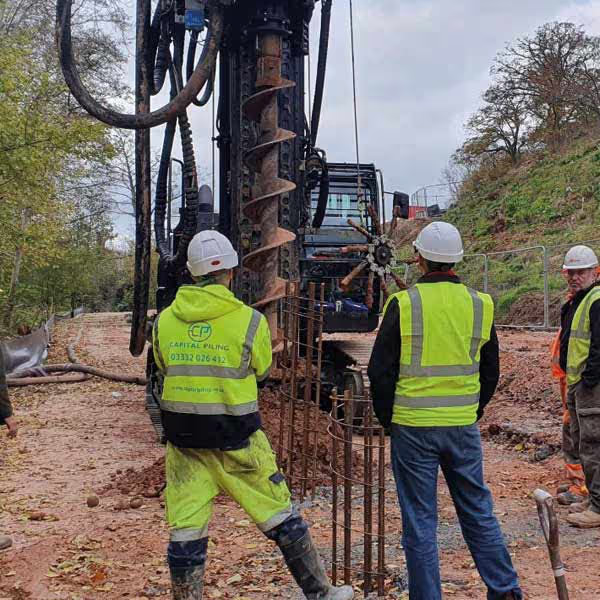
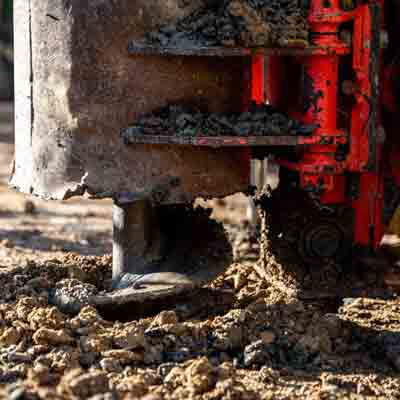
Ground Conditions Suitable for Mini Piling
Mini piling suits ground conditions where traditional shallow foundations will not work. Rather than relying on the strength of near-surface soils, mini piles transfer loads to deeper, more stable strata. This allows construction to proceed on sites with weak, variable, or unpredictable ground.
It is often used across residential and commercial projects, particularly in areas such as London and the South East. Here, ground conditions are often inconsistent.
Weak or Low-Bearing-Capacity Soils
Mini piling is often used where the ground near the surface does not have enough strength to support structural loads. This includes soft clays, loose sands, and compressible soils. These would be unsuitable for traditional strip or trench fill foundations.
By installing piles on a suitable bearing layer, loads are transferred away from these weaker soils. This reduces the risk of settlement and improves long-term stability.
Made Ground and Previously Developed Sites
On many sites, particularly in urban areas, the ground consists of made ground or previously disturbed material. These layers can vary in composition and compaction. This makes them unreliable for shallow foundations.
Mini piling bypasses these upper layers, transferring loads into consistent ground below. This makes it a practical solution for brownfield sites or locations with a history of previous development.
Clay Soils and Ground Movement
Large areas of the UK, particularly London and the South East, are underlain by clay soils. These soils are prone to shrinkage and expansion due to changes in moisture levels. They are also often influenced by seasonal conditions or nearby trees.
Mini piling allows foundations to extend below the zone affected by this movement. This provides a more stable solution and reduces the risk of structural damage over time.
Variable Ground Conditions Across a Site
On some projects, ground conditions can vary across the footprint of the building. This may include layers of clay, sand, gravel, or made ground within a somewhat small area.
Mini piling is well-suited to these conditions. After all, the pile depth and design can be adjusted to suit local ground variations. This ensures consistent load transfer across the structure. Such applies even where soil conditions are inconsistent.
Water-Affected Ground and High Groundwater Levels
Mini piling can also be used in ground conditions where groundwater is present or where soils are prone to water ingress. Certain piling methods allow installation to be carried out in a controlled manner. They maintain stability during construction.
Groundwater conditions are considered during design. This is because they can influence both the installation method and the long-term performance of the foundation.
No Reliance on Surface Soil Strength
One of the key advantages of mini piling is that it does not rely on the strength of the ground at shallow depth. Instead, the system carries loads down to deeper, more stable strata, whatever the surface conditions.
This makes it a very adaptable solution across a wide range of soil types. This includes clay, sand, gravel, and mixed ground.
The Role of Ground Investigation
Mini piling can be used in a wide range of conditions. Yet, understanding the ground profile is essential for accurate design. A ground investigation provides information on soil type, strength, and the depth of suitable bearing strata.
Where this information is available, pile depth and diameter can be designed with more precision. Without a full investigation, contractors base their designs on typical ground conditions. They refine the design during installation if needed.
A Reliable Solution for Challenging Ground
Mini piling suits sites where ground conditions would otherwise prevent or complicate construction. It provides a consistent and reliable foundation solution. This is whether you are dealing with weak soils, clay movement, made ground, or variable strata.
Its ability to adapt to different site conditions makes it suitable for everything. Use cases extend from small residential extensions to larger and more complex developments.
Do You Need More Information?
Do you need further guidance on ground conditions suitable for mini piling? If so, a specialist contractor such as Capital Piling can review your site. We will recommend the most appropriate foundation solution.